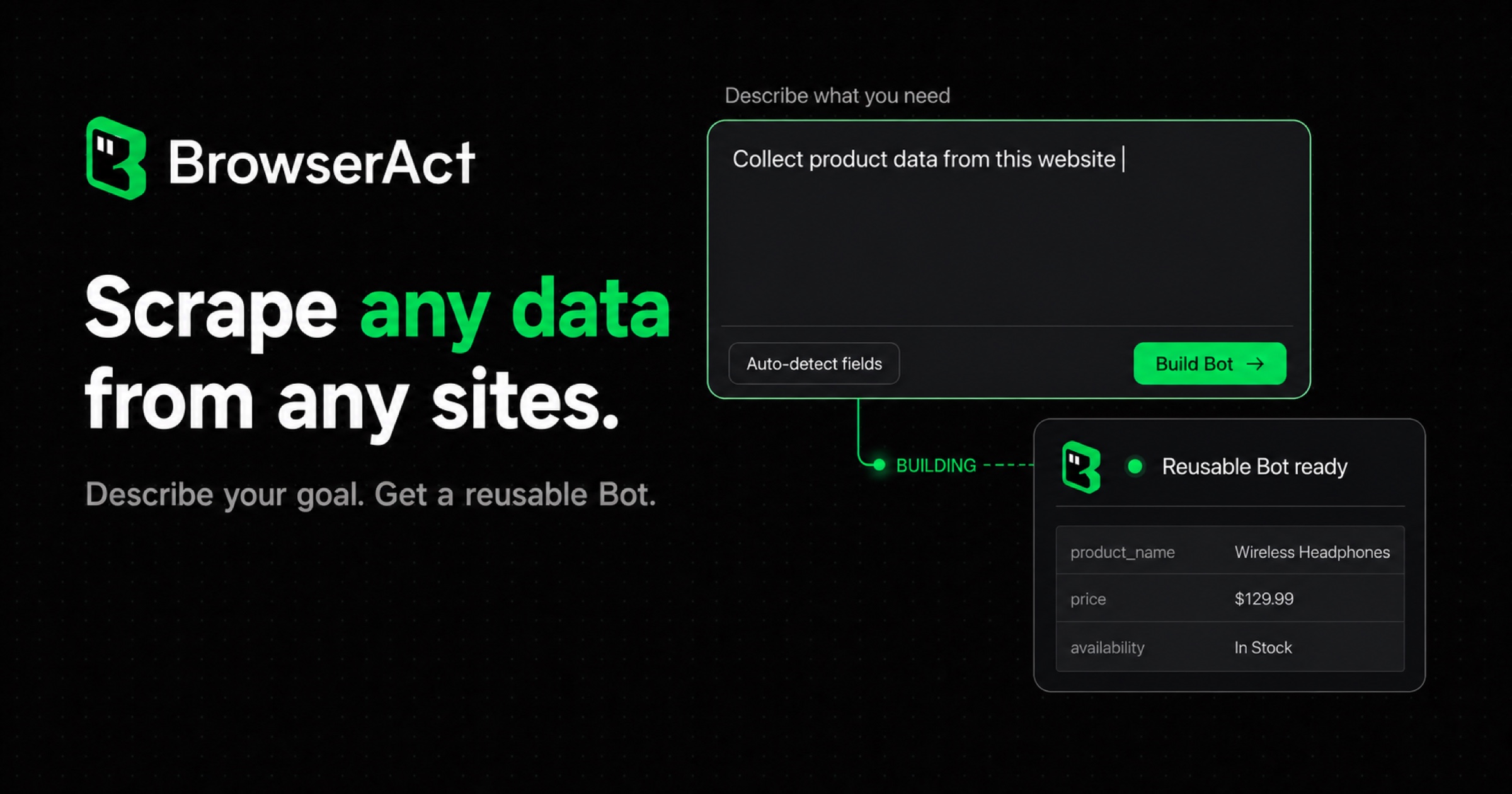
For data scientists, quickly build and deploy web scrapers using natural language, ensuring consistent data collection for your analytics projects.
Describe your data needs, and BrowserAct creates verified, reusable scraping agents that handle infrastructure and page changes.
What is BrowserAct?
BrowserAct: For data scientists, quickly build and deploy web scrapers using natural language, ensuring consistent data collection for your analytics projects. It has a free plan. Zekai scores it 7.6 out of 10 after independent testing. Best for data teams needing reliable web data.
Zekai Verdict
- What is it?
- BrowserAct is a cloud-based AI web scraping platform that allows you to describe data requirements in natural language.
- Best for
- AI for Data Science & Advanced Predictive Analytics
- Not ideal for
- Reliance on AI interpretation for complex scraping tasks
- Price
- Free plan
- Zekai Score
- 7.6/10
 SerpApi
 Nanonets
Top AI for Data Science & Advanced Predictive Analytics picks
See all 64 AI tools for Data Science →BrowserAct is a cloud-based AI web scraping platform that allows data scientists and analysts to collect structured data from any website using natural language prompts. It manages all the underlying infrastructure, including browsers, proxies, and CAPTCHA handling, ensuring reliable and consistent data extraction. For instance, you can prompt it to 'Track the top 20 Amazon listings and return price, rating, stock status, and source URL,' and it will build and run a bot to deliver the data. The platform offers a freemium model, with free capabilities available to get started, and paid usage based on credits for more extensive needs. It's designed to reduce the manual effort and maintenance associated with traditional web scraping, making it easier to integrate fresh web data into predictive models and market intelligence systems.
Your workflow, automated
Before & After
Manually coding and maintaining web scrapers for dynamic websites.
Hours spent on scraper upkeepConsistently acquire structured web data with minimal effort and maintenance.
Reliable data feed uptimePrompts for Data Science
Trusted by professionals
BrowserAct integrations
Best BrowserAct alternatives
BrowserAct vs. traditional custom scripting: BrowserAct is ideal for those who need quick, managed, and low-maintenance web data extraction without coding. Traditional scripting offers maximum flexibility and control for highly unique or complex scraping scenarios, but demands significant development and maintenance resources.
Is BrowserAct worth it?
Why Data Science & Advanced Predictive Analytics choose this tool
Key Use Cases
BrowserAct offers a compelling solution for data professionals who require consistent web data without the overhead of traditional scraping. Its natural language interface and self-healing bots promise significant time savings and reliability. However, the exact limits of its 'self-healing' capabilities and its performance on highly dynamic or complex sites would require hands-on testing. For routine data collection from public web sources, it appears to be a strong contender.
Frequently asked questions
What is BrowserAct?
How does BrowserAct work?
What are the pricing options for BrowserAct?
What kind of websites can BrowserAct scrape?
Can BrowserAct handle website changes?
How does BrowserAct compare to traditional web scraping tools?
Last reviewed:
BrowserAct pricing and plans
Prices and features are updated regularly but can change at any time — always confirm on the official website. Some links on this page are affiliate links.
Top 10 AI tools in this category

Get BrowserAct deal alerts
Be the first to know when BrowserAct drops a new discount, adds features, or changes pricing.
More on AI for Data Science & Advanced Predictive Analytics
- Data Scientists Slash Recommender Latency by 75% with Near Real-Time Adaptation
- Data Scientist’s Edge: Why Engineering Skills Are Now Essential
- Data Scientists: Master LLM Evaluation to Prevent Hallucinations
- Pandas Still Reigns: A Data Scientist’s Guide to Essential Data Wrangling
- Best ChatGPT for Excel Tools in 2026



About BrowserAct
Full Description
BrowserAct is a cloud-based AI web scraping platform that allows you to describe data requirements in natural language. It builds and verifies reusable scraping agents that can run on demand or on a schedule. The platform manages browser infrastructure, proxies, and CAPTCHA handling for reliable data extraction.
Editorial Verdict
BrowserAct offers a compelling solution for data professionals who require consistent web data without the overhead of traditional scraping. Its natural language interface and self-healing bots promise significant time savings and reliability. However, the exact limits of its 'self-healing' capabilities and its performance on highly dynamic or complex sites would require hands-on testing. For routine data collection from public web sources, it appears to be a strong contender.