العربية
 English
 Français
 Deutsch
 हिन्दी
 Português
 Русский
 Español
 Türkçe
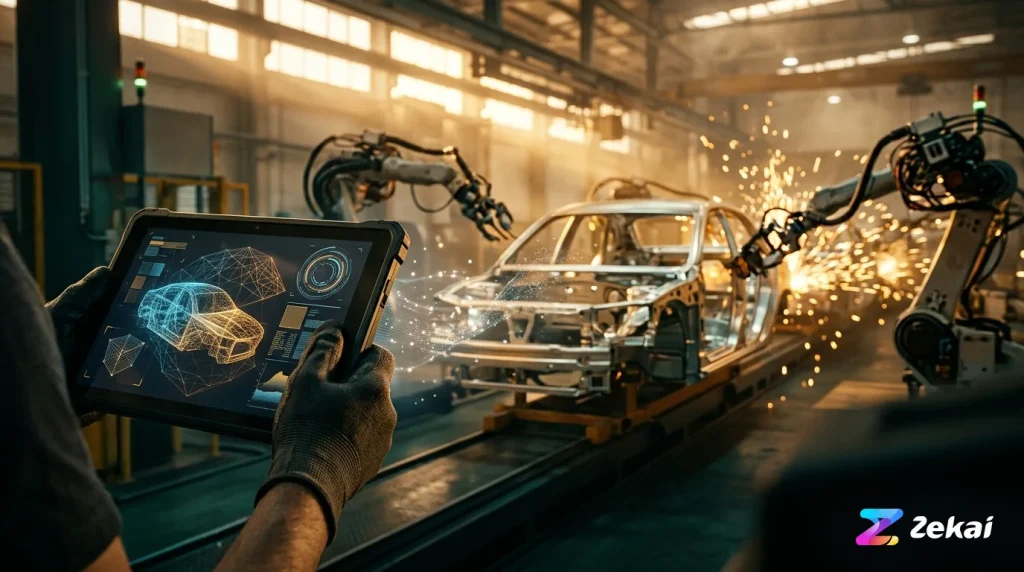
Looking for the full ranked list? See AI for manufacturing: every tool we score for this field, sorted by Zekai Score.
The short answer
Deploying AI for automotive manufacturing involves applying machine learning, computer vision, and edge computing across physical plant operations, engineering validation, and downstream logistics. Rather than relying on cloud-heavy general models, automotive plants use specialized algorithms to automate real-time defect inspection, reduce physical prototyping iterations, optimise material consumption, and process sensor data directly on low-power hardware at the production line.
Manufacturing engineers and plant operations directors face tight margins, strict compliance standards, and increasing SKU complexity. Integrating artificial intelligence in automotive manufacturing is no longer about experimental chatbots; it focuses on deploying direct operational software capable of catching sub-millimetre flaws, managing real-time schedule adjustments, and executing predictive logic on active assembly lines.
Finding software designed specifically for factory floors requires moving past generic enterprise tools. Automotive manufacturing AI software must run reliably near hardware, handle non-standard sensors, and process existing engineering records. This guide breaks down verified tools built for physical production, hardware testing, visual merchandising, and telematics profiling, giving engineering leads actionable insights for plant adoption.
| Tool | Best for | Pricing | Zekai score |
|---|---|---|---|
| SwitchOn | High-speed visual defect inspection on assembly lines | Pricing on request | 8.5/10 |
| Spyne | Automated studio car photos, 360 tours, and DMS integration | Pricing on request | 8.3/10 |
| Plataine | Shop-floor scheduling, waste reduction, and composite optimization | Contact for Pricing | 8.1/10 |
| Monolith AI | Engineering prototype reduction and legacy test data analysis | Contact for Pricing | 7.9/10 |
| Myelin Foundry | Deploying real-time edge AI models on low-power hardware | Contact for Pricing | 7.5/10 |
| Root Insurance Telematics Platform | Assessing automotive risk with real-time driver behavior data | Has a paid tier (Pricing on request) | 7.4/10 |
Swipe the table sideways →
How does edge AI improve vehicle systems and production?
Edge AI improves vehicle systems and production by executing computer vision and logic models directly on local hardware, eliminating the latency and connectivity risks associated with remote cloud processing. In high-speed assembly environments, processing camera frames locally prevents network delays from stalling conveyor lines or missing rapid sub-assembly checks. Software such as Myelin Foundry deploys agentic, multimodal AI models onto low-compute, low-power edge devices, enabling real-time decisions directly at the sensor layer.
To implement these edge systems on the factory floor, engineering teams must first map physical hardware interfaces to specific model runtime constraints. Plant engineers connect sensors directly to local microprocessors and configure models to inspect sub-assemblies or monitor embedded hardware. Keeping this processing on-device ensures plant data remains strictly inside the facility. This reduces cloud data ingress and egress costs while insulating critical quality checks from network outages or bandwidth throttling across large production plants.
During deployment, operational failures can occur if model complexity exceeds the processing limits of low-cost hardware. If algorithms are not adequately compressed, local microprocessors experience thermal throttling, leading to dropped frames and delayed logic execution that halts inspection lines. To avoid this, engineers must calibrate model compression against strict precision targets. Teams should systematically check runtime latency, chip temperatures, and inference accuracy under peak assembly loads to verify stability.
Finalising the deployment requires navigating specific commercial and technical constraints. While Myelin Foundry provides targeted solutions for automotive and industrial deployments, engineering teams must engage directly with the enterprise provider. Because no self-serve option or public technical documentation exists for independent evaluation, project leads must validate model requirements and hardware compatibility directly with supplier engineers before committing to a factory-wide rollout.
Which AI tools optimize automotive design and prototyping?
AI tools optimise automotive design and prototyping by deploying physics-informed machine learning platforms that train predictive models on historical test datasets to replace physical validation runs. Historically, vehicle engineering teams spent months conducting physical crash tests, thermal evaluations, and durability cycles to validate individual components. By training predictive models directly on legacy test files, software platforms generate statistical predictions that forecast how a component behaves under stressed conditions, bypassing the need for repeated physical testing.
To execute this workflow, mechanical and testing engineers begin by ingesting raw engineering files into specialised platform architectures like Monolith AI. The system automatically scans the unorganised test data to identify over 90% of structural or operational errors, cutting root cause fault analysis from weeks down to hours. Engineers then configure predictive models using domain-specific workflows, eliminating the requirement for specialised deep data science expertise while mapping structural performance under simulated stress.
Implementing these automated evaluations allows engineering teams to slash physical test plans and cut prototyping time by up to 70% without compromising structural safety compliance. What frequently goes wrong during deployment is an over-reliance on incomplete or unvalidated data. If the ingested historical records contain gaps, unstandardised stress metrics, or inconsistent operational conditions, the predictive models will produce flawed risk assessments that misrepresent real-world component durability.
To prevent false predictions, teams must rigorously check historical data quality and volume before scaling down physical test runs. Predictive effectiveness remains strictly bound to the depth of consolidated legacy records. When engineers introduce radical new component geometries that lack historical baseline testing, machine learning models cannot accurately predict stress responses. In these scenarios, teams must perform physical validation cycles to build new reference datasets.
Can AI eliminate defects in automotive component production?
Quality control on high-speed production lines demands sub-millimetre precision at throughput speeds exceeding hundreds of parts per minute. Visual inspection systems like SwitchOn address this by applying AI quality inspection in automotive industry settings to detect microscopic defects down to 150 microns. Operating on high-speed lines handling over 1,000 parts per minute, the system targets a zero-defect objective while cutting the cost of poor quality by over 50%.
Line flexibility is critical when shifting between component variations and short production runs. SwitchOn allows quality managers to train new part SKUs in less than 45 minutes, using specialized vision models validated by industrial producers such as Sansera. This rapid retraining capability prevents quality bottlenecks during retooling and eliminates the extended downtime typically required to reprogram traditional rule-based machine vision systems.
Complementing component inspection, advanced shop-floor optimization platforms like Plataine address operational material waste and scheduling bottlenecks. Plataine applies optimization algorithms across composite and structural manufacturing, delivering documented throughput increases up to 30% and reducing material rework by up to 40%. By establishing full digital traceability and replacing manual scheduling spreadsheets, the system coordinates material lifespans and cut plans dynamically across complex production shifts.
How do telematics and visual platforms shape automotive AI?
Automotive AI tools extend beyond the core assembly line into downstream vehicle validation, risk modeling, and digital commercialization. Telematics integration platforms assess vehicle operational data in real time to generate accurate operational and risk profiles. The Root Insurance Telematics Platform provides real-time driver behavior processing, allowing underwriters and fleet managers to evaluate continuous risk profiles rather than relying on broad demographic assumptions.
Collecting real-time telematics requires precise hardware integration and clear data governance policies. Systems must ingest continuous sensor streams from vehicle OBD-II ports or mobile telematics software while maintaining strict user consent frameworks. When implemented, real-time risk profiling improves portfolio management and premium setting by reflecting direct operational metrics such as braking intensity, cornering force, and vehicle mileage.
On the visual merchandising and inventory management side, specialized platforms automate digital vehicle presentation. Spyne provides automated image and video processing that generates studio-quality visual assets for vehicle listings without requiring physical photography studios. Integrated directly into dealership management systems like VinSolutions, Spyne automates background replacement, 360-degree tour generation, and license plate blurring, cutting manual editing overhead for fleet inventory.
When is AI the wrong choice on the shop floor?
Despite performance gains, applying AI tools for automotive production is counterproductive when process data is sparse, unstructured, or unreliable. Machine learning models require clean baseline data to draw valid correlations. Attempting to deploy predictive maintenance or automated scheduling in a facility without standardized logging often leads to false alarms and erratic machine control, wasting capital that would be better spent on basic digital infrastructure.
High-stress safety components and unique structural failure modes still demand physical validation and human engineering sign-off. Automated inspection systems excel at repetitive surface defect detection, but they cannot evaluate unmodeled stress strain or novel material fatigue behaviors. Over-relying on algorithmic pass/fail criteria without human quality auditing exposes manufacturers to systemic safety recalls if underlying calibration drifts off-target.
Small-scale or low-complexity operations frequently find enterprise AI deployments inefficient. Platforms like Plataine and Monolith AI involve substantial integration scope, hardware configuration, and enterprise onboarding. For facilities producing low volumes of simple components, standard deterministic controls and manual quality sampling provide higher financial returns without the capital expenditure and integration friction of enterprise AI platforms.
How to choose the right AI platform for your automotive plant
Selecting an automotive AI deployment strategy requires matching software architectures to specific operational bottlenecks. Plant leads must determine whether their primary challenge lies in high-speed visual defects, legacy engineering validation, downstream asset presentation, or shop-floor material scheduling. Each domain requires distinct hardware integration, data pipelines, and team skill sets.
Evaluate vendor deployment models against facility infrastructure realities. Edge-focused platforms like Myelin Foundry and hardware-linked inspection platforms like SwitchOn require local sensor interfaces, low-latency microprocessors, and physical installation on the line. Conversely, simulation platforms like Monolith AI require consolidated databases of historical engineering files. Ensure your internal IT and automation teams can support the vendor's integration requirements before finalizing contracts.
Pricing transparency across enterprise automotive AI remains low, with tools operating primarily on custom sales quotes or per-deployment enterprise contracts. None of the verified tools offer standard public self-serve tiers, and platforms like Plataine and SwitchOn lack free trials due to complex hardware integration. Manufacturers should request detailed proofs of concept focusing on specific SKUs or test cases, demanding clear benchmark metrics on setup time, rework reduction, or fault detection accuracy prior to plant-wide rollout.
SwitchOn
AI-powered quality inspection for manufacturers to achieve zero defects and slash the cost of poor quality by over 50%.
Pricing on request
Spyne
Generate high-volume, studio-quality car photos and videos for automotive marketing without a physical studio.
Pricing on request
Plataine
AI-powered optimization for advanced manufacturing, boosting throughput, cutting waste, and ensuring on-time delivery.
Pricing on request
Monolith AI
Slash physical prototyping and test plan time by up to 70% using AI trained on your existing engineering data.
Pricing on request
Myelin Foundry
Deploy agentic, multimodal AI models directly on low-compute edge devices for automotive, industrial, and media applications.
Pricing on request
Act as an automotive manufacturing engineering director. Create a tool evaluation matrix comparing [INSPECTION_OR_SCHEDULING] software for a facility producing [ANNUAL_COMPONENT_VOLUME] units per year. Outline specific evaluation criteria across hardware setup time, model accuracy targets, network latency limits, and expected ROI on reducing [COPQ_OR_REWORK_PERCENTAGE].Act as a senior vehicle test engineer. Draft a validation protocol to test AI prototype reduction models using [HISTORICAL_TEST_DATASET_TYPE]. Include steps for error detection benchmarking, root cause analysis validation, historical data quality filtering, and human engineering sign-off gates before reducing physical test runs.Act as an industrial automation manager. Write an implementation and risk management plan for installing [EDGE_AI_OR_VISION_SYSTEM] on a high-speed assembly line running at [LINE_SPEED_PPM] PPM. Include technical requirements for sensor integration, edge compute hardware, network downtime contingency, and operator safety protocols.How is AI used in automotive manufacturing plants?
Automotive plants use AI software for automated visual quality inspection, physics-informed prototyping predictions, real-time shop-floor scheduling, edge device model execution, and driver behavior telematics profiling. These tools process sensor data, historical test files, and production logs to catch defects, cut material rework, and streamline throughput.
Can AI tools eliminate physical crash and stress testing entirely?
No. While platforms like Monolith AI slash physical test plans by up to 70% by predicting outcomes from legacy test data, physical validation remains mandatory for safety compliance, novel structural geometries, and critical regulatory certification.
What hardware is required to run edge AI in automotive factories?
Edge AI tools like Myelin Foundry and SwitchOn run on low-power industrial microprocessors and embedded edge devices connected to high-speed cameras or shop-floor sensors. This local setup allows real-time processing without relying on cloud bandwidth.
Do automotive AI platforms offer free trials?
Most enterprise automotive AI platforms do not offer free self-service trials. Because tools require complex hardware integration, legacy data ingest, or on-site setup, vendors operate through custom enterprise demonstrations and structured proofs of concept.
How fast can AI vision systems inspect components on assembly lines?
High-speed inspection platforms like SwitchOn can evaluate components on lines running over 1,000 parts per minute, catching microscopic surface defects down to 150 microns at accuracy rates exceeding 99.95%.
Paid remote work · AI for Manufacturing & Industrial
Paid remote AI jobs in AI for Manufacturing & Industrial
AI companies pay experts by the hour to test and improve AI. Remote and flexible. These roles are open now.
1,513 open roles · updated today
Get new roles like these by email
One short email each morning with new roles open in your country. Free. Unsubscribe any time.
Where to go next
Three routes, picked for what you just read.
See Zekai first in Google
Questions readers ask
What AI sensor integration partners are available for automotive assembly lines that don't require a massive cloud subscription?
For automotive assembly lines, Myelin Foundry provides a specialist edge AI stack with a score of 7.5/10. Additionally, SwitchOn offers industrial-grade AI inspection with a score of 8.5/10. Both options do not feature a free plan, and their specific pricing is not published.
Get all 3 prompts for Manufacturing & Industrial by email
Plus the top-scored tools for Manufacturing & Industrial. You also get the weekly Zekai briefing for your profession; unsubscribe any time.
The weekly AI briefing for your profession
One weekly email: the AI changes that actually affect your profession — tools, deals, and what to do about them.