العربية
 English
 Français
 Deutsch
 हिन्दी
 Português
 Русский
 Español
 Türkçe
The short answer
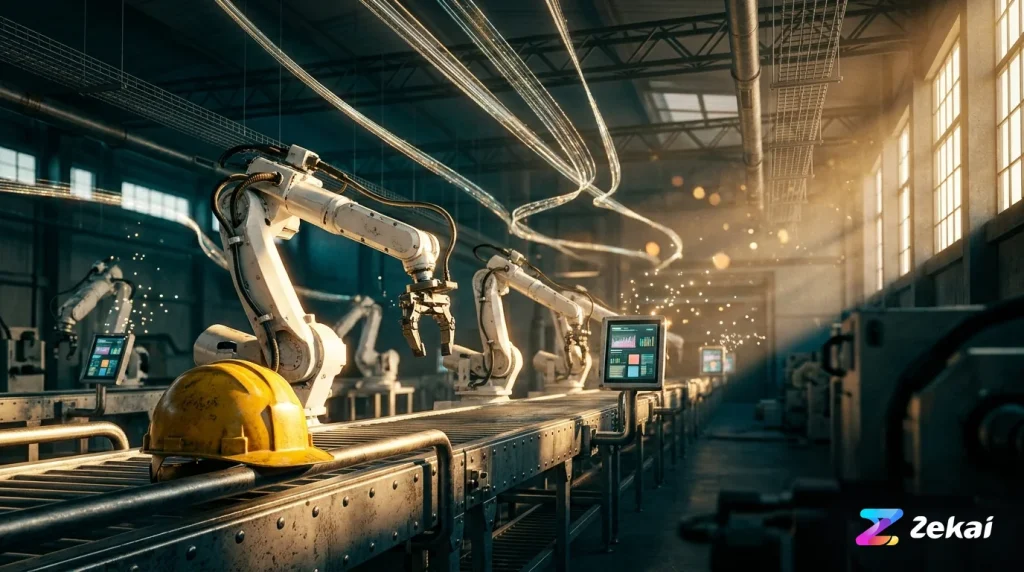
AI for manufacturing in 2026 means using machine learning and computer vision for specific jobs, not just high-level concepts. Engineers use it to predict equipment failures with tools like Augury and Samotics, automate quality inspection with Landing AI, optimize processes using Monolith AI, and generate production workflows with Tulip.
Artificial intelligence is moving from corporate presentations to the plant floor, but most of the conversation online is theoretical. It focuses on “digital transformation” and “Industry 4.0” without explaining what a production supervisor or a reliability engineer should actually *do* with this technology. This guide is different.
At ZEKAI, we review AI tools independently. This is a practical, task-based guide for manufacturing professionals on how to use AI today. We’ll cover the specific tools that solve real problems, the workflows they enable, and the prompts you can use to get immediate value. This is about applying AI, not just talking about it. For a deeper dive into how AI is changing industrial work, visit our AI in Manufacturing & Industrial Automation hub.
What “AI for Manufacturing” Actually Means in 2026
For a working engineer, “AI for manufacturing” isn’t one single thing. It’s a set of specialized tools applied to distinct problems. The term is often used interchangeably with machine learning, but in practice, it splits into several categories:
- Predictive & Prescriptive Maintenance: Using sensor data (vibration, thermal, electrical) to forecast equipment failures before they happen and recommend specific corrective actions.
- Computer Vision for Quality: Applying image recognition models to automate visual inspection, catching defects on the production line that the human eye might miss.
- Process Optimization & Digital Twins: Creating a dynamic software model of a production line or process, then using AI to run simulations, identify bottlenecks, and test efficiency improvements without disrupting the physical line.
- Generative AI for Operations: Using Large Language Models (LLMs) to create Standard Operating Procedures (SOPs), troubleshooting guides, shift handoff reports, and even initial drafts of code for PLCs or robots.
- Robotics & Physical Automation: This is the “physical AI stack,” where software intelligence translates into physical action through robots and autonomous mobile robots (AMRs) performing tasks like picking, packing, and material transport.
The adoption of these tools is accelerating. A Federal Reserve Bank of New York survey found that as of August 2026, 51% of manufacturers reported using AI in their business processes, a sharp increase from 26% the previous year. However, the same survey notes that for most firms, investments are still modest and usage is limited to a small percentage of the workforce. This signals that while adoption is broad, deep, scaled implementation is the next major hurdle.
report measurable value from AI, but only 20% of use cases are scaled enterprise-wide as of 2026. Source: deloitte.com
The critical distinction is between the Information Technology (IT) stack (ERP, cloud servers) and the Operational Technology (OT) stack (PLCs, SCADA, MES). Most generic AI discussions miss this. Effective manufacturing AI must bridge this gap, pulling data from OT systems and pushing insights back in a way that operators can trust and act upon.
The Manufacturing Engineer’s AI Toolkit: By Job Task
The right tool depends entirely on the job. A quality engineer has different needs than a maintenance manager or a production planner. We’ve organized the leading AI platforms by their primary function on the plant floor.
| Job Task | Key AI Tools | What It Does | Data Sources |
|---|---|---|---|
| Predictive Maintenance | Augury, Samotics, Tractian | Forecasts machine failure from sensor data. | Vibration, thermal, acoustic, electrical current/voltage. |
| Process Optimization | Monolith AI, Oden Technologies, Cognite | Identifies production bottlenecks & optimizes parameters. | MES, SCADA, Historian, ERP data. |
| Quality Inspection | Landing AI, Sereact | Automates visual defect detection on the line. | Camera feeds, images. |
| Robotics & Automation | Vention, RobCo, Locus Robotics | Simplifies design, programming, and deployment of robots. | CAD files, robot controller data. |
| Frontline Operations | Tulip, Andustry | Builds no-code apps for SOPs, training, and data collection. | Operator input, machine data, ERP. |
| OT Cybersecurity | Dragos | Detects threats and vulnerabilities in industrial control systems. | Network traffic, asset configurations. |
Swipe the table sideways →
Predictive Maintenance & Machine Health
Predictive Maintenance (PdM) is the most mature application of AI in manufacturing. Instead of waiting for a machine to fail (reactive) or servicing it on a fixed schedule (preventive), PdM uses AI to predict the failure ahead of time.
The workflow is straightforward:
- Sensors are attached to critical equipment (pumps, motors, compressors) to collect data like vibration, temperature, and ultrasonic noise. Some advanced systems use Electrical Signature Analysis (ESA), which analyzes the motor’s current and voltage from the control cabinet, requiring no sensors on the machine itself.
- AI models, trained on vast datasets of both healthy and failing equipment, analyze this stream of data in real-time.
- Alerts are generated when the AI detects a pattern that indicates a developing fault, such as a bearing flaw or misalignment.
- Prescriptive insights go a step further, not just flagging a problem but suggesting the root cause and the specific corrective action needed.
Augury
Best-in-class for vibration-based prescriptive analytics on rotating equipment.
Pricing on request
Augury is a leader in machine health, combining proprietary sensors with powerful AI diagnostics. Its strength is turning complex vibration data into clear, actionable guidance for maintenance teams, often predicting failures weeks or months in advance. As of September 2026, pricing is quote-based and requires a consultation, but industry reports estimate costs in the range of $50 to $150 per monitored machine per month, with significant upfront costs for hardware and implementation. This makes it a premium solution.
What it does badly: Augury is primarily focused on rotating equipment (motors, pumps, fans). It is not a general-purpose analytics platform for process data. The high cost and focus on a specific equipment class mean it’s not a fit for plants on a tight budget or those whose primary failure modes are not mechanical.
- Price from
- Custom quote; estimated $50-$150/machine/month
- Free tier
- No free tier, demo only
Samotics
Top choice for electrical signature analysis (ESA), covering hard-to-reach assets.
Pricing on request
Samotics specializes in ESA, a non-invasive method that analyzes a motor’s electrical input to detect both electrical and mechanical faults. This is a huge advantage for assets where installing sensors is impractical, like submerged pumps or enclosed equipment. Their SAM4 platform boasts a 90%+ accuracy rate in detecting faults up to five months in advance. As of September 2026, Samotics provides custom quotes, with public guidance suggesting a cost of around $200-$500 per asset, which includes hardware and monitoring services.
What it does badly: While powerful, ESA can have reduced confidence on assets driven by complex Variable Frequency Drives (VFDs). The system relies on expert review by Samotics reliability engineers to filter out false positives, which introduces a human-in-the-loop dependency that some organizations may not prefer.
- Price from
- Custom quote; guidance of $200-$500/asset
- Free tier
- No free tier, demo only
Process Optimization & Digital Twins
Where predictive maintenance focuses on individual assets, process optimization looks at the entire production system. The goal is to use AI to analyze data from Manufacturing Execution Systems (MES), SCADA, and historians to find hidden inefficiencies and improve metrics like Overall Equipment Effectiveness (OEE), yield, and throughput.
A “digital twin” is a core concept here: a living, virtual model of a physical process. Engineers can test changes on the digital twin—like altering a recipe, changing line speed, or re-routing materials—to see the impact before committing to a costly, disruptive change on the real factory floor.
Monolith AI
Excellent for engineers who need to build their own ML models without being data scientists.
Pricing on request
Monolith AI is a no-code platform built by engineers, for engineers. It allows users to connect disparate data sources (test data, sensor streams, simulation results) and use AI to understand complex physical phenomena. Instead of just identifying a correlation, it helps engineers understand the underlying physics. As of September 2026, Monolith operates on an enterprise sales model with custom pricing. It’s best for R&D and engineering teams at large manufacturers (e.g., automotive, aerospace) who are trying to solve complex product performance and testing challenges, not just basic production monitoring.
What it does badly: Monolith is a platform for building, not a pre-packaged solution. It requires a user who understands their engineering problem deeply. It is not an out-of-the-box OEE dashboard or a simple anomaly detection tool. Companies looking for a plug-and-play monitoring system should look elsewhere.
- Price from
- Custom quote, enterprise focus
- Free tier
- No free tier, demo only
Oden Technologies
Strong choice for real-time process analytics and correlating quality issues to production settings.
Pricing on request
Oden Technologies provides a platform for manufacturers to analyze real-time production data to improve output and quality. It excels at unifying data from different machines and systems into a single view, making it easier to troubleshoot issues. For example, it can help an engineer correlate a specific batch of raw material with a downstream increase in quality defects. As of September 2026, Oden uses a custom, quote-based pricing model aimed at mid-to-large manufacturers.
What it does badly: Oden is focused on analyzing existing data to find improvements. It is less of a forward-looking simulation tool like some “digital twin” platforms. Its value depends heavily on the quality and availability of data from your existing OT systems. Plants with poor data infrastructure will struggle to get the full benefit.
- Price from
- Custom quote, enterprise focus
- Free tier
- No free tier, demo only
Quality Control & Defect Detection
Automated Quality Control (QC) is one of the most impactful areas for AI in manufacturing. Computer vision models can be trained to spot defects in products moving down a production line with superhuman speed and accuracy. This replaces tedious manual inspection, reduces human error, and provides a rich dataset for root cause analysis.
The process involves:
- Data Collection: Capturing thousands of images of both “good” products and products with various types of defects.
- Model Training: Using a platform like Landing AI to label these images and train a machine learning model to recognize the difference. Modern platforms use a “data-centric” approach, focusing on improving the quality of the data rather than just tweaking the algorithm.
- Deployment: Deploying the trained model to an edge device (a small computer) connected to a camera on the production line.
- Inference: The model analyzes the video feed in real-time, flagging or rejecting defective parts automatically.
Landing AI
The leading data-centric platform for building and deploying custom computer vision models.
Free plan; paid from $250/month
Founded by AI pioneer Andrew Ng, Landing AI’s flagship product, LandingLens, empowers manufacturers to build their own visual inspection solutions without needing a team of AI experts. Its data-centric workflow guides users to curate high-quality datasets, leading to highly accurate models even with limited data. As of September 2026, LandingLens offers a generous free tier that provides 1,000 credits per billing cycle for training and inference, which is enough to build and test a proof-of-concept. Enterprise plans for production deployment are custom-quoted.
What it does badly: LandingLens is a platform to *build* vision solutions, not a pre-built, off-the-shelf product. It requires effort to collect images, label data, and manage the model lifecycle. Companies looking for a turnkey inspection system with pre-trained models for a common application might find other specialized vendors faster to deploy initially.
- Price from
- Free tier with 1,000 credits/cycle; Enterprise plans are custom quoted.
- Free tier
- Yes, includes 1,000 credits for training and inference, suitable for small projects and evaluation.
Robotics, Automation & The Physical AI Stack
AI is also making physical automation more accessible. Instead of requiring complex, specialized programming, new platforms allow engineers to design and simulate robotic workcells in a virtual environment and generate the required code automatically.
industrial manufacturers expecting to have highly automated key processes will more than double by 2030, rising from 18% to 50%. Source: pwc.com
This area also includes Autonomous Mobile Robots (AMRs), which use AI-powered navigation to transport materials around the factory floor, a significant step up from older Automated Guided Vehicles (AGVs) that followed fixed magnetic tape paths. The cost of a typical AMR in 2026 ranges from $50,000 to over $200,000 per unit before software and integration.
Vention
An ‘erector set’ for industrial automation, simplifying the design and deployment of custom machines.
Free plan available
Vention’s platform is unique. It combines a free, browser-based 3D design tool (MachineBuilder) with a library of modular hardware components that you can order directly. Users can design a complete workcell—from the frame to the robot arm to the safety guarding—and the platform ensures all parts are compatible. Its MachineLogic software provides a code-free environment for programming the sequence of operations. As of September 2026, the design software is free, while the hardware and advanced software features are purchased. This model lowers the barrier to entry for designing custom automation.
What it does badly: Vention is focused on the design and commissioning phase. While its component library is extensive, it may not include highly specialized or heavy-payload robots required for some applications. It is best suited for light assembly, pick-and-place, and inspection tasks, not heavy-duty industrial processes like welding entire car bodies.
- Price from
- Hardware is purchased, software access is tiered. Free design tools.
- Free tier
- Yes, the cloud-based MachineBuilder design software is free to use.
Knowledge, SOPs & Frontline Support
One of the most immediate uses for AI is tackling documentation and knowledge transfer. Generative AI tools, like the models behind ChatGPT, can be fine-tuned on a company’s internal documents to act as expert assistants for frontline workers.
▶ Watch the ChatGPT video review (0:31)
A major challenge in manufacturing is capturing the tacit knowledge of experienced operators before they retire. AI can help by turning a few bullet points or a short video into a complete, well-formatted Standard Operating Procedure (SOP).
Tulip
The leading no-code platform for building interactive apps for frontline workers.
Paid, from $100/mo
Tulip is not just a documentation tool; it’s a “Frontline Operations Platform.” It allows manufacturing engineers to build their own applications for operators without writing code. These apps can guide workers through complex assemblies, collect quality data, monitor machine status, and connect to other systems like the MES and ERP. As of September 2026, Tulip offers several tiers, with paid plans starting at $100 per interface per month, billed annually with a 10-interface minimum. A limited free plan is also available, intended primarily for evaluation.
What it does badly: Tulip’s flexibility is its greatest strength and weakness. It’s a blank canvas, which means you have to invest the time to design and build the apps your operators need. This can be a significant undertaking compared to buying a pre-built, special-purpose solution. Its per-operator or per-interface pricing can also become expensive for large factories with hundreds of workers.
▶ Watch the Canva video review (0:37)
- Price from
- Starts at $100/interface/month (10 interface min).
- Free tier
- A limited free plan exists for evaluation purposes.
10 Ready-to-Use Prompts for Common Manufacturing Tasks
Generic prompts give generic answers. Effective prompting for manufacturing requires providing specific context, constraints, and standards. Here are 10 prompts you can adapt, designed for a plant floor environment.
You are a senior manufacturing engineer specializing in creating clear, safe, and efficient Standard Operating Procedures (SOPs) compliant with ISO 9001.
Generate an SOP for the task: "Final Assembly of Product P-4500."
The process involves these 6 key steps:
1.  Inspect housing (Part # H-789) for defects.
2.  Install main circuit board (Part # CB-112) using 4x M3 screws.
3.  Connect the red and black power leads to the terminal block.
4.  Attach the front cover (Part # C-550).
5.  Run the 60-second functional test sequence using Test Jig #3.
6.  Package the unit in the approved shipping container.
The SOP must include:
• A "Scope" section.
• A "Safety Precautions" section, explicitly mentioning the need for ESD wrist straps during board installation and the location of the nearest E-stop.
• A "Required Tools and Materials" list.
• A "Step-by-Step Procedure" with clear, concise instructions for each of the 6 steps.
• A "Quality Check" section detailing the pass/fail criteria for the functional test.
• A "Document Control" footer with fields for Version, Author, and Approval Date.
Example Output Snippet:
...
4.0 Safety Precautions
• 4.1 Electrical Hazard: Ensure main power to the assembly station is locked-out and tagged-out before performing any internal maintenance.
• 4.2 ESD Sensitivity: An ESD-compliant wrist strap, connected to the common ground point on the bench, MUST be worn at all times when handling Part # CB-112.
• 4.3 Emergency Stop: The station E-stop button is located on the top-right corner of the assembly frame. Familiarize yourself with its location before starting work.
...Act as a Quality Manager. A customer reported that product Model X failed in the field due to a cracked solder joint on the main board. The failure occurred after 3 months of use. This is the problem statement for a 5-Why root cause analysis.
Generate a plausible 5-Why analysis for this failure. Start with the problem statement and drill down through 5 levels of "Why?". For each "Why," provide a concise answer that leads to the next question. Conclude with a proposed "Corrective Action."
Example Output Snippet:
Problem: Customer's Model X failed due to a cracked solder joint.
1. Why did the solder joint crack?
• *Answer:* The joint experienced excessive vibration during normal operation.
2. Why was there excessive vibration?
• *Answer:* The main board was not properly secured and was able to resonate.
3. Why was the board not properly secured?
• *Answer:* The mounting screw in the corner nearest the joint was found to be loose.
4. Why was the screw loose?
• *Answer:* The operator at the assembly station did not torque the screw to the required specification (0.5 Nm).
5. Why did the operator not apply the correct torque?
• *Answer:* The pneumatic torque driver at that station was out of calibration and was delivering inconsistent torque.
Corrective Action: Implement a daily torque verification check for all critical pneumatic drivers on the assembly line using a certified torque sensor. Add this check to the line startup checklist.Generate a shift handoff report for the end of 1st shift (07:00 - 15:00) on Line 3.
Key information:
• Production Target: 800 units
• Production Actual: 750 units
• Downtime: 45 minutes on Machine #L3-M5 due to a jam. The issue was resolved by maintenance.
• Quality: 2 units rejected for cosmetic scratches. 1 unit rejected for failing functional test (logged as NCMR-2026-098).
• Consumables: Low on Part #C-550 (front covers). A new pallet has been requested from the warehouse but has not arrived.
• Action for Next Shift: Monitor Machine #L3-M5 closely. Follow up on the arrival of Part #C-550.
Format the output as a clear, structured report with headings for Production, Downtime, Quality, and Action Items for 2nd Shift.
Example Output Snippet:
Shift Handoff Report: Line 3
Date: 2026-09-03
Shift: 1st Shift (07:00 - 15:00)
Outgoing Supervisor: [Your Name]
1. Production Summary
• Target: 800 units
• Actual: 750 units
• Deficit: 50 units
2. Downtime Events
• Total Downtime: 45 minutes
• Details: Machine #L3-M5 (Packaging) experienced a jam at 11:20. Maintenance cleared the jam and the machine was back online at 12:05. Root cause was determined to be a worn guide rail.
3. Quality Summary
• Cosmetic Rejects: 2 units (scratches on housing)
• Functional Rejects: 1 unit (failed final test). Non-conformance report NCMR-2026-098 has been created.
4. Action Items for 2nd Shift
• URGENT: Part #C-550 (front covers) are critically low. A new pallet was requested but has not arrived. Please follow up immediately with materials handling.
• MONITOR: Keep a close watch on Machine #L3-M5 for any recurrence of jamming issues.Additional prompts to try:
- 4. Equipment Troubleshooting: “I am a maintenance technician. A hydraulic press (Model H-500) is showing a ‘Low Pressure’ alarm, but the gauge reads normal pressure. List the top 5 most likely causes, starting with the simplest to check.”
- 5. Supplier Communication: “Draft a professional but firm email to our supplier, ‘ComponentCorp,’ regarding late delivery of PO #78912. The original delivery date was August 25th. It is now September 3rd. We need a firm new delivery date and a reason for the delay.”
- 6. Process Improvement Idea: “Analyze the following process steps for a manual packing station. Suggest 3 ways AI or automation could improve efficiency or reduce errors. Steps: [List steps].”
- 7. Safety Training Outline: “Create an outline for a 15-minute toolbox talk on Lockout/Tagout (LOTO) procedures for new employees. Include key concepts like ‘energy-isolating device’ and ‘zero energy state’.”
- 8. Data Analysis Query: “I have a dataset of machine sensor readings with columns: ‘Timestamp’, ‘Temperature’, ‘Vibration’, ‘Pressure’. Write a Python script using the pandas library to find all time periods where Temperature exceeded 95°C and Vibration was above 5 mm/s simultaneously.”
- 9. PLC Logic Description: “Translate this ladder logic snippet into a plain English description of what it does: [Insert image or text description of a simple ladder logic rung].”
- 10. OEE Calculation & Analysis: “My OEE for yesterday was 65%. Availability was 90%, Performance was 80%, and Quality was 90.2%. Which of the three OEE factors had the biggest negative impact, and what does this suggest I should investigate first?”
How to Pilot AI Without Becoming a Statistic
Many AI projects in manufacturing fail. A 2026 Deloitte report notes that while 84% of manufacturers get value from AI, only 20% of projects are successfully scaled across the enterprise. The “pilot purgatory” is real. The primary reasons cited are risks of operational disruption (79%), cybersecurity concerns (51%), and a lack of user acceptance (29%).
To avoid this, we recommend a focused, problem-first approach:
- Don’t Start with “AI.” Start with a painful, measurable business problem. Is it unplanned downtime on a critical asset? A high scrap rate on a specific product line? Inefficient changeovers?
- Pick One KPI. Choose a single, specific Key Performance Indicator (KPI) that your pilot project will aim to improve. This provides a clear benchmark for success or failure.
- Start Small & Non-Invasive. Choose a pilot that doesn’t require ripping and replacing existing systems. A computer vision system that monitors a line is less disruptive than replacing your entire MES. An electrical signature analysis tool that monitors motors from the electrical cabinet is less invasive than installing sensors on 100 machines.
- Engage the Front Line. Involve the operators, maintenance techs, and supervisors who will use the tool from day one. If they see it as a threat or a hassle, it will fail. If they see it as a tool that makes their job easier, they will champion it.
- Validate the Data. Before you trust an AI’s output, ensure the input is reliable. Garbage in, garbage out. Work with your controls engineers and IT team to ensure the data from your PLCs, SCADA, and sensors is clean and contextualized.
- Set a Time Limit. Define a clear timeframe for the pilot (e.g., 90 days). At the end, make a clear decision: adopt, adapt, or abandon. Don’t let pilots drag on indefinitely.
- Use Free Tiers. Take advantage of the free tiers offered by vendors like Landing AI and Tulip to test the platform’s capabilities on a small scale without a major financial commitment.
Consider joining an AI Challenge to structure your first project and compete against peers. The goal is to get a quick win that demonstrates tangible value, building momentum for broader adoption.
This structured approach transforms AI from a risky, expensive science project into a targeted business solution, dramatically increasing your odds of success and helping you build a more resilient and efficient operation. For more insights on building the business case, see our guide to AI tools statistics.
How is AI used for quality control in manufacturing?
AI is primarily used for quality control through computer vision. High-resolution cameras are installed on production lines, and AI models are trained to analyze the images in real-time to detect defects like scratches, cracks, misalignments, or incorrect components. This automates manual inspection, increasing speed and accuracy.
Will AI replace manufacturing engineers?
No, AI is not expected to replace manufacturing engineers. Instead, it is augmenting their capabilities. AI automates repetitive and data-intensive tasks like monitoring processes and analyzing sensor data, freeing up engineers to focus on higher-value work like complex problem-solving, system-level design, and managing the human elements of production.
What are the biggest limitations of AI in manufacturing?
The biggest limitations as of 2026 are data quality, integration complexity, and the cost of scaling. AI models require large amounts of clean, contextualized data, which is often siloed in legacy OT systems. Integrating AI with existing MES, SCADA, and ERP platforms can be difficult, and moving from a successful pilot to an enterprise-wide deployment requires significant investment.
How much does manufacturing AI software cost?
Costs vary dramatically. Predictive maintenance platforms like Augury can cost $50-$150 per machine per month. CMMS/PdM tools like Tractian start around $60/user/month with user minimums. Frontline platforms like Tulip start around $1,000/month for a minimum deployment. Computer vision platforms like Landing AI have free tiers but require custom enterprise quotes for production use.
Can I use ChatGPT for manufacturing tasks?
Yes, but with extreme caution. General-purpose models like ChatGPT can be very useful for drafting initial documents like SOPs, reports, or emails. However, they lack specific process knowledge and, critically, have no understanding of safety protocols like LOTO. All output must be carefully verified by a qualified human before being used on the plant floor.
What is the difference between AI and industrial automation?
Industrial automation traditionally refers to machines programmed to perform a specific, repetitive task (e.g., a robot arm welding the same spot on every part). AI adds a layer of intelligence and adaptability. An AI-powered robot can adjust its path based on what a vision system sees, and an AI-powered process can adjust its own parameters to maintain quality.
What is OT cybersecurity?
OT (Operational Technology) cybersecurity focuses on protecting the industrial control systems (ICS), SCADA systems, and PLCs that run the factory floor. Unlike IT security, which prioritizes data confidentiality, OT security prioritizes operational availability and safety. Tools like the Dragos Platform are specifically designed to detect threats in these unique environments.
Paid remote work · AI for Manufacturing & Industrial
Paid remote AI jobs in AI for Manufacturing & Industrial
AI companies pay experts by the hour to test and improve AI. Remote and flexible. These roles are open now.
1,521 open roles · updated today
Get new roles like these by email
One short email each morning with new roles open in your country. Free. Unsubscribe any time.
Where to go next
Three routes, picked for what you just read.
Sources (47)
- MachineCDN Blog, “Tulip Pricing in 2026: What Does Tulip Actually Cost for Manufacturing?”, March 2026.
- LandingAI Docs, “Plans – LandingAI”.
- Tractian, “Tractian CMMS Pricing & Plans”.
- Coast, “Honest Tractian Review: Is Tractian a Good CMMS?”, March 2026.
- Tractian, “Top 5 CMMS Software for Maintenance Teams in 2026”, July 2026.
- Deloitte, “AI in Manufacturing 2026: From pilot value to scaled industrial impact”.
- Deloitte, “AI in Manufacturing 2026: From pilot value to scaled industrial impact”, June 2026.
- Software Connect, “Tractian CMMS – 2025 User Reviews & Pricing”, October 2025.
- EVS Robotics, “Industrial Robot Price 2026: Cost Breakdown, ROI & Quote Guide”, May 2026.
- EVS Robotics, “How Much Does a Robotic Arm Cost? (2026 Price Guide)”, July 2025.
- Capterra, “Tulip Software Pricing, Alternatives & More 2026”, August 2026.
- MillBrief, “How Much Does an Industrial Robot Cost? 2026 Price Ranges”, July 2026.
- Standard Bots, “How much does a robotic arm cost in 2026?”, January 2026.
- Federal Reserve Bank of New York, “Businesses Are Using AI to Transform Work, Not Cut Jobs”, September 2026.
- Dragos, “Dragos Platform: A Cybersecurity Platform Built for OT Environments”, October 2025.
- SourceForge, “LandingLens Pricing 2026”, April 2026.
- MESH Automation, “How Much Does an AMR Cost in 2026? Price by Type & Features”.
- SAP Store, “LandingAI Inc. | LandingLens: End-to-end Visual AI Platform”.
- RFP.wiki, “Petasense vs Samotics (2026): Data‑driven comparison”, August 2026.
- Dragos, “Dragos Platform Streamlines OT Threat and Vulnerability Workflows…”, August 2024.
- NIST, “The Rise of Artificial Intelligence (AI) in U.S. Manufacturing”, May 2026.
- MachineCDN Blog, “Augury Pricing in 2026: What Does Augury Actually Cost?”, March 2026.
- Dragos, “Advanced OT Cybersecurity Threat Hunting”.
- Dragos, “Dragos Platform 3.1: AI for OT Security & Visibility”, April 2026.
- Business Wire, “Dragos Named a Leader in Operational Technology Security Solutions”, September 2026.
- Flexachem, “Samotics – SAM4”.
- Manufacturing.digital, “Deloitte: Reshoring and AI Power 2026 US Supply Chains”, December 2025.
- SourceForge, “Tulip Pricing 2026”, April 2026.
- Factory AI, “Augury in Maintenance: From Ancient Omens to AI Machine Health”, February 2026.
- Deloitte Insights, “2026 Manufacturing Industry Outlook”, November 2025.
- Deloitte US, “The State of AI in the Enterprise – 2026 AI report”.
- MaintainX, “MaintainX vs Tractian: CMMS Comparison 2026”.
- AI Agent, “LandingLens – AI Agent | Pricing, Reviews & Alternatives”, April 2025.
- PwC, “Industrial manufacturers to more than double automation of key processes by 2030”, February 2026.
- NVIDIA Blog, “How AI Is Driving Revenue, Cutting Costs and Boosting Productivity for Every Industry in 2026”, March 2026.
- Tulip Fertility, “Our Egg Donor Database Pricing Tiers”. (Note: Irrelevant result for Tulip Interfaces).
- AWS Marketplace, “LandingAI: LandingLens Visual AI Platform”.
- Tulip Interfaces, “Plans & Pricing”.
- Software Advice, “Tulip Software Reviews, Demo & Pricing – 2026”.
- JUUSTE, “JUUSTE vs Tulip — Platform Comparison 2026”.
- Augury, “Get Pricing and Quotes”.
- Tractian, “Top 3 Augury Alternatives in 2026”, July 2026.
- Siemens, “SAM4 Health | Siemens”.
- Samotics, “Remote Pump Monitoring Systems – Samotics”, March 2025.
- Tulip Charts LLC, “Support and Contact Info – Tulip Indicators”. (Note: Irrelevant result for Tulip Interfaces).
- Augury, “Predictive Maintenance in Manufacturing: Use Cases and Benefits”, April 2026.
- Samotics, “How SAM4 works | Electrical signature analysis explained”.
See Zekai first in Google
Questions readers ask
What are the best providers of AI for industrial quality and production management?
For industrial quality and production management, SwitchOn is rated 8.5/10 for industrial-grade AI inspection. Additionally, Oden Technologies is rated 7.6/10 and is best for a factory floor AI co-pilot, while Braincube holds a 7.2/10 rating for enterprise-grade process AI.
What are the best tools for physical AI deployment in industrial settings that engineers recommend?
Engineers looking at physical AI deployment can consider Emmi AI, which has a 7/10 score and is best for industrial-scale physics AI. For factory automation, Vention is rated 8.8/10 with a free plan available, and Standard Bots is rated 8.2/10 for AI-powered factory automation.
What industrial machinery design and automation software options include AI features?
Key options include nTopology, which scores 8.4/10 and is best for advanced computational design, and Vention, which scores 8.8/10 for simplified factory automation with a free plan available. Standard Bots also offers AI-powered factory automation with a score of 8.2/10.
Which vendors provide remote monitoring and predictive maintenance for AI welding workcells used in large-part fabrication?
Based on the directory, iMaintain is rated 6.2/10 and is best for AI-powered proactive maintenance, priced at £49/user/mo with no free plan. For broader industrial process optimization and monitoring, Braincube provides enterprise-grade process AI with a score of 7.2/10.
Get all 3 prompts for Manufacturing & Industrial by email
Plus the top-scored tools for Manufacturing & Industrial. You also get the weekly Zekai briefing for your profession; unsubscribe any time.
The weekly AI briefing for your profession
One weekly email: the AI changes that actually affect your profession — tools, deals, and what to do about them.