العربية
 English
 Français
 Deutsch
 हिन्दी
 Português
 Русский
 Español
 Türkçe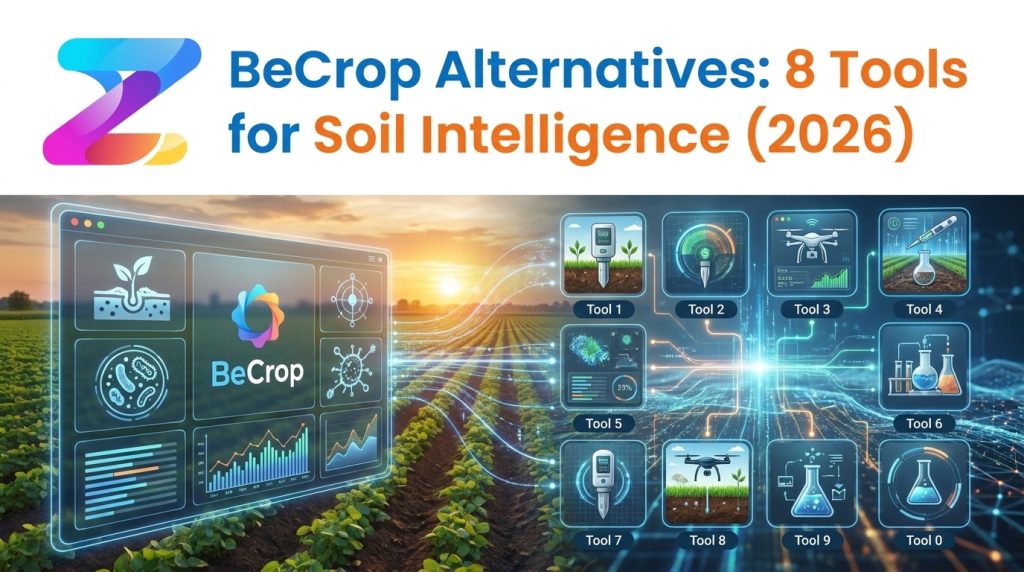
BeCrop by Biome Makers sets the standard for soil intelligence, using DNA sequencing and AI to decode the complex world under our feet. It delivers powerful insights into nutrient cycling, disease risk, and soil biodiversity. But its deep biological analysis comes at a premium price and isn’t the right fit for every operation.
For farmers and agronomists seeking different capabilities or price points, a growing ecosystem of alternatives offers compelling options. We’ve analyzed the top tools—from direct DNA-sequencing competitors to satellite imagery platforms and robotic samplers—to help you find the right fit for your farm’s goals and budget. As an independent AI-tools directory, ZEKAI’s analysis is based on verified public data and a consistent set of criteria, not vendor claims. This is part of our ongoing work to map out the best tools for AI in agriculture and smart farming.
The short answer
The best BeCrop alternatives for 2026 depend on your goal. For direct DNA-based soil pathogen and nutrient analysis, consider Pattern Ag or Trace Genomics. For affordable, field-level variability monitoring using satellite imagery, OneSoil is the top choice with a robust free tier. For improving soil sampling accuracy and consistency,Rogo offers an autonomous robotic service.
How We Evaluated Soil Intelligence Tools
Choosing a soil intelligence platform is a high-stakes decision that influences fertilizer, seed, and biologicals spending for seasons to come. We ranked these BeCrop alternatives based on four practical criteria relevant to a working farm or agronomy service, as of September 2026:
- Data Quality & Actionability: How reliable is the core analysis? Does the platform provide clear, specific recommendations (e.g., “high risk of corn rootworm, consider trait selection or soil-applied insecticide”) or just raw data?
- Cost-Effectiveness (ROI): What is the per-acre or per-sample cost, and how does it compare to the potential savings on inputs or gains in yield? We looked for verified pricing and a clear return on investment.
- Ease of Use & Integration: How difficult is it to get started? Does the tool require complex new workflows, or does it integrate with existing farm management platforms like John Deere Operations Center or FieldView?
- Support & Validation: Is the tool backed by published research, on-farm trials, and responsive agronomic support? Or is it a black box?
Here are the eight platforms we found that offer a compelling alternative to BeCrop for different jobs on the farm.
Direct Competitors: Full-Spectrum Soil DNA Analysis
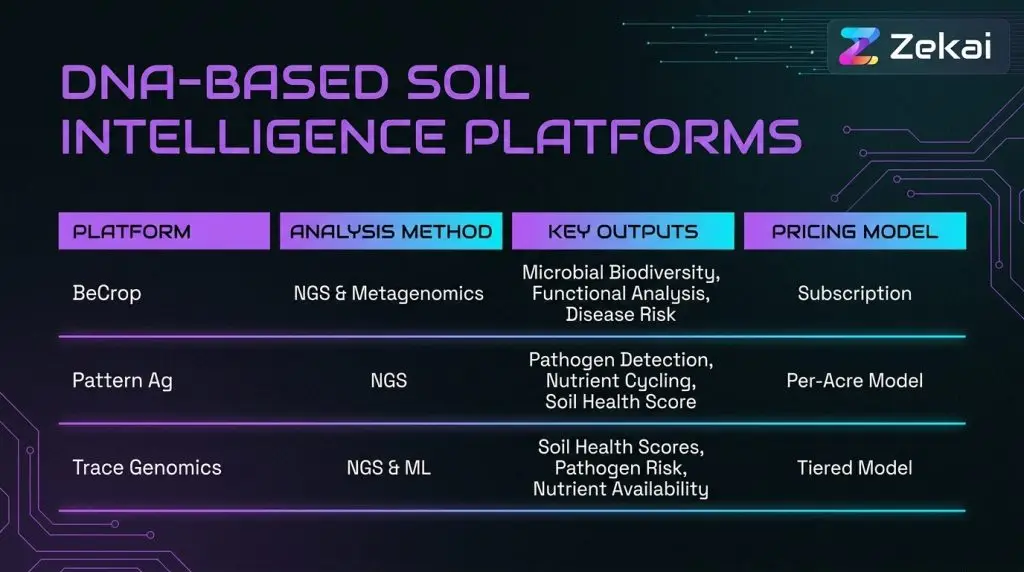
These platforms, like BeCrop, use genomic sequencing to analyze the soil’s microbiome. They are the most direct one-to-one alternatives, offering deep biological insights into pathogens, nutrient cycling, and soil health. The market for these tools has seen consolidation, with Pattern Ag merging with EarthOptics and Trace Genomics being acquired by Miraterra, signaling the high cost and scientific challenge of this space.
| Tool | Primary Analysis Method | Key Outputs | Pricing Model (as of Sep 2026) | Best For |
|---|---|---|---|---|
| BeCrop | Soil DNA Sequencing (Metagenomics) | Nutrient pathways, disease risk, biodiversity index, carbon estimates. | Per-Acre or Per-Sample | Overall soil health assessment and optimizing biologicals. |
| Pattern Ag | Soil DNA Sequencing | Predictive analytics for specific pests, diseases, and nematodes. | Pricing on request | Proactive risk management for key yield-limiting pests and diseases. |
| Trace Genomics | Soil DNA Sequencing | Pathogen pressure analysis, nutrient cycling indicators (N & P). | Per-Sample | Diagnosing specific nutrient and disease issues to guide input selection. |
Swipe the table sideways →
1. Pattern Ag (now part of EarthOptics)
Pattern Ag focuses its DNA analysis on a single, high-value outcome: predicting next season’s pest, disease, and nematode pressure with high confidence. Instead of a broad biodiversity score, it gives you a targeted risk assessment for specific threats like corn rootworm or soybean cyst nematode (SCN). This allows for precise decisions on trait selection, seed treatments, and crop rotation before planting.
Pattern Ag
The best BeCrop alternative for purely predictive pest and disease management.
Pricing on request
What it does well: Its predictive focus is its greatest strength. Knowing you have high SCN pressure *before* you select your soybean variety is immediately actionable and has a clear ROI. The reports are designed to guide specific, high-cost input decisions.
What it does badly: It is less focused on the broader “soil health” and nutrient cycling metrics that BeCrop emphasizes. If your primary goal is to understand carbon sequestration potential or improve overall soil biology, Pattern Ag’s targeted approach may feel too narrow.
Who should use it: Row-crop farmers in the Midwest and other major production regions where predictable pests and diseases represent a significant annual yield threat and financial risk.
Who should NOT use it: Organic growers or those focused on holistic soil health metrics, who may find BeCrop’s wider-angle view on biodiversity and ecosystem function more valuable.
- Price from
- ~$4/acre (EarthOptics Total Farm platform, as of Sep 2026)
- Free tier
- No free tier
2. Trace Genomics (now part of Miraterra)
Trace Genomics, now part of the Canadian measurement company Miraterra, offers a comprehensive soil DNA analysis that is very similar to BeCrop. It provides detailed reports on pathogen risk for over 225 pathogens across 70 crops, but also includes specific modules for nutrient cycling, like TraceN™ and TracePHOS™, which analyze the biological pathways for nitrogen and phosphorus availability.
Trace Genomics
A strong direct competitor to BeCrop, especially for phosphorus and nitrogen insights.
Paid, from $105+/Acre
What it does well: Trace excels at connecting soil biology directly to nutrient management. Its reports can help you decide if a phosphorus-liberating biological product is likely to work in a specific field or where a nitrogen stabilizer would be most effective. This bridges the gap between biological data and fertilizer decisions. The cost can be around $4/acre more than standard soil sampling.
What it does badly: The cost is a significant barrier to widespread adoption, often running ten times the price of a standard chemical soil test. Like all DNA-based tools, translating its complex biological insights into a simple ROI can be challenging for farmers accustomed to chemical analysis.
Who should use it: Agronomists and farmers looking to fine-tune their nutrient management programs with biological data or diagnose persistent yield-limiting factors that chemical tests can’t explain.
Who should NOT use it: Farmers on a tight budget or those who are not prepared to manage the complexity of biological data. A simpler, less expensive tool would be a better starting point.
- Price from
- Per-sample, est. $200+
- Free tier
- No free tier
Satellite & Imagery-Based Alternative
Instead of analyzing the soil itself, this category of tools uses satellite or aerial imagery to monitor crop health and field variability from above. This provides a powerful, scalable, and often much cheaper proxy for what’s happening on the ground. It’s a different approach to the same problem: identifying and managing in-field variation.
3. OneSoil
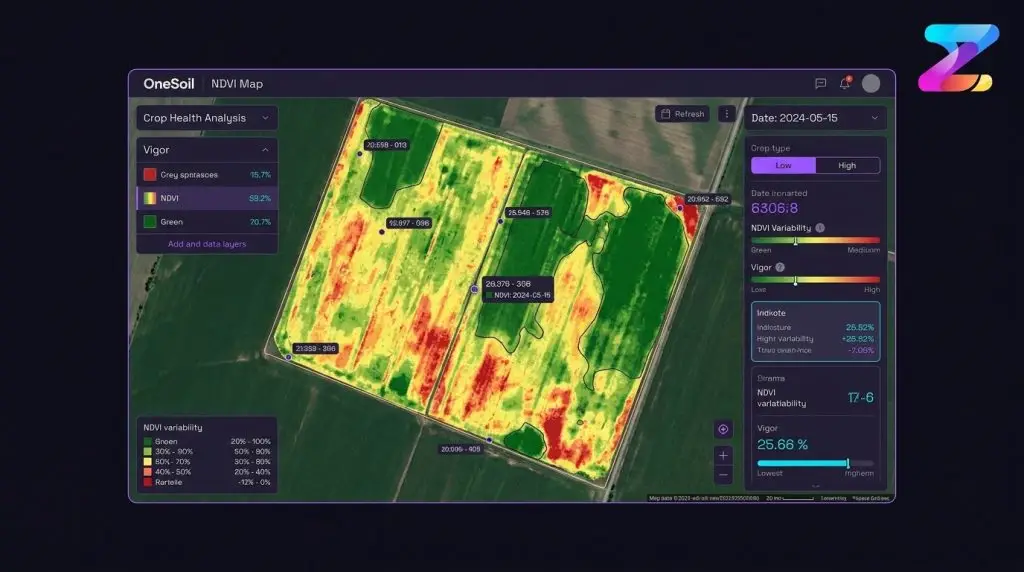
OneSoil is a standout platform in the precision agriculture space, using high-quality satellite imagery to provide actionable insights. It doesn’t analyze soil DNA, but it excels at showing you *where* to focus your attention. Its core function is creating vegetation maps (NDVI) that highlight differences in crop growth across a field.
in a 2022 study had adopted soil testing and formulated fertilization technology, but the overall adoption level remains low, highlighting a need for accessible tools. Source: mdpi.com
OneSoil
The best free tool for identifying field variability and creating management zones.
Free plan available
What it does well: The free tier is incredibly powerful. You can map all your fields, monitor NDVI throughout the season, and use the mobile scouting app to investigate problem areas—all without paying anything. It’s the perfect entry point to precision agriculture. For paid users, it creates variable-rate application (VRA) maps for fertilizer and seed, helping you act on the variability it identifies.
What it does badly: It tells you the “what” and “where” (e.g., “this part of the field is underperforming”) but not the “why.” It can’t distinguish between low yield caused by compaction, disease, or a nutrient deficiency. You still need to put boots on the ground or take a soil sample to diagnose the root cause.
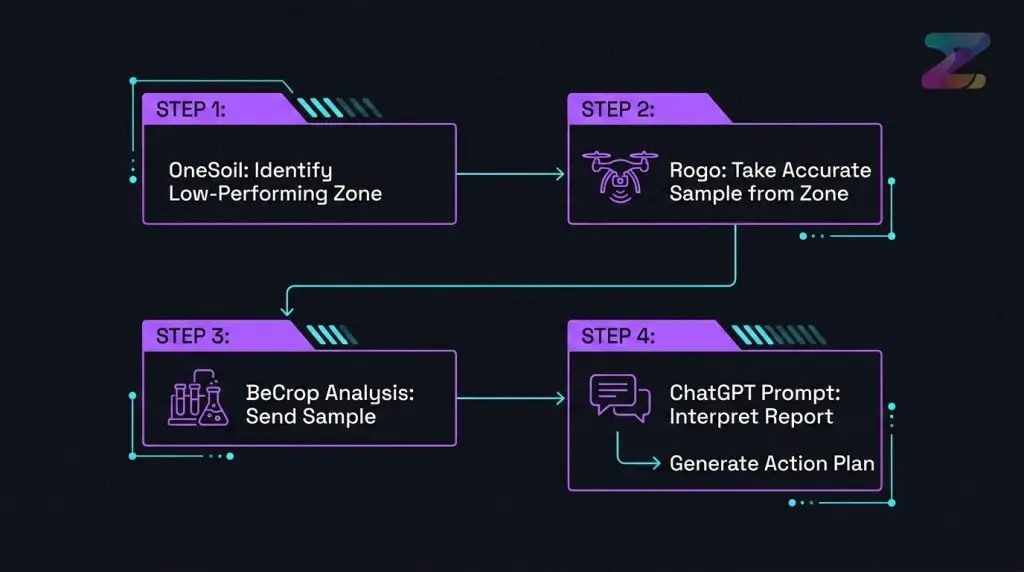
Who should use it: Virtually any farmer or agronomist. The free version is a no-risk way to start using precision data. It’s especially valuable for creating management zones for more targeted (and cost-effective) soil sampling with tools like BeCrop or Pattern Ag.
Who should NOT use it: Anyone who needs a definitive biological or chemical diagnosis from a remote platform. OneSoil is a map, not a laboratory.
- Price from
- Paid plans for advanced features (region-dependent per-hectare pricing; contact for quote); robust free tier
- Free tier
- Free field mapping, NDVI monitoring, weather, and scouting app.
In-Field Hardware & Automation Alternatives
This category focuses on improving the physical process of data collection or management in the field. These tools are less about biological analysis and more about bringing robotic precision and automation to foundational tasks like soil sampling and irrigation, providing a different path to better management.
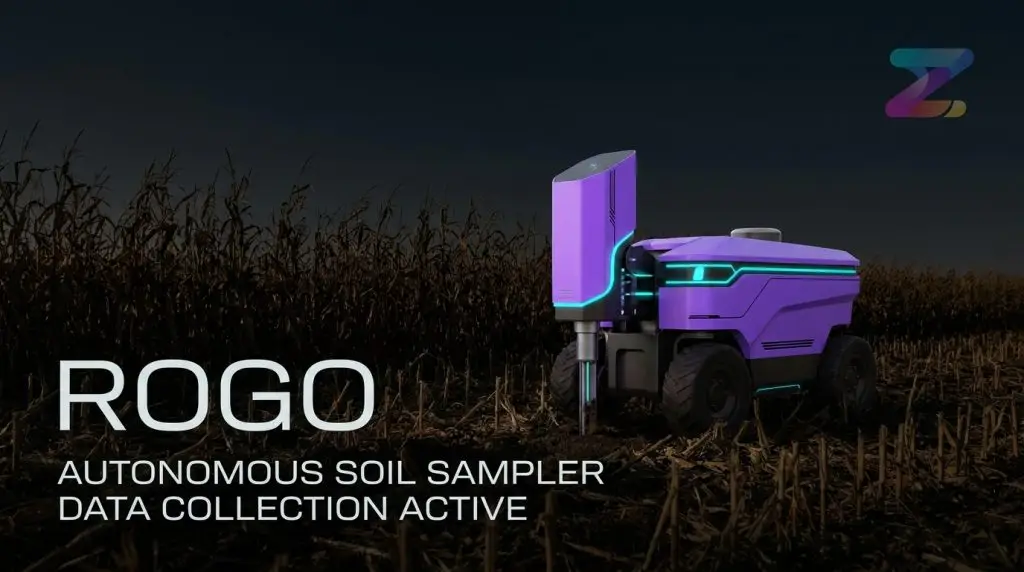
4. Rogo
Rogo tackles the biggest source of error in any soil testing program: the human taking the sample. Its autonomous and semi-autonomous robots navigate to precise GPS locations and collect soil cores at a consistent depth, every time. This eliminates the variability that happens when a person gets tired or rushes through a field. Rogo provides the sampling *service*; you still send the collected samples to the lab of your choice (which could even be for a BeCrop analysis).
Rogo
The best way to ensure your soil samples—for any type of test—are accurate and repeatable.
Pricing on request
What it does well: Consistency. A 2019 study showed Rogo’s SmartCore was 10% more accurate on location and depth and twice as fast as human samplers. This accuracy is critical for tracking changes in soil fertility over time and for building reliable variable-rate fertilizer maps. The ROI can be significant, with one study showing returns of $13.50 to $17.40 per acre from improved fertilizer accuracy.
What it does badly: Rogo is a service, not an analytics platform. It delivers perfectly collected soil in a bag; it doesn’t tell you what’s in it. It’s also primarily focused on the US Midwest, so availability may be limited in other regions.
Who should use it: Large-scale row-crop operations that rely on grid or zone sampling for their fertility program and want to maximize the accuracy and value of their soil testing investment.
Who should NOT use it: Small-scale or specialty crop growers where the per-acre service cost may be prohibitive, or those in regions where Rogo doesn’t operate.
- Price from
- Service priced per acre, from $2.50 to $4+
- Free tier
- No free tier
5. Verdi
Verdi is an alternative in a different sense: it focuses on precisely *acting* on soil and plant data. Instead of more detailed soil analysis, Verdi provides hardware that retrofits to existing irrigation valves, allowing for sensor-driven automation. You can control and automate irrigation for specific blocks or even individual rows based on data from soil moisture sensors, weather forecasts, or other inputs.
Verdi
A practical alternative for managing crop health through precision irrigation, not deeper soil analysis.
Pricing on request
What it does well: Verdi excels at turning data into action and saving labor. Farmers using the system report significant savings in water (up to 30%), labor ($250-$500/acre), and increases in yield (10-20%). Its ability to retrofit onto existing infrastructure makes automated, precision irrigation accessible without a complete system overhaul.
What it does badly: It’s a specialized tool for irrigated crops. Its value is entirely dependent on your ability to control water application. It doesn’t offer any soil nutrient or biological insights.
Who should use it: Specialty crop growers (vines, nuts, fruits) where precision irrigation has a direct and immediate impact on crop quality and yield, and where irrigation labor is a major cost center.
Who should NOT use it: Dryland or broadacre row-crop farmers who do not use irrigation.
- Price from
- Hardware + subscription; est. $2000 gateway + $450/controller
- Free tier
- No free tier; 90-day satisfaction guarantee
You are an experienced agronomist specializing in soil fertility for corn and soybeans in the US Midwest. I have a soil report from [Tool Name, e.g., BeCrop or Trace Genomics] for a field named "North 40."
Here is the key data:
- **Field History:** Continuous corn for 3 years.
- **Yield Goal:** 220 bu/ac corn.
- **BeCrop Data:** Low nutrient mobilization score for Phosphorus (P). High risk score for Fusarium.
- **Standard Chemical Test:** pH 6.2, P (Bray) 15 ppm (Medium), K 120 ppm (Low).
Based *only* on this information and restricting your knowledge to recommendations from US land-grant university extension programs, provide a 3-point action plan for this field for the upcoming season. For each point, explain your reasoning.Broader Farm Management Platform Alternatives
For some operations, a dedicated soil intelligence tool is too specific. They need a broader platform that integrates soil data with financial records, machinery data, and daily work logs. These farm management systems are an alternative for the farmer who wants one platform to run their entire operation, with soil health being just one component.
6. Ag-Analytics
Ag-Analytics is a data integration platform that connects with systems like John Deere Operations Center and Climate FieldView to create profitability maps. Its flagship feature, ProfitLayers®, combines machine data (yield, as-applied) with financial data (input costs) to show profit and loss on a sub-field level. It’s an alternative to BeCrop because it answers the “what should I do?” question through an economic lens, rather than a biological one.
Ag-Analytics
A strong, data-driven alternative for identifying which parts of a field are losing money.
What it does well: Profitability analysis. Seeing a map of your field in shades of red (loss) and green (profit) is a powerful decision-making tool. It helps you identify areas that might be better suited for conservation programs or require a completely different management strategy, a conclusion you might also reach from a BeCrop test, but for different reasons.
What it does badly: It requires clean, high-quality data from your existing precision ag systems. If you don’t have accurate yield maps or as-applied data for your inputs, the “garbage in, garbage out” principle applies. It doesn’t generate new biological insights, it just analyzes the data you already have.
Who should use it: Data-savvy farmers who already have several years of yield and application data and want to translate it into clear financial insights.
Who should NOT use it: Farmers who are not yet using precision ag hardware or who lack reliable digital records for yield and inputs.
- Price from
- Free basic account; Premium tier (unlimited ProfitLayers maps) is $1,000/year per organization
- Free tier
- Yes, a free account is available with limited features.
7. AgriWebb
AgriWebb is a comprehensive farm management platform designed primarily for livestock producers. While its core focus is on grazing management, animal records, and traceability, it serves as a viable alternative for ranchers and mixed-farming operations who need a single system for all their records, including pasture and soil health.
AgriWebb
The best management platform for livestock producers who want to integrate soil and pasture data.
Pricing on request
What it does well: It provides a single source of truth for livestock operations. You can track grazing moves, record pasture yields, and map fields. While it doesn’t offer biological soil analysis, you can upload lab reports and track soil metrics over time against your grazing records, providing a holistic view of your ranch’s ecosystem. Its offline capability is also a major strength for fieldwork.
What it does badly: The platform’s soil and crop features are basic compared to a dedicated tool like BeCrop or OneSoil. It’s built for tracking and record-keeping, not deep agronomic analysis. It has no milk yield tracking, making it less suitable for dairy operations.
Who should use it: Beef and sheep producers who want one digital hub to manage their entire operation, from individual animal records to overall pasture health.
Who should NOT use it: Row-crop farmers or anyone needing detailed agronomic or biological soil analysis. The tool is not built for crop-focused operations.
- Price from
- Paid subscription tiers (Essentials from ~$34/mo), priced by average livestock numbers
- Free tier
- Not verified: AgriWebb’s official pricing page shows no perpetual free tier as of Sep 2026, only a free trial.
8. Granular (by Corteva)
Granular is a top-tier farm management software platform that focuses on integrating agronomic and financial data to drive profitability. It helps create operational plans, direct field activities, and analyze the financial performance of different decisions. Like Ag-Analytics, it offers an economic alternative to BeCrop’s biological approach.
Granular
An enterprise-grade platform for large farms wanting to connect financial performance to field operations.
Free plan available
What it does well: Financial integration. Granular shines at connecting agronomic plans to a farm’s budget and profit centers. It allows managers to see the financial implications of their decisions in near real-time, making it a powerful tool for professional farm managers and large family operations.
What it does badly: Cost and complexity. Granular is an enterprise-level system with a corresponding price tag and learning curve. It is not a plug-and-play solution and requires significant commitment to set up and maintain.
Who should use it: Large, professionally managed farming operations that need a robust system for financial planning, operational management, and reporting across multiple team members and locations.
Who should NOT use it: Small to medium-sized farms where the cost and complexity of the platform would outweigh its benefits.
- Price from
- Quote-based; entry-level plans have been estimated around $1,200/year, per market reports — contact Granular for a quote
- Free tier
- No, but a free basic version called FarmLogs was previously available.
projected size of the global precision agriculture market by 2028, growing at a rate of 11.6% annually as more farmers adopt these technologies. Source: iot-now.com
Which BeCrop Alternative Is Right for You?
No single tool can replace BeCrop for every user. The right choice depends entirely on the job you need to do.
- For direct biological insights: If you want to stick with DNA analysis to guide input decisions, Pattern Ag is the best choice for its sharp focus on predicting pest and disease risk.
- For a zero-cost starting point: If you’re new to precision ag and want to understand field variability without a major investment, OneSoil‘s free platform is the undisputed best option.
- For maximum data accuracy: If you believe that good data starts with good sampling, investing in a service like Rogo will improve the ROI of *any* soil test you run.
- For an all-in-one financial view: If your primary concern is profitability, a farm management platform like Granular or Ag-Analytics will give you the economic lens you need to manage your operation.
The world of soil intelligence is expanding beyond a single methodology. While BeCrop remains a leader in biological analysis, this new class of alternatives offers powerful, specialized, and sometimes more affordable ways to make smarter decisions on the farm. For more in-depth reviews and comparisons of tools for AI in agriculture, visit our profession hub.
Is BeCrop worth the cost?
It depends. For high-value specialty crops or for farmers looking to diagnose complex biological issues limiting yield, the deep insights from BeCrop can provide a clear ROI. For broadacre crops with tight margins, the high per-sample cost can be difficult to justify unless you are targeting a specific, high-cost problem.
What is the best free tool for soil analysis?
For truly free analysis, OneSoil is the best platform. It uses free Sentinel satellite imagery to show you in-field crop variability (NDVI), which acts as a proxy for soil health and productivity. While it’s not a soil test, it’s a powerful tool for identifying where to focus your management efforts.
How does soil DNA testing work?
Soil DNA testing, or metagenomics, involves extracting all the genetic material from the microorganisms (bacteria, fungi, etc.) in a soil sample. This DNA is then sequenced, and AI algorithms compare it to vast databases to identify the microbes present and predict their functions, such as nutrient cycling or disease potential.
Can I use satellite imagery instead of soil testing?
No, they are complementary tools. Satellite imagery (like from OneSoil) is excellent for identifying variability across large areas at a low cost. It tells you *where* problems or differences exist. Soil testing (chemical or biological) is for diagnosing *why* those differences exist by analyzing the soil in those specific zones.
How accurate are predictive soil analytics like Pattern Ag?
Leading platforms claim high confidence in their predictions for specific pests and diseases. However, accuracy depends on the quality of the sample, the specific threat being predicted, and regional environmental factors. These tools are best used as a powerful risk management aid, not an infallible guarantee.
What is the difference between BeCrop and a standard chemical soil test?
A standard chemical test measures the abiotic properties of soil—pH, organic matter, and the quantity of nutrients like N, P, and K. A biological test like BeCrop analyzes the living component of the soil—the microbiome—to assess its function, such as how effectively it can make those nutrients available to the plant.
Where to go next
Three routes, picked for what you just read.
Sources (49)
- iot-now.com · 144670 the precision agriculture market to reach e 9 5 billion worldwide by 2028 · iot-now.com
- dtnpf.com · Smart sample · dtnpf.com
- soilhealthinstitute.org · Nationwide study on 30 u s farms shows positive economic impact of
- nrcs.usda.gov · Invest in Soil Health IA Jan 2024.pdf · nrcs.usda.gov
- bccresearch.com · Global precision farming market · bccresearch.com
- intellectualmarketinsights.com · Agriculture · intellectualmarketinsights.com
- ers.usda.gov · Err 353.pdf · ers.usda.gov
- agresearchmag.ars.usda.gov · The economics of regenerative agriculture · agresearchmag.ars.usda.gov
- rogoag.com · Soil sampling methods tools and companies · rogoag.com
- mordorintelligence.com · Precision farming market · mordorintelligence.com
- flypix.ai · Top precision farming software tools and AI solutions for modern agriculture · flypix.ai
- marketsandmarkets.com · Digital agriculture market 175194953 · marketsandmarkets.com
- onesoil.ai · What is onesoil · onesoil.ai
- afponline.org · Usda launches new regenerative pilot program to lower farmer
- devopsschool.com · Top 10 AI agriculture tools in 2026 features pros cons comparison · devopsschool.com
- rogoag.com · Robotic soil sampling services · rogoag.com
- play.google.com · Details · play.google.com
- aibizguide.net · Best AI tools farmers agriculture · aibizguide.net
- rhizebio.com · Soil testing in agriculture enhancing sustainable farming · rhizebio.com
- businesswire.com · Biome Makers Launches BeCrop 4.0 Advancing AI Powered Soil
- techpoint.org · Rogo · techpoint.org
- ag-analytics.org · Profit ag · ag-analytics.org
- chsinc.com · 5 tech innovations changing agriculture · chsinc.com
- rhizebio.com · Biological nutrient availability dna soil testing in agriculture · rhizebio.com
- mdpi.com · mdpi.com
- rogoag.com · Pricing and services · rogoag.com
- blog.biomemakers.com · Becrop farm the precision agriculture tool for retailers and farmers · blog.biomemakers.com
- tracxn.com · P7Tz6pE1kXh0L90Lq g57U3dYyWc86Kj8P1H5X4t U · tracxn.com
- verdiag.com · verdiag.com
- mdpi.com · mdpi.com
- businessinsider.com · Startup soil health dna sequencing agriculture biodiversity 2023 5 · businessinsider.com
- portal.becrop.com · Login · portal.becrop.com
- softwr.ai · Indigo agriculture pricing · softwr.ai
- cattly.com · Best dairy farm apps · cattly.com
- mordorintelligence.com · Agricultural testing market · mordorintelligence.com
- mazaohub.com · 10 global farm management software for smallholder farmers · mazaohub.com
- agweb.com · Biodiversity index field look diagnostic microbiome tests soil health · agweb.com
- agfundernews.com · Miraterra acquires soil dna startup trace genomics independent growth
- miraterra.com · Trace · miraterra.com
- softwr.ai · Granular pricing · softwr.ai
- facebook.com · Pfbid0qQ37k156Yd5H19qS56C51wN3tGjB1oJ5j49sY43p4p6y1F5w1o1fX1z6b1z1f1Zl · facebook.com
- agtechnavigator.com · Can Verdi switch on farmers to the benefits of automated irrigation · agtechnavigator.com
- verdiag.com · Dashboard · verdiag.com
- verdiag.com · Block controller · verdiag.com
- cattly.com · Best cattle management software · cattly.com
- greenskin.ai · Agrierp · greenskin.ai
- lsuagcenter.com · Partnerships · lsuagcenter.com
- agfundernews.com · Camoag reaches profitability with ag sales intel platform as corbett
- agleader.com · agleader.com
See Zekai first in Google
The weekly AI briefing for your profession
One weekly email: the AI changes that actually affect your profession — tools, deals, and what to do about them.