العربية
 English
 Français
 Deutsch
 हिन्दी
 Português
 Русский
 Español
 Türkçe
Investing in autonomous sprayers, robotic weeders, and other AI-driven equipment is a major capital expense. The good news is that Section 179 of the U.S. tax code is a powerful tool for recovering a significant portion of that cost upfront. This guide explains exactly how farmers can use Section 179 and bonus depreciation to write off these investments for the 2026 tax year. ZEKAI provides independent reviews of AI tools for professionals, including those in the AI in agriculture and smart farming sector. We do not offer tax advice, and you should always consult a qualified tax professional about your specific financial situation.
The short answer
Yes, most AI-powered farm equipment and its embedded “off-the-shelf” software qualifies for the Section 179 deduction. For the 2026 tax year, you can immediately expense up to $2,560,000 of new or used equipment purchased. This allows you to deduct the full cost in the year of purchase rather than depreciating it over many years.
What Is Section 179 and How Does It Help Farmers?
Section 179 is a part of the IRS tax code designed to encourage businesses to invest in themselves. Instead of depreciating a large purchase over its useful life (e.g., deducting a portion of a tractor’s cost over 5-7 years), Section 179 allows you to deduct the *entire purchase price* from your gross income in the year the equipment was placed in service.
For a farm, this means if you buy a $600,000 autonomous sprayer and place it in service before the end of the tax year, you can potentially reduce your taxable income by the full $600,000. This immediate deduction can dramatically improve cash flow, freeing up capital to reinvest elsewhere in your operation.
Source: nifa.usda.gov
A University of Arizona workshop on automated thinning and weeding systems led to an estimated $1.4 million in annual labor cost savings for participating growers.
2026 Section 179 Limits You Must Know (as of September 2026)
The tax law includes specific dollar limits for the Section 179 deduction. For the 2026 tax year, these are the key numbers:
| Limit Type | 2026 Amount | What It Means |
|---|---|---|
| Maximum Deduction | $2,560,000 | This is the most you can elect to expense for qualifying property placed in service in 2026. |
| Spending Cap / Phase-Out | $4,090,000 | Once your total qualifying equipment purchases exceed this amount, the deduction begins to phase out on a dollar-for-dollar basis. |
Swipe the table sideways →
If a farm spends $4,200,000 on qualifying equipment in 2026, its maximum Section 179 deduction would be reduced by $110,000 (the amount over the $4.09M cap), leaving a potential deduction of $2,450,000.
Does Your AI Farm Equipment Qualify?
Most AI-powered machinery and software used on a farm will qualify. The IRS has a clear set of rules. Here is a checklist to see if your purchase is eligible:
- It must be tangible property. This includes machinery and equipment like autonomous tractors, robotic harvesters, and smart sprayers.
- It can be new or used. As long as the equipment is “new to you” and not acquired from a related party, it qualifies.
- It includes “off-the-shelf” software. The software that runs your AI equipment qualifies as long as it’s commercially available and not custom-developed specifically for you.
- It must be purchased or financed. You must take ownership. Leased equipment does not qualify for Section 179.
- It must be used for business more than 50% of the time.
- It must be placed in service during the tax year. The equipment must be ready and available for its intended use by December 31st of the tax year you’re claiming the deduction. Just ordering it isn’t enough.
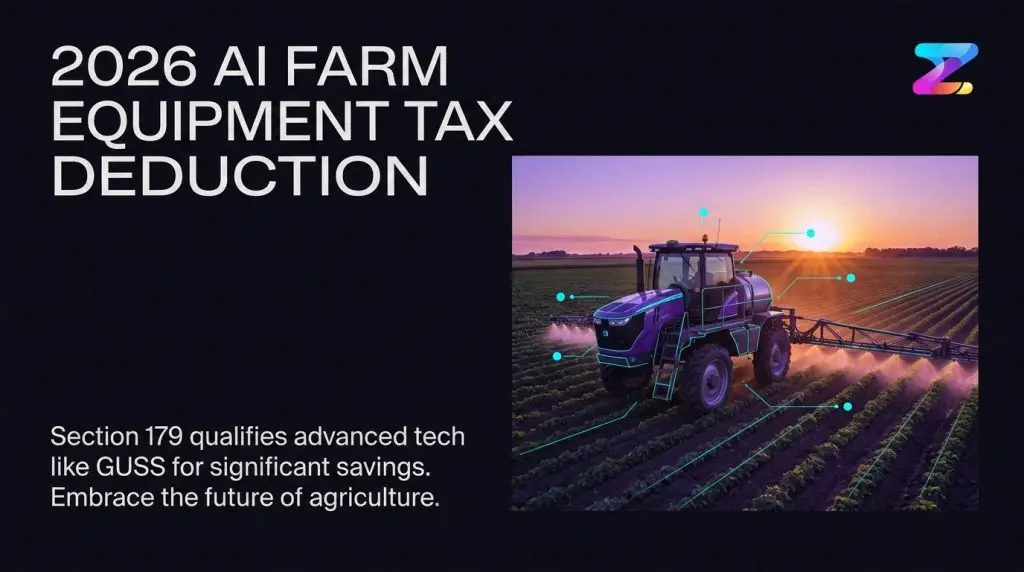
Examples of qualifying AI equipment include robotic systems from Saga Robotics, GUSS autonomous sprayers, and Carbon Robotics LaserWeeders.
SA Tool review Saga Robotics — read our full review Pricing, free tier and where it falls shortSection 179 vs. 100% Bonus Depreciation: Which Is Better for Your Farm?
Bonus depreciation is another powerful tax incentive that was made permanent at 100% for property acquired after January 19, 2025. It allows you to deduct 100% of the cost of eligible assets in the first year, but it works differently from Section 179. Understanding the distinction is key to tax planning.
| Feature | Section 179 Deduction | 100% Bonus Depreciation |
|---|---|---|
| Deduction Limit | Capped at $2,560,000 for 2026. | No dollar limit on total deductions. |
| Income Limit | Deduction cannot exceed your net taxable business income. | Can be used to create or increase a net operating loss (NOL). |
| Application | You elect to take it and can choose which specific assets to apply it to. | Applies automatically to all eligible property unless you elect out. |
| Eligible Property | New and used equipment, off-the-shelf software, some real property improvements. | New and used equipment, software, plants/vines, property with a recovery period of 20 years or less. |
Swipe the table sideways →
The Strategy: A common strategy is to use Section 179 first to write off specific assets up to the $2.56 million limit. Then, 100% bonus depreciation automatically applies to the remaining cost of all other eligible assets. This combination allows many farms to write off 100% of their capital expenditures in a single year.
The Software Catch: Purchased Software vs. SaaS
The distinction between purchased software and “Software as a Service” (SaaS) is critical for tax purposes.
- Purchased “Off-the-Shelf” Software: If you buy a perpetual license for software that is installed on your equipment or computers, it generally qualifies for the Section 179 deduction. This often applies to the software embedded within a piece of AI machinery you buy outright.
- Software as a Service (SaaS): If you pay a monthly or annual subscription fee for access to a cloud-based platform, this is treated as a regular operating expense, not a capital purchase. You deduct these subscription fees as you pay them. This model is common for irrigation management tools like Lumo or farm management platforms.
While SaaS subscriptions aren’t eligible for the large upfront Section 179 deduction, they are still fully deductible as a normal business cost.
LU Tool review Lumo — read our full review Pricing, free tier and where it falls shortA Step-by-Step Example: Writing Off a Robotic Weeder
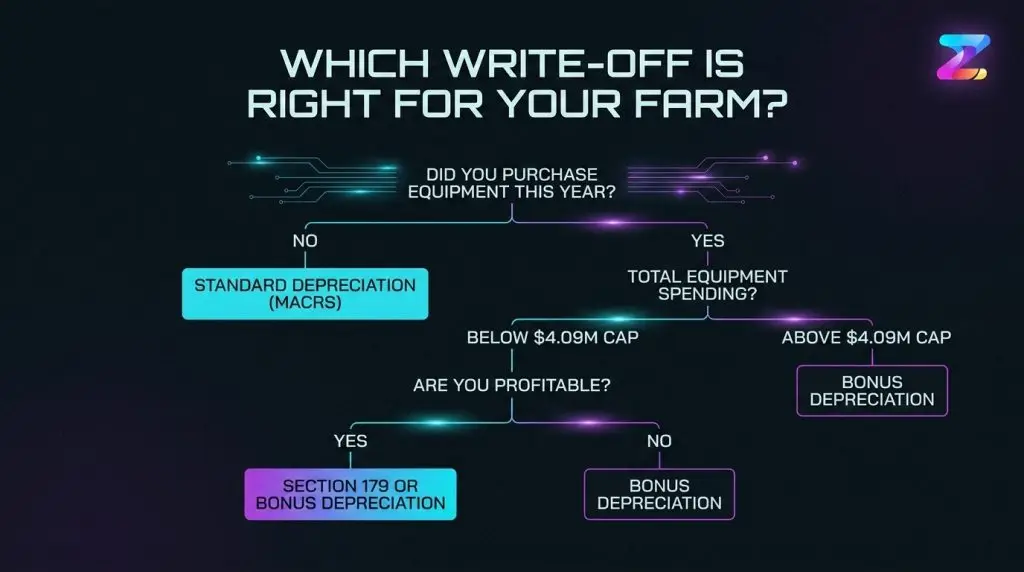
Let’s walk through a simplified scenario for the 2026 tax year.
- The Purchase: A farm buys a new autonomous weeding robot for $750,000. It also purchases a new GPS-enabled planter for $300,000. Total qualifying purchases are $1,050,000.
- Check the Limits: The total spend of $1.05M is well below the $4.09M spending cap, so the farm is eligible for the full Section 179 deduction.
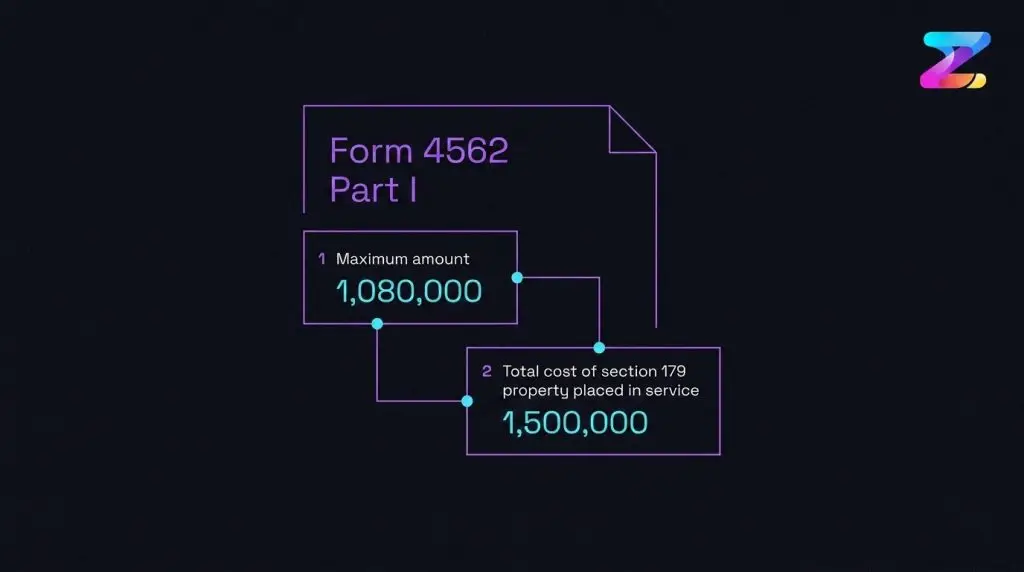
- Make the Election: The farm elects to take the Section 179 deduction for the full $1,050,000 on its tax return using IRS Form 4562.
- Calculate the Savings: Assuming the farm is in a 24% federal tax bracket, the deduction of $1,050,000 translates to an immediate tax savings of $252,000 ($1,050,000 x 0.24).
This immediate cash-flow benefit makes the high cost of the equipment much more manageable.
Strategic Planning: When NOT to Take a Full Write-Off
While powerful, taking a 100% first-year deduction isn’t always the best strategy. You should discuss with your accountant whether it makes sense to forgo Section 179 or bonus depreciation if:
- You expect higher income in the future. If you anticipate being in a much higher tax bracket next year, you might save more in taxes by depreciating the asset over several years to offset that future income.
- You have a business loss. The Section 179 deduction cannot be used to create a business loss. If your farm has a net loss for the year before the deduction, you can’t use it (though you can carry it forward). Bonus depreciation, however, *can* create or increase a loss.
- State tax law doesn’t conform. Many states do not follow the federal rules for Section 179 or bonus depreciation. Taking a large federal deduction could create a mismatch and complexity on your state return.
Ultimately, the decision to accelerate deductions is a strategic one that depends on your farm’s profitability, cash flow needs, and long-term outlook. This is why consulting a professional who understands both federal and state agricultural tax law is essential before making a large purchase. For more guidance on integrating AI into your operation, visit our AI in agriculture hub.
Can I use Section 179 for used AI farm equipment?
Yes. Both new and used equipment are eligible for the Section 179 deduction, as long as the equipment was acquired by purchase, is new to you and your business, and was not acquired from a related party. This is a key benefit for farms looking to adopt technology more affordably.
What happens if I sell the equipment before its useful life is over?
If you sell equipment that you previously expensed under Section 179, you may have to “recapture” the deduction. This means you would report the sales price as ordinary income, up to the amount you originally deducted. You should consult a tax professional to understand the implications of selling an asset early.
Does Section 179 apply to state income taxes?
It depends on the state. Many states do not fully conform to the federal Section 179 deduction limits or bonus depreciation rules. It is critical to work with a tax advisor who understands your specific state’s tax laws to accurately calculate your total tax liability and savings.
Can I finance the equipment and still claim the deduction?
Yes. You can claim the full Section 179 deduction on financed equipment in the year it is placed in service, even if you have not fully paid off the loan. The deduction is based on the full purchase price of the asset, not the amount you’ve paid.
Do single-purpose agricultural structures qualify for Section 179?
Yes, certain single-purpose agricultural or horticultural structures, such as milking parlors or greenhouses, can qualify for the Section 179 deduction. This allows you to expense the cost of these specialized buildings in the year they are placed in service, similar to how equipment is treated.
Where to go next
Three routes, picked for what you just read.
Sources (30)
- Vertex AI Search Result
- MorganMyers, “2026 Farmer Trust In AI Report,” June 8, 2026.
- Nationwide, “Section 179 Tax Deductions for Farm Equipment.”
- Bloomberg Tax, “From TCJA to OBBBA: Bonus Depreciation Strategy for 2026 and Beyond,” March 26, 2026.
- Sensiba (source for SaaS tax treatment).
- Facebook (source for general Section 179 information).
- Madras Accountancy, “Publication 946 Depreciation: Your Complete Guide (2026),” April 5, 2026.
- WhippleWood, “IRS Notice 2026-11: 100% Bonus Depreciation,” May 12, 2026.
- CalCPA, “Bonus Depreciation Updates for the 2026 Filing Season,” January 14, 2026.
- Source for bonus depreciation rules.
- Source for bonus depreciation rules.
- Sensiba, “How Businesses Deduct Software Costs for Tax Purposes,” June 23, 2026.
- OUTDOORICA, “2026 Section 179 & Bonus Depreciation Equipment Guide,” August 21, 2026.
- Source for software and financing qualification rules.
- Hive Tax AI, “Can I expense software subscriptions or licenses?,” July 3, 2025.
- Source for Section 179 limit inflation indexing.
- Precedence Research, “United States Agricultural Equipment Market Size Report 2034,” July 28, 2026.
- Intellias, “AI in Agriculture: A 2026 Guide for Agricultural Executives,” July 16, 2026.
- Mordor Intelligence, “AI In Agriculture Market Statistics, Size & Overview 2031,” July 30, 2026.
- Pease Bell, “Section 179 Deduction: Rules, Limits, and What Qualifies,” March 19, 2024.
- Source for new vs. used equipment qualification.
- Block Advisors, “Section 179 Deduction Guide 2026,” March 6, 2026.
- Wolters Kluwer, “Section 179 Deduction – Federal – Topics – CCH AnswerConnect.”
- Source for OBBBA tax law changes.
- University of Nebraska-Lincoln, “Can AI Improve Farm Decision-Making? Evidence and Tradeoffs,” April 29, 2026.
- Global Market Insights Inc., “Autonomous Tractors Market Size, Growth Forecasts 2036-2035,” March 15, 2026.
- USDA NIFA, “Automation for Specialty Crops,” February 2, 2026.
- DLL Group, “Innovative Agriculture: Key Trends for 2026.”
- P&S Intelligence, “U.S. Agriculture Equipment Market Size, Share & Trends Analysis, 2032.”
- USDA, “Precision agriculture use increases with farm size and varies widely by technology,” December 10, 2024.
See Zekai first in Google
The weekly AI briefing for your profession
One weekly email: the AI changes that actually affect your profession — tools, deals, and what to do about them.