العربية
 English
 Français
 Deutsch
 हिन्दी
 Português
 Русский
 Español
 Türkçe
The short answer
As of September 2026, standard AIA A201 contracts do not address liability from Artificial Intelligence. This creates significant risk, as AI tools for design, scheduling, and site monitoring can introduce errors or violate privacy laws. Professionals remain liable even if the AI is at fault. Updating your A201 is critical to allocate risk for AI-generated outputs and define the standard of care before a dispute arises.
Artificial Intelligence is no longer a theoretical technology in construction. It’s embedded in tools for estimating, scheduling, safety monitoring, and design. Yet the contracts governing most projects, particularly the AIA A201™-2017 General Conditions, were written before this wave of AI adoption and remain silent on the issue. This silence is a significant, unaddressed risk.
When an AI tool produces a flawed design, an unworkable schedule, or a “hallucinated” specification, who is legally responsible? The answer, according to legal precedent and professional standards bodies like NCARB, is unequivocal: the licensed professional of record. The architect or engineer who stamps the drawing or the contractor who submits the schedule is accountable for the output, regardless of whether it was generated by a human or a machine. Software vendor license agreements almost universally disclaim liability for the outputs of their tools. You cannot outsource professional judgment or legal responsibility to an algorithm.
This guide provides a clause-by-clause framework for updating your AIA A201 contracts to address AI liability head-on. We will cover the primary risk scenarios, propose specific contractual language, and review tools where these compliance issues are most acute. ZEKAI reviews all tools independently; our goal is to equip professionals in the construction and engineering fields to adopt technology responsibly.
Why Standard AIA Contracts Fail to Cover AI Risk
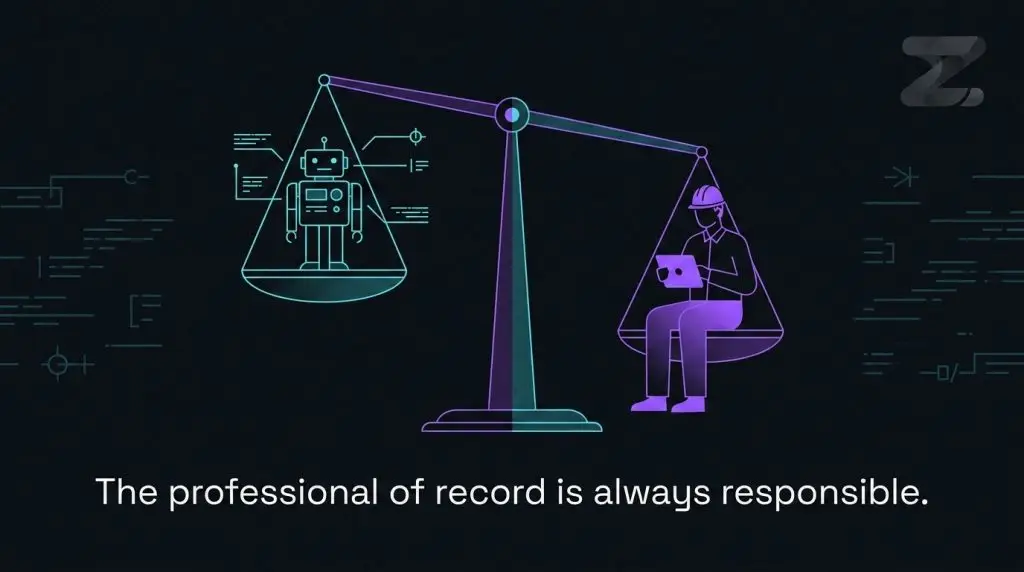
The AIA A201™-2017, the industry’s most-used contract document, is a robust framework for allocating risk—but it never mentions “Artificial Intelligence.” This omission creates critical gaps. The core problem lies with the “standard of care,” the legal duty for professionals to perform their work with the skill and judgment a reasonably prudent peer would exercise. AI complicates this in two ways:
- Opacity: Many AI tools are “black boxes,” making it impossible to audit *how* they reached a conclusion. If you can’t explain the logic, can you claim you exercised professional judgment?
- Novel Errors: AI can produce confident, plausible-sounding errors—like citing non-existent building codes or specifying materials that are physically incompatible—that a human expert might not make.
While the AIA has published digital practice documents like the E203™-2013 (now superseded by 2022 documents), these were primarily designed for BIM and digital data exchange, not the predictive and generative capabilities of modern AI. They provide a starting point for data protocols but do not adequately address liability for AI-generated design, analysis, or site monitoring. The responsibility for adapting contracts falls to the parties on each project.
“Regardless of disclaimers issued by software developers or the autonomy of machine-generated outputs, the architect of record is still bound by the standard of care.” — NCARB, February 2026. Source: ncarb.org
The Three Core AI Liability Scenarios
Before drafting new clauses, it’s essential to understand the specific risks. We see three primary categories of AI-related disputes emerging in construction.
1. Design and Preconstruction Errors
Generative design tools can produce thousands of design options, and AI-powered takeoff software can estimate quantities in minutes. But these tools can also “hallucinate” unbuildable geometry, misinterpret drawings, or base estimates on flawed data. If an architect incorporates an AI-generated, code-non-compliant design element into stamped drawings, the architect is liable. If a contractor submits a bid based on an AI’s erroneous quantity takeoff, the contractor owns the financial consequences of that error.
2. Scheduling and Management Failures
AI scheduling platforms can analyze millions of sequences to optimize a project’s critical path. However, their effectiveness depends entirely on the quality of the input data. If a schedule is generated from incomplete historical data or fails to account for a site-specific constraint, the resulting “optimized” plan can lead to significant delays and disputes. The contractor who submits that schedule as their plan of record is ultimately responsible for its viability.
3. Jobsite Monitoring and Data Privacy Violations
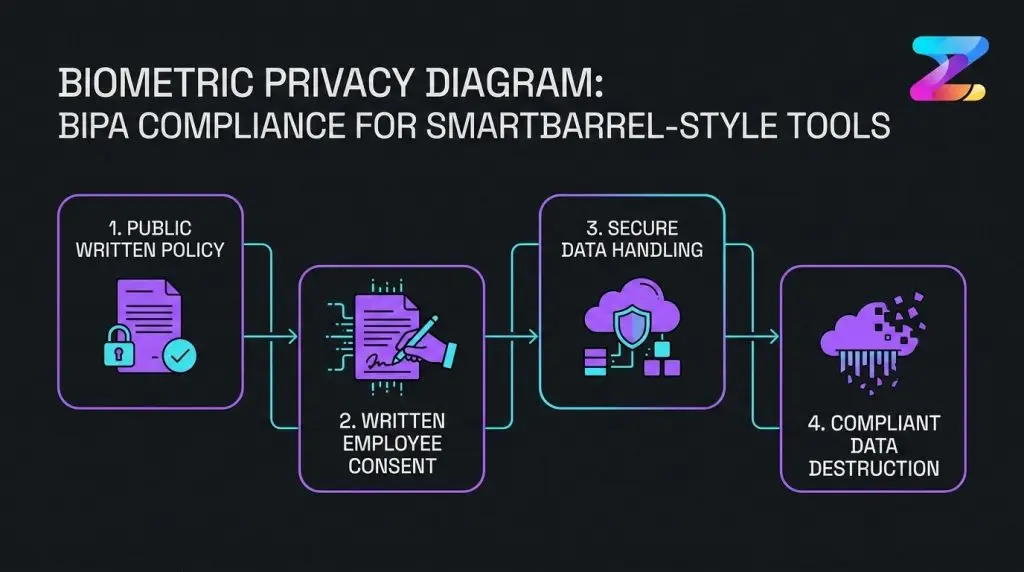
AI-powered camera systems can track progress, spot safety hazards, and verify worker attendance. This creates two distinct liability paths. First, if the system fails to flag a genuine safety hazard that leads to an incident, the contractor may face questions about negligent reliance on the technology. Second, and more immediately, many of these systems use biometric identifiers like facial scans for timekeeping. This directly implicates strict privacy laws like Illinois’ Biometric Information Privacy Act (BIPA), which mandates specific written consent and data-handling policies. A violation can lead to statutory damages per employee, per violation, creating massive financial exposure.
How to Update Your AIA A201: A Clause-by-Clause Guide
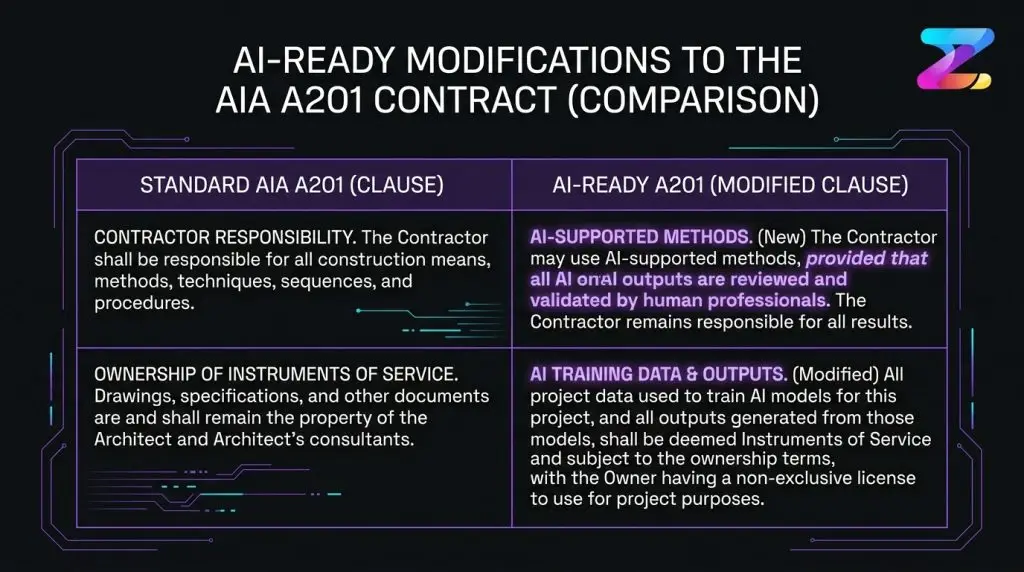
Amending the A201 should be done deliberately and with legal counsel. The goal is not to disclaim all AI risk, but to define its use and allocate responsibility clearly. Parties should consider creating a project-specific “AI Use Protocol” exhibit, similar to a BIM Execution Plan, that is incorporated by reference.
Here are four key areas of the A201 to address as of September 2026.
| A201-2017 Section | Standard Language Implication | Proposed AI-Ready Modification |
|---|---|---|
| § 1.1 / § 1.6 (Definitions / Ownership of Instruments of Service) | “Instruments of Service” are the Architect’s work product. The contract is silent on whether AI-generated outputs used to create them are included. | Add a definition for “AI-Assisted Output” and clarify that while such outputs may be used as tools, the final Instruments of Service are the sole responsibility of the professional of record. State that no ownership or liability is conferred upon the AI tool provider. |
| § 3.2 / § 4.2 (Contractor’s Review / Architect’s Review) | The contractor must review contract documents and report errors, but is not liable for design defects. The architect reviews submittals for conformance with the design intent. | Explicitly state the protocol for using AI in review processes. For example: “AI-assisted review may be used for preliminary analysis, but all findings, interpretations, and approvals must be independently verified and confirmed by a qualified human professional.” |
| § 3.18 (Indemnification) | The contractor indemnifies the Owner and Architect for negligent acts or omissions of the Contractor. The language is broad and does not contemplate AI as a causal agent. | Modify the indemnification clause to address AI. For example: “To the extent a claim arises from the use of an AI tool, liability shall be allocated to the party that selected, controlled, and relied upon the tool’s output, consistent with their respective standard of care and responsibilities under this Agreement.” |
| Article 11 (Insurance) | Requires standard coverages like CGL, Auto, and Professional Liability. It is unclear if current policies respond to claims arising from AI errors. | Require parties using AI for design, engineering, or safety monitoring to confirm with their Professional Liability (E&O) and Cyber Liability insurance carriers that their use of AI is a covered activity. This should be verified with a certificate or policy endorsement. |
Swipe the table sideways →
You are a construction lawyer. Draft a preliminary contract clause for an addendum to an AIA A201-2017 agreement. The clause should define "Artificial Intelligence (AI) Tool," establish that each party is responsible for its own use of AI tools, and require that any party using an AI tool to generate an output (e.g., a design, schedule, or report) must have that output independently verified by a qualified human professional before it is submitted or relied upon by other parties. The clause must affirm that the professional standard of care applies to all work, regardless of whether AI was used as a tool.Featured AI Tools with Compliance Considerations
The contractual risks are not abstract. They apply directly to tools being deployed on jobsites today. We review hundreds of tools at ZEKAI, and for this topic, two platforms highlight the intersection of innovation and liability.
Smartbarrel
Excellent for eliminating time theft, but requires strict BIPA compliance.
Pricing on request
Smartbarrel is an AI-powered workforce management platform that uses biometric facial verification for time tracking. Its primary function is to provide 100% accurate labor hours, eliminate “buddy punching,” and automate daily logs that sync with systems like Procore. The AI recognizes workers even with PPE on, and the system works via ruggedized site kiosks or mobile apps.
Where it excels: For job costing and payroll accuracy, Smartbarrel is a top-tier solution. It provides granular, real-time data on labor costs, productivity, and site attendance that is difficult to achieve manually.
Where to be cautious: The use of facial geometry for clock-ins places Smartbarrel squarely under the purview of biometric privacy laws. In states like Illinois, employers must have a publicly available written policy, obtain written consent from each worker *before* their first scan, and adhere to strict data retention and destruction guidelines. Failure to comply can be financially devastating. The legal risk is not with the tool itself, but with the contractor’s implementation process. It is not a tool to deploy without consulting legal counsel.
- Price from
- Custom pricing
- Free tier
- No free tier, demo available
Urbanistic
A powerful generative tool for master planning, but outputs require rigorous human verification.
Pricing on request
Urbanistic is an AI platform for urban design and master planning. It uses generative AI to produce site plans, massing studies, and feasibility analyses based on user-defined parameters and GIS data. It can dramatically accelerate the early stages of design, allowing planners and architects to explore more options in less time.
Where it excels: As an ideation and feasibility tool, Urbanistic is powerful. It can generate data-driven design outcomes that consider factors like zoning, density, and green space, helping teams move from a blank slate to a viable concept quickly.
Where to be cautious: The platform’s outputs are “plausible,” not “certified.” The architect of record remains 100% responsible for verifying that any AI-generated design complies with all applicable zoning ordinances, building codes, and accessibility standards. An attractive rendering from Urbanistic is not a substitute for a detailed code review and professional due diligence. The standard of care requires the architect to independently validate the design, and contracts should reflect that the AI is a tool for exploration, not a final authority.
- Price from
- Custom pricing (pricing on request)
- Free tier
- No
of architects express concern about the potential inaccuracy of AI-generated information, according to a 2025 AIA study. Source: constructconnect.com
The Path Forward: Adopt, but Verify and Allocate
AI tools offer immense potential to make construction more efficient, accurate, and safe. However, adopting the technology without updating the contractual frameworks that govern our projects is a recipe for disputes. The legal and professional consensus is clear: a human expert must stand behind the work.
The core principle is to treat AI output as raw material requiring professional judgment, not as finished work product. Before deploying any AI tool on a project, all parties—owners, architects, and contractors—must have a frank discussion about risk. That conversation should be documented in the A201 and any corresponding agreements. By defining the rules of engagement before a problem arises, teams can put AI to work while protecting themselves from the significant liabilities it can create.
To learn more about the tools transforming the industry, visit our hub for AI in construction and engineering.
Can I make the AI software vendor liable for errors in my contract?
No, this is generally not possible. Software End-User License Agreements (EULAs) almost always contain strict limitations of liability, disclaiming responsibility for any damages caused by the use of their software. The professional using the tool retains the ultimate responsibility and liability.
Does my Professional Liability (E&O) insurance cover AI-related mistakes?
It depends. This is an emerging area of risk, and insurance policies vary widely. Some may cover errors from software use if it’s considered part of your professional service, while others may have specific exclusions. You must consult your insurance broker to verify your coverage before using AI for professional work.
What is the difference between AIA E203 and the new 2022 digital documents?
AIA E203-2013 was an exhibit for BIM and digital data that established protocols for model sharing. It was retired on July 31, 2024, and replaced by the 2022 suite (e.g., E201-2022, E202-2022). The new documents offer more flexible options for how BIM models are used and shared, but like their predecessor, they do not specifically address liability for generative AI outputs.
If an owner requires the use of a specific AI tool, are they liable for its errors?
This is a complex issue that should be explicitly addressed in the contract. If an owner mandates a tool, the contractor or architect should negotiate language that clarifies the limits of their liability for errors originating from the mandated tool. Without such language, the professional of record could still be held responsible.
What is the most critical first step for a firm using AI?
Develop a cohesive internal policy for AI use. This policy should establish clear guardrails on which tools are permitted, for what tasks they can be used, and what the mandatory human review and verification process is for all AI-generated outputs. This internal discipline is the foundation for managing external liability.
Where to go next
Three routes, picked for what you just read.
Sources (48)
- panynj.gov · Ai advisory services construction industry.pdf · panynj.gov
- cincybar.org · Artificial Intelligence in Construction The Legal Implications · cincybar.org
- hahnloeser.com · Understanding the impact of AI artificial intelligence construction
- lexilio.com · Ai construction contract review · lexilio.com
- are.na · are.na
- axaxl.com · Artificial intelligence genuine risks for design professionals · axaxl.com
- research.com · Smartbarrel review · research.com
- ncarb.org · How AI reshaping architecture industry · ncarb.org
- danielinocente.com · Ai will not replace architects but architects who use AI well will
- asce.org · Mishandling AI tools puts civil engineers at risk for ethical violations · asce.org
- karnoenergy.com · The meaning of bim lod · karnoenergy.com
- aiasf.org · aiasf.org
- bernsteinshur.com · The hidden legal risks of using artificial intelligence in construction · bernsteinshur.com
- getitright.uk.com · Giri research report artificial intelligence and error reduction the
- gma-cpa.com · Using AI for construction contract review · gma-cpa.com
- linkedin.com · When smart tools make dumb mistakes ais hidden risks howard blecher z7gmc · linkedin.com
- aia.org · New research explores perceptions and opportunities of artificial
- bassberry.com · An employers guide to the illinois biometric information privacy act · bassberry.com
- mdpi.com · mdpi.com
- aia.org · 6786961 architects are excited about the potentia · aia.org
- mdpi.com · mdpi.com
- consensusdocs.org · The hidden risks of using AI on construction projects · consensusdocs.org
- pillsburylaw.com · Illinois court curtails broad bipa exemption · pillsburylaw.com
- buildsync.com · No exceptions taken vs approved · buildsync.com
- ascelibrary.org · (ASCE)LA.1943 4170.0000450 · ascelibrary.org
- gtlaw.com · Bipa update illinois limits liability and clarifies electronic consent · gtlaw.com
- consensusdocs.org · It pays to review the review the contract documents clause before you
- procore.com · Smartbarrel · procore.com
- ascelibrary.org · (ASCE)CO.1943 7862.0001691 · ascelibrary.org
- linkedin.com · Delay analysis construction contracts assessing claims dr nour abou prqnc · linkedin.com
- wermansalas.com · Biometrics faqs for employees · wermansalas.com
- dcba.org · Vol291016art1 · dcba.org
- monograph.com · Will AI replace architects · monograph.com
- support.aiacontracts.com · Edits to AIA Contract Documents due to Retired BIM and Digital
- linkedin.com · Interpretations clarifications part 1 introduction resolving kevin
- smartbarrel.io · Construction labor cost tracking software · smartbarrel.io
- smartbarrel.io · General contractor software · smartbarrel.io
- workyard.com · Best biometric time clock systems · workyard.com
- procore.com · The aia a201 general conditions explained · procore.com
- masonandhanger.com · The current state of affairs on using artificial intelligence AI for
- ironcladapp.com · Construction contract management process · ironcladapp.com
- dancumberlandlabs.com · Change order definition aia a201 · dancumberlandlabs.com
- theclm.org · Bare the risk · theclm.org
- facebook.com · Pfbid02yQeJ6qD3f7Q4dM12F8L6t5t1n9M6wW3e6iE2j7Z5uY9p8pX3w4Q7m6z4E9vG9Tsl · facebook.com
- artefact.com · Ai powered pricing strategies in the property sector · artefact.com
- learning.uli.org · Ai for value added decision making in real estate on demand · learning.uli.org
- linkedin.com · Ai urban design · linkedin.com
- zuora.com · Ai pricing models compared seats tokens outcomes · zuora.com
See Zekai first in Google
The weekly AI briefing for your profession
One weekly email: the AI changes that actually affect your profession — tools, deals, and what to do about them.