Browse
AI Directory Open Source AI News AI Statistics
Browse by profession
Accounting, Bookkeeping & TaxCompliance, Audit & GRCConstructionCustomer SupportData ScienceMedical All 38 professions →
Company
About Advertise Submit a tool Get the free Engineering AI guide
Overview How It Works Before & After Reviews Integrations Why This Tool FAQ Pricing Top 10 Get Alerts News

AI simulation infrastructure for engineering agents to design, simulate, verify, and iterate on complex physical models.

Let your agents author geometry, run verified solvers, and get back reusable models via a single API.

Best forAutomating FEA in AI-driven design loops
DifferentiatorReturns verified, reusable models for agent-based iteration, not just static reports.
Proof987+ numerical verification comparisons and published benchmarks.
Explore Physicsbase.ai
Pricing on request
8.6 Zekai
Agent-driven FEA infrastructure.
AI for Engineering & Architecture
Ease of Use
7.2
Accuracy
9.4
Value
8.5
Time Saving
9.2
API AccessAI CopilotCAD ImportDesign OptimizationVerified Solvers
🏷 Is this your tool? Claim this listing →
Hand-scored by Zekai

Top AI for Engineering & Architecture picks

See all 27 AI for Engineering & Architecture tools →
⚡ Quick answer

For engineers and architects building automated design systems, Physicsbase.ai is a leading choice. It provides API-driven simulation infrastructure that allows AI agents to design, solve, and iterate on models. Its strength is its verifiable accuracy, with over 987 numerical checks, and its ability to return reusable models, which is essential for creating automated optimization and generative design loops.

CategoryAI Simulation Infrastructure
Best ForAutomating FEA in AI-driven design loops
Price FromOn request
FreeNo (Free Trial available)
DifferentiatorReturns verified, reusable models for agent-based iteration, not just static reports.
Proof987+ numerical verification comparisons and published benchmarks.
Rating4.3/5
📖 About Physicsbase.ai

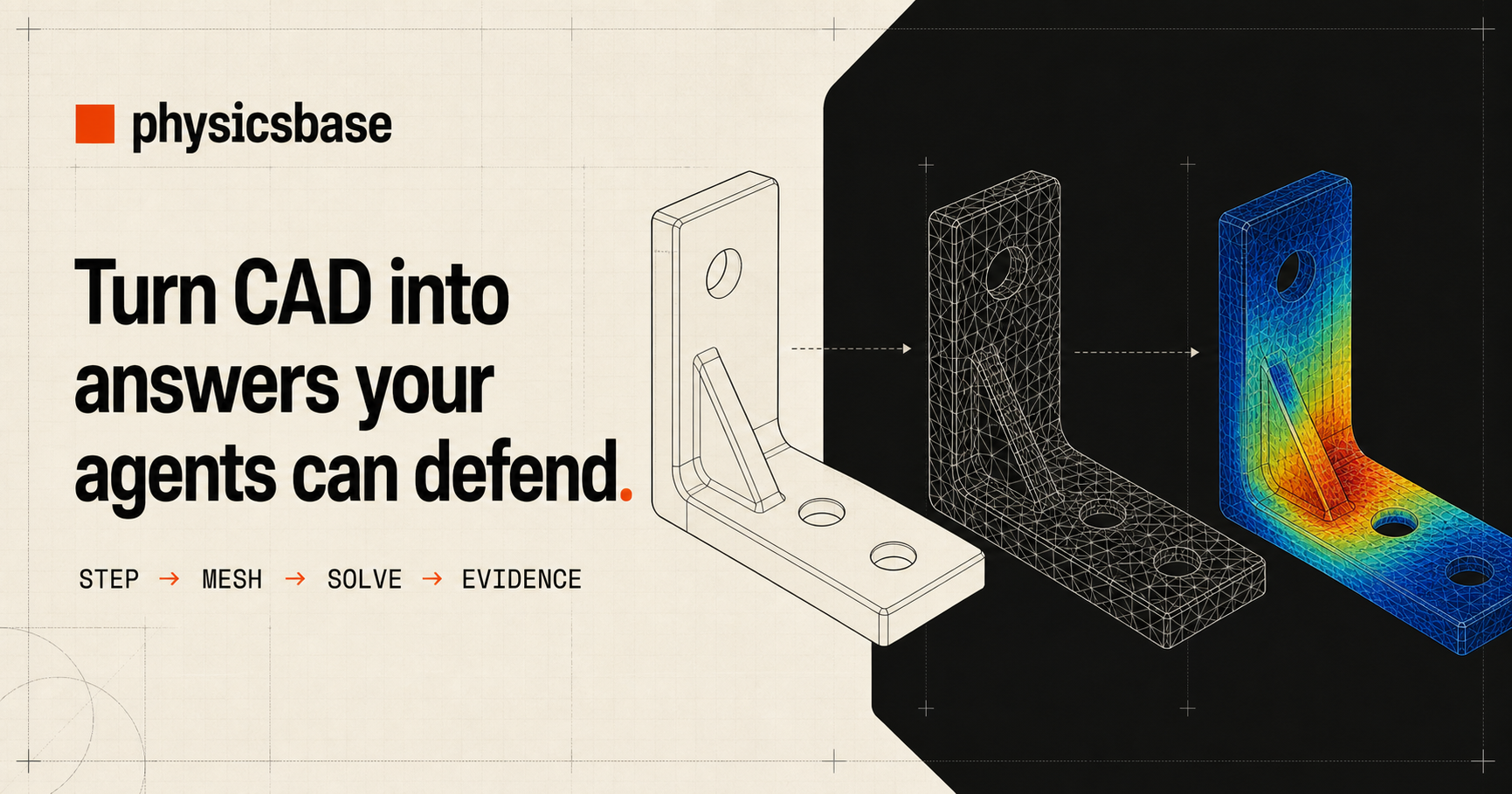
Physicsbase.ai provides simulation infrastructure for engineering AI. It enables AI agents to author, simulate, and verify designs using a unified API, handling meshing, solving, and numerical checks to return reusable models for iterative optimization.

How It Works

Your workflow, automated

1
Define Intent via API
Author geometry, materials, and loads programmatically or import existing CAD/solver files using the REST or Python API.
2
Execute Simulation
Submit the model to the API. Physicsbase handles meshing, solving, and numerical self-checks for the specified analysis type.
3
Iterate on the Result
Receive a complete, reusable model bundle. Your agent can inspect fields, check results, and modify the model for the next design loop.
Ready to automate your workflow with Physicsbase.ai?
Explore Physicsbase.ai →
Real Impact

Before & After

❌ Before

Manual, time-consuming simulation loops for each design change.

Hours per iteration
✅ After

Automated, agent-driven design, simulation, and optimization cycles.

Minutes per iteration
Social Proof

Trusted by professionals

Ease of Use
7.2
Accuracy
9.4
Value
8.5
Time Saving
9.2

"The ability to drive the solver via an API and get a reusable model back has transformed our optimization workflows. It's the execution layer for engineering AI we've been missing."

David R., Simulation Lead · June 2026

"We integrated Physicsbase to power our generative design agent. The emphasis on verification and evidence gives us confidence in the automated results."

Maria K., AI Systems Architect · May 2026

"A powerful engine for automation, but it's not a complete replacement for our existing tools yet. We're waiting for more advanced contact and nonlinear dynamics features for our specific use cases."

Chen W., Senior Mechanical Engineer · June 2026

"The Copilot is surprisingly effective. Describing a problem in plain English and getting back a fully solved, interactive model with checks is a massive time-saver for initial feasibility studies."

Sam B., R&D Engineer · April 2026
Connects With

Works with your existing stack

REST API Python OpenAPI MCP Claude GPT STEP IGES Abaqus .inp Nastran Gmsh VTK STL
Setup complexity: Developer-focused
Physicsbase.ai provides simulation infrastructure for engineering AI. It enables AI agents to author, simulate, and verify designs using a unified API, handling meshing, solving, and numerical checks to return reusable models for iterative optimization.
Comparison

How it compares

Physicsbase.ai vs. Scripting Ansys/Abaqus: Traditional solvers like Ansys or Abaqus can be scripted (e.g., using Python) for automation. This is powerful but often complex, requiring deep knowledge of the specific solver's commands and data structures. **Choose traditional scripting** if your team is already deeply invested in one ecosystem and needs its most advanced, niche features. **Choose Physicsbase.ai** when you need a modern, clean, API-first approach that is solver-agnostic and designed from the ground up for integration with AI agents, providing a consistent contract for various physics and returning reusable models for easier iteration.

The decision

Is it worth it?

Return on investment
By automating the design-simulate-verify loop that takes hours manually, a team could justify the subscription cost within months through accelerated project timelines.
Built for
Engineers, architects, and data scientists developing AI agents or automated workflows for structural analysis, design optimization, and physical simulation.
Effort to adopt
Developer-focused
Compliance
Compliance posture not publicly documented — verify with vendor.
Who It's For

Why Engineering & Architecture choose this tool

🎯
Built for
Best for automating finite element analysis (FEA) within AI-driven design loops, allowing agents to iteratively test and optimize structures.
In-Depth Overview
For engineers building automated design systems, Physicsbase.ai moves simulation from a manual bottleneck to an integrated, programmatic step. Instead of a traditional GUI, it provides a robust API that allows an AI agent to control the entire workflow: authoring geometry, defining materials and loads, and triggering a solve. Its key differentiator is the emphasis on verification and trust. Every result is returned with numerical self-checks and is backed by a library of over 987 documented test cases. This gives you the confidence to let an agent make decisions. The platform supports a wide range of analyses crucial for engineering—from static and dynamic structural analysis to nonlinear materials and thermal coupling. It ingests standard formats like STEP, Abaqus, and Nastran, fitting into existing toolchains. The new Copilot feature even allows natural language prompts to run the verified solver, speeding up initial feasibility studies. Ultimately, Physicsbase.ai isn't just another solver; it's the execution engine that enables true, agent-driven design optimization and verification at scale, returning a complete, editable model for the next loop, not a dead-end report.

Key Use Cases

🏗️
Automate Design Verification
Structural Engineer
Use an AI agent to automatically import a STEP file of a new bracket design, apply loads, and run a static analysis to check the safety factor against requirements.
Reduced verification time per design
🤖
Build a Design Optimization Loop
AI/ML Engineer
Create a workflow where an agent proposes geometric changes to a component, uses the Physicsbase API to solve for stress, and uses the results to inform the next design iteration.
Automated generative design
🔬
Explore Complex Nonlinear Behavior
R&D Scientist
Leverage the API to script simulations for snap-through analysis using arc-length continuation or study material plasticity without manual solver setup.
Faster feasibility studies
✓ Pros
Enables fully automated design-simulate-iterate loops for AI.
Extensive library of 40 analyses and 25 element types.
Strong emphasis on verification with 987+ numerical comparisons.
Supports major engineering formats like STEP, IGES, and Abaqus.
Returns reusable models, not dead-end reports or images.
· Cons
Not a standalone GUI tool; requires programming/API integration.
Advanced features like general contact and fluid-structure interaction are not yet implemented.
Some material models and dynamics for shells/beams are still in development.
Physical validation is explicitly 'not established,' relying on numerical verification.
⚡ Editorial Verdict

Physicsbase.ai is a powerful, developer-first platform for integrating real-world physics simulation into AI workflows. Its strength lies in the verified, reusable models it returns, perfect for automated optimization. The primary trade-off is its complexity; it's an API-driven tool for building systems, not a simple point-and-click solver for casual users.

Questions & Answers

Frequently asked questions

Does Physicsbase.ai work with existing CAD software?

+
Yes, it can import standard engineering formats including STEP, IGES, BREP, as well as solver formats like Abaqus (.inp), Nastran, Gmsh, VTK, and STL.

Is this a replacement for traditional FEA software like Ansys or Abaqus?

+
Not directly. Physicsbase.ai is an API-first infrastructure designed to be integrated into automated, AI-driven workflows. It's not a graphical, interactive desktop application for manual simulation.

What kind of physics can it simulate?

+
It supports a wide range, including structural analysis (static, modal, buckling), nonlinear behavior (plasticity, contact, large displacement), thermal analysis (conduction, coupled thermo-mechanical), and failure modes (fatigue, fracture).

How does the AI Copilot work?

+
The Copilot is an expert FEA agent, not a chatbot. You describe a structure and question in plain language, and it plans the analysis, calls the verified solver, and returns the answer in SI units with a PASS/REVIEW verdict and an interactive model.

How can I trust the results from Physicsbase.ai?

+
Every result includes self-checks for numerical validity (e.g., equilibrium balance). The platform is built on a foundation of evidence, with over 987 documented numerical comparisons against 181 definitions and published benchmarks for verification.

Can I use Physicsbase.ai for generative design?

+
Yes, it's designed for this. An AI agent can propose a design, use the API to solve and check it, and then use the returned, reusable model to inform the next iteration, creating a complete generative design loop.

Last reviewed:

Plans & Pricing

Start today

Prices and features are updated regularly but can change at any time — always confirm on the official website. Some links on this page are affiliate links.

See all 27 AI for Engineering & Architecture tools →
Free guide

Take it with you

  • **What is Physicsbase.ai?**
  • An API-first simulation engine for engineering AI.
  • Not a GUI, but an infrastructure layer for automation.
  • **Core Concepts:**
  • **Agent-Driven:** Your AI agent authors the design intent.
+10 more steps inside the guide
Send me the full guide

Get Physicsbase.ai deal alerts

Be the first to know when Physicsbase.ai drops a new discount, adds features, or changes pricing.

Exclusive Physicsbase.ai discount codes
New feature announcements
Best alternative picks when pricing changes
Zero spam — unsubscribe anytime
🎉
You're subscribed!
We'll notify you when Physicsbase.ai has a new deal.
AI Directory

About Physicsbase.ai

Full Description

Physicsbase.ai provides simulation infrastructure for engineering AI. It enables AI agents to author, simulate, and verify designs using a unified API, handling meshing, solving, and numerical checks to return reusable models for iterative optimization.

Editorial Verdict

Physicsbase.ai is a powerful, developer-first platform for integrating real-world physics simulation into AI workflows. Its strength lies in the verified, reusable models it returns, perfect for automated optimization. The primary trade-off is its complexity; it's an API-driven tool for building systems, not a simple point-and-click solver for casual users.

Last reviewed:
Disclaimer
Zekai is an independent AI tools directory. We are not affiliated with, endorsed by, or officially connected to Physicsbase.ai unless clearly stated. All product names, logos, and brands are the property of their respective owners and are used for identification purposes only. The information on this page — including pricing, features, and availability — is general information, may have changed since our last review, and is not professional advice. Zekai Scores and verdicts are our editorial opinion. Some outbound links are affiliate links that may earn us a commission at no extra cost to you. Spotted outdated or incorrect information? Request a correction →
Previous Tool Rendair AI
All AI Tools A–Z →
Physicsbase.ai8.6Try Physicsbase.ai ↗Next tool →
Today's top 3 AI for Engineering & Architecture tools →