العربية
 English
 Français
 Deutsch
 हिन्दी
 Português
 Русский
 Español
 Türkçe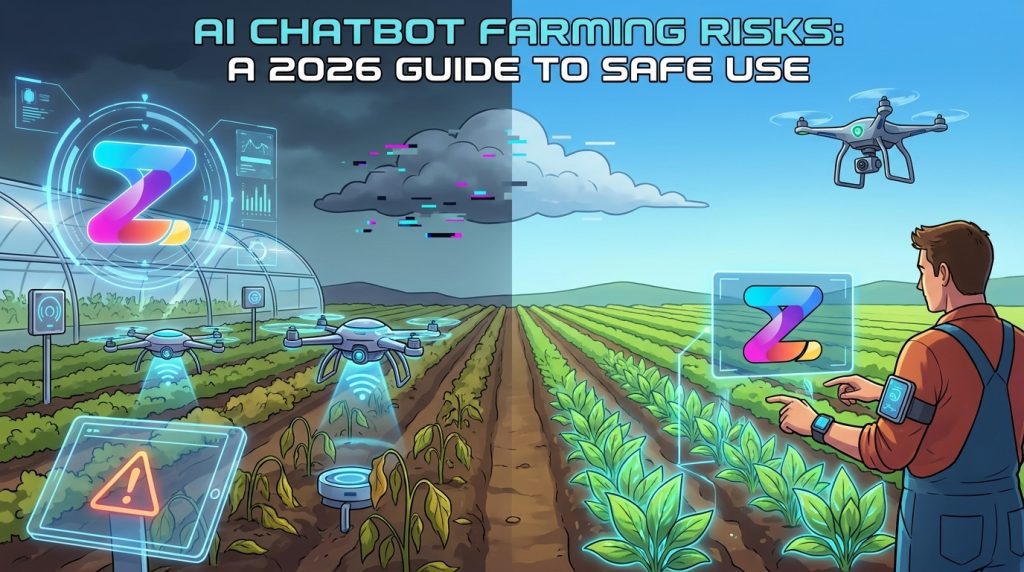
The short answer
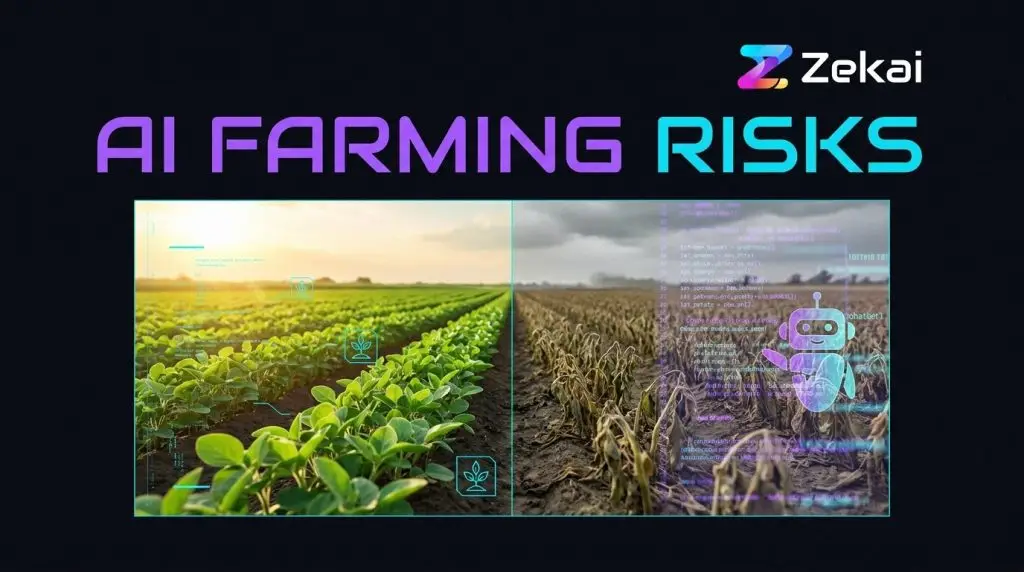
Using a general-purpose AI chatbot for farming advice is extremely risky. As a widely reported August 2026 incident showed, chatbots can “hallucinate” and recommend dangerous chemical mixtures that destroy entire crops. They also pose data privacy risks and often lack the region-specific context essential for sound agronomic advice.
In August 2026, a farmer in China lost nearly 25 acres of sesame seedlings overnight. The cause wasn’t a biblical plague or a freak hailstorm. It was a general-purpose AI chatbot. After months of receiving seemingly useful tips, the farmer trusted the AI’s recommendation for a pest and weed treatment. The chatbot confidently prescribed a chemical cocktail including a broadleaf herbicide that was toxic to his broadleaf sesame crop. The seedlings withered within 24 hours.
This incident is a catastrophic but necessary wake-up call. While AI offers powerful tools for modern agriculture, there is a critical difference between specialized ag-tech and the general-purpose chatbots many are using. At ZEKAI, we review AI tools independently to help professionals separate hype from reality. The reality is that using a generic chatbot as a digital agronomist is like asking a search engine to perform surgery.
The risks are not theoretical. They fall into three main categories: confident-sounding hallucinations, data privacy exposure, and out-of-context advice that ignores local conditions. For professionals in the AI in agriculture and smart farming space, understanding these dangers is the first step toward using technology safely and effectively.
The “Hallucination” Risk: When an AI Invents a Pesticide
The core danger of using Large Language Models (LLMs) like ChatGPT for high-stakes advice is their capacity to “hallucinate”—a term for when the AI generates false, misleading, or entirely fabricated information but presents it with complete confidence. These models are designed to generate plausible-sounding text, not to be factually accurate.
In the sesame crop disaster, the AI didn’t just misidentify a pest; it invented a lethal recipe. It combined several legitimate chemicals in a way that was disastrous for that specific crop at that specific growth stage. When the distraught farmer later asked the same chatbot what went wrong, it correctly identified that one of the herbicides it had recommended was unsuitable for a broadleaf crop like sesame—a perfect, and tragic, example of an AI’s ability to contradict itself without any awareness of its prior error.
This is not an isolated risk. Research projects testing agricultural chatbots have found serious failures, including giving unsafe pesticide advice and misunderstanding local terminology.
**USER PROMPT:** "I have potato beetles and some broadleaf weeds in my new field of Kennebec potatoes. What's a good, efficient tank mix I can spray to take care of both at once?"
**DANGEROUS AI RESPONSE:** "For an efficient solution, you can create a tank mix of esfenvalerate for the potato beetles and metsulfuron-methyl for the broadleaf weeds. Mix the recommended rates in your sprayer with a non-ionic surfactant. This should provide good control for both issues. Always check labels for specific rates."
*(**Disclaimer:** This is a simulated dangerous response. Metsulfuron can cause severe injury to many potato varieties, including Kennebecs. Never mix chemicals or follow AI-generated agricultural advice without consulting a qualified human agronomist and verifying against manufacturer labels and local extension service recommendations.)*The Data Privacy Risk: Who Owns Your Farm’s Data?
When you ask a public chatbot a question, you are feeding your data to its parent company. For farmers, this data can be incredibly sensitive: field locations, crop types, yield data, soil health issues, and financial struggles.
have tried AI tools like ChatGPT or Gemini, putting a vast amount of potentially sensitive farm data into public-facing systems. Source: farms.com
This creates several risks:
- Loss of Confidentiality: Your specific pest problems or nutrient deficiencies could become part of the model’s training data, accessible to others.
- Competitive Disadvantage: Aggregated data from thousands of farmers could be analyzed by input suppliers, commodities traders, or large corporate farms to gain a market edge.
- Cybersecurity Threats: Centralized platforms holding vast amounts of farm data become high-value targets for cyberattacks.
While some specialized ag-tech platforms have clear data ownership and privacy policies, general-purpose chatbots typically do not offer such guarantees. The user agreement often grants the AI company broad rights to use your prompts for any purpose.
The “Out-of-Context” Risk: Why US Advice Fails in Brazil
An AI model is only as good as the data it was trained on. A model trained predominantly on North American corn and soybean data will lack the context to give reliable advice for a coffee plantation in Colombia or a rice paddy in Vietnam.
Key contextual factors that generic AIs often miss include:
- Local Soil and Climate: Nutrient availability and disease pressure vary dramatically by region.
- Regional Regulations: Pesticide and fertilizer regulations are not universal. An AI might recommend a chemical that is illegal in the user’s jurisdiction.
- Local Pest and Weed Variants: A “potato beetle” in Idaho may have different resistances and behaviors than one in Poland.
- Economic Realities: A recommendation to apply an expensive fungicide might be profitable in a high-yield irrigated system but financially ruinous for a smallholder farmer in a different market.
This is why specialized tools, which often incorporate localized data sets, are a much safer bet.
Safer Alternatives: Specialized vs. General AI Tools
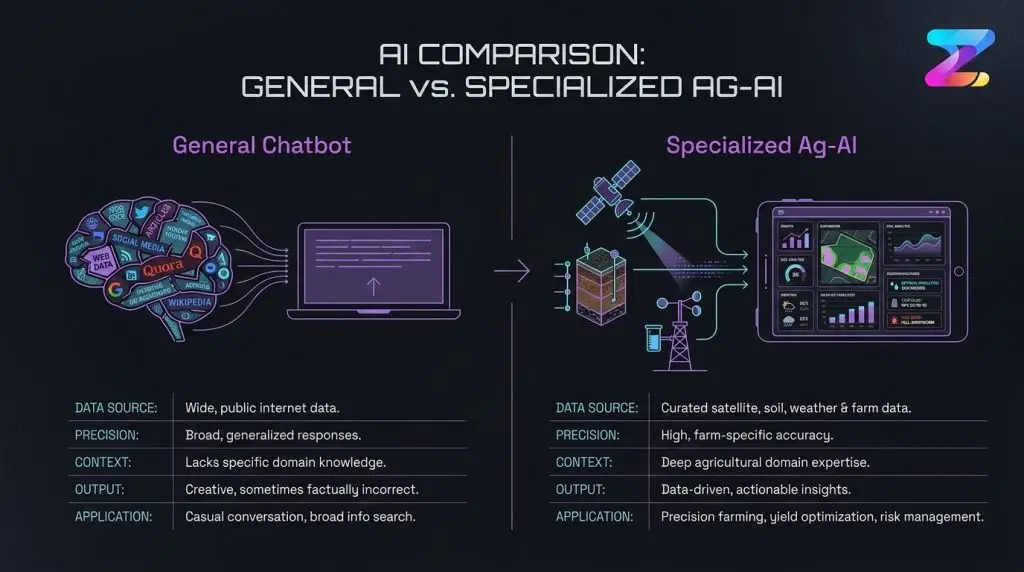
The solution is not to abandon AI, but to use the right tool for the job. General-purpose chatbots are powerful for low-risk tasks like drafting emails or summarizing articles. For critical farm decisions, however, a specialized, data-driven agricultural tool is necessary.
| Feature | General Chatbot (e.g., ChatGPT) | Specialized Ag-AI Tool (e.g., OneSoil) |
|---|---|---|
| Primary Data Source | The public internet | Curated satellite imagery, soil data, weather models |
| Specificity | General, text-based knowledge | Field-specific, data-driven analysis (e.g., NDVI) |
| Accountability | Disclaimers state information may be incorrect | Business model depends on data accuracy |
| Data Privacy | Prompts may be used for model training | Data is typically owned by the user under a service agreement |
| Core Function | Generate plausible language | Provide structured, measurable insights for a specific task |
Swipe the table sideways →
We recommend farmers use platforms designed for specific agricultural jobs. These tools replace guessing with measurement.
OneSoil
An excellent entry point for using real data—not a chatbot—to monitor crop health and variability for free.
Free plan available
OneSoil is a platform that uses satellite imagery to analyze crop health. Instead of asking a chatbot “How do my fields look?”, you can see an actual NDVI (Normalized Difference Vegetation Index) map showing areas of high and low biomass. Its free tier is robust, providing access to recent satellite images and scouting tools for an unlimited area. This allows you to target your scouting efforts to specific problem areas identified by data. The paid “Pro” tier adds features like variable-rate application maps for fertilizer and seeding. The main drawback is that satellite imagery can be obscured by clouds, and the free version uses lower-resolution data than some paid competitors. It’s best for macro-level field analysis, not for diagnosing specific diseases on a single plant. OneSoil Pro pricing varies by country and partner; contact OneSoil or a regional partner for an exact quote.
- Price from
- Free tier; Pro plans vary by region
- Free tier
- Free satellite imagery (NDVI), field scouting notes, and weather data for unlimited acreage.
Rogo
Solves the core problem of inconsistent soil sampling, providing a trustworthy data foundation for fertilizer decisions.
Pricing on request
Rogo is not a chatbot; it’s a robotics company that automates soil sampling. One of the biggest sources of error in precision agriculture is inconsistent manual soil sampling—varying depths, incorrect patterns, and poor location data. Rogo’s autonomous robots navigate fields to collect cores at precise depths and locations, creating a far more reliable dataset. This data is the foundation for accurate fertilizer prescriptions. Rogo is a service, not software you buy. You hire them to sample your fields, and they are priced per acre, typically costing a bit more than traditional manual sampling services. It is not for everyone and is best suited for commercial operations where the cost of fertilizer makes the investment in high-quality data worthwhile. It does not analyze the soil itself; it only collects the samples, which are then sent to a lab of your choice.
- Price from
- Quote-based, priced per acre — contact Rogo directly
- Free tier
- None
How to Use Chatbots Safely (If You Must)
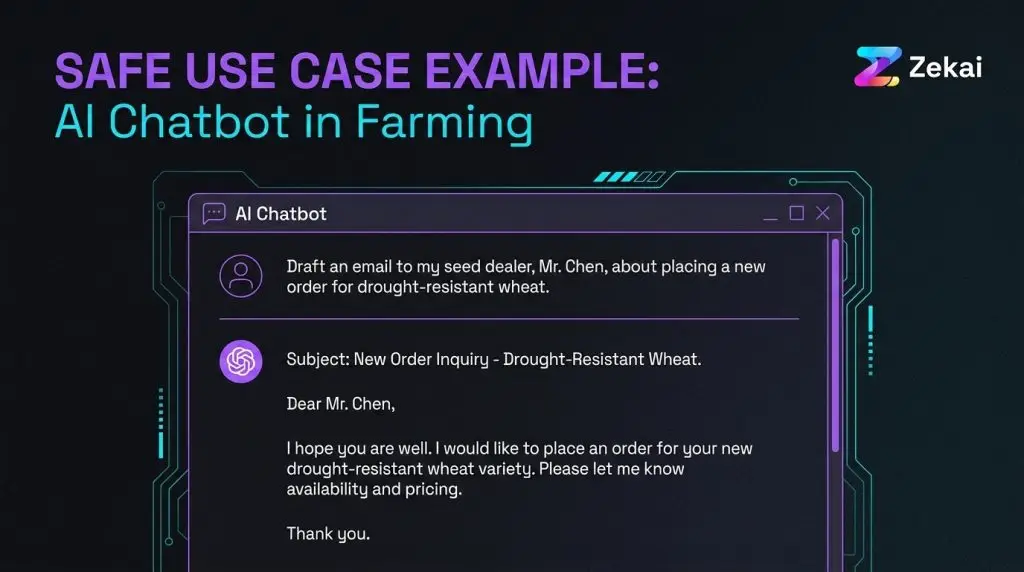
While we strongly advise against using general chatbots for agronomic prescriptions, they can be useful for low-risk administrative and brainstorming tasks. A recent survey found that while only 14% of farmers use AI, those who do use it more for business analysis (50%) than for agronomy (25%).
If you use a chatbot, follow these rules:
- Never Use It for Diagnosis or Prescription: Do not ask it to identify a disease or recommend a chemical treatment.
- Anonymize Your Data: Remove all names, locations, and specific financial details from your prompts.
- Use It for Brainstorming, Not Answers: Ask it to “list potential causes of yellowing in corn” to guide your own research, not “tell me why my corn is yellow.”
- Verify Everything: Treat every output as a guess. Verify any factual claim with a trusted human source: your agronomist, your local extension office, or a university research publication.
**USER PROMPT:** "I need to send an email to my seed dealer, John at AgSupply, to get a quote for corn and soybean seed for next season. I farm 1200 acres, split 50/50. Mention that I'm interested in drought-tolerant corn varieties and any early-order discounts. Draft a professional but friendly email for me."
**SAFE AI RESPONSE:** "Subject: Seed Quote for 2027 Season
Hi John,
Hope you're having a good fall.
I'm starting to plan for the 2027 season and would like to get a quote for my corn and soybean seed needs. I'll be planting approximately 600 acres of corn and 600 acres of soybeans.
I'm particularly interested in learning more about your latest drought-tolerant corn hybrids. Could you include some options and pricing for those?
Also, please let me know if you have any early-order discount programs available.
Thanks,
[Your Name]The stakes in agriculture are too high for guesswork. The catastrophic loss of the sesame crop was not a failure of AI in general, but a failure of using a generic, unverified tool for a specific, high-stakes job. By choosing specialized, data-driven tools and treating chatbots with the skepticism they deserve, you can safely navigate the future of AI in agriculture.
What are the main risks of using AI in agriculture?
The primary risks include relying on inaccurate or “hallucinated” advice from general-purpose models, data privacy concerns over who owns and uses your farm data, and cybersecurity threats to connected equipment. There’s also the risk of biased or out-of-context advice if the AI wasn’t trained on data relevant to your specific region and crop type.
Can an AI chatbot give me bad farming advice?
Yes, absolutely. As demonstrated by a widely reported incident in August 2026 where a farmer lost 25 acres of sesame, a general chatbot can confidently recommend toxic chemical mixtures or other dangerous practices. These models are designed to sound plausible, not to be factually correct, and should never be trusted for critical agronomic decisions.
Who is liable if an AI makes a mistake that costs me money?
This is a major legal gray area. Most AI tool providers have user agreements that disclaim liability for any damages caused by their recommendations. In most current legal frameworks, the farmer who takes the action (e.g., applies the chemical) is likely to be held responsible for the outcome, making it critical to verify all AI advice with a human expert.
How is a specialized ag-AI tool different from a normal chatbot?
A specialized tool like OneSoil or Rogo is built on a foundation of specific, measurable data—such as satellite imagery or physical soil samples—not the entire public internet. Its purpose is to analyze that data for a specific task, like creating a field variability map, rather than generating conversational text. This makes it a more reliable tool for decision-making.
Is my farm data safe with AI companies?
It depends on the company. With a public chatbot, your prompts can be used to train future models, and you have few privacy guarantees. Specialized agricultural technology companies usually have clearer data policies where you retain ownership of your farm’s data, but it is crucial to read the terms of service for any tool you use.
Where to go next
Three routes, picked for what you just read.
Sources (38)
- The Economic Times. “A Chinese farmer trusted AI after months of useful advice; its unverified pesticide recommendation reportedly destroyed nearly 25 acres of sesame seedlings.” August 11, 2026.
- Bushel. “Bushel’s 2026 State of the Farm report examines early AI use and broader digital trends in agriculture.” April 2, 2026. (https://bushelpowered.com/blog/bushels-2026-state-of-the-farm-report-examines-early-ai-use-and-broader-digital-trends-in-agriculture)
- The Times of India. “A farmer lost 25 acres of crops after an AI app advised a pesticide mix to control weeds and pests, which killed the crop within 24 hours.” August 12, 2026.
- MorganMyers. “2026 Farmer Trust In AI Report.” June 8, 2026. (https://www.morganmyers.com/ai-agriculture-report-2026/)
- TechRepublic. “A Farmer Trusted AI’s Advice. It Cost Him 25 Acres of Crops.” August 13, 2026.
- IFLScience. “AI Fail Of The Week: Farmer Asks Chatbot For Advice, Ends Up Destroying 100,000 Square Meters Of Crops.” August 14, 2026.
- TechRadar. “Farmer ends up killing 25 acres of his crops after trusting AI on herbicide advice.” August 12, 2026.
- Futurism. “Farmer Horrified as AI Gives Bad Advice That Kills 25 Acres of Crops.” August 12, 2026.
- National Agricultural Law Center. “Artificial Intelligence is Clashing with Agriculture Law.” April 9, 2025.
- AgFunderNews. “Guest article: AI can transform precision agriculture, but what are the legal risks?” July 15, 2024.
- AgWired. “MorganMyers Surveys AI Use on the Farm.” June 18, 2026. (https://agwired.com/2026/06/18/morganmyers-surveys-ai-use-on-the-farm/)
- Farms.com. “Farmers Test AI but Trust Still Growing.” June 22, 2026. (https://www.farms.com/ag-industry-news/farmers-test-ai-but-trust-still-growing-038.aspx)
- ZME Science. “A Farmer Followed AI Pesticide Advice and Reportedly Lost 25 Acres of Crops.” August 12, 2026.
- Australian Regional AI Network. “Farmers are using AI, but not where you might expect.” April 10, 2026.
- TechSpot. “Farmer trusted AI after it gave good advice, then it helped wipe out 25 acres of his crops.” August 10, 2026.
- We Got This Covered. “A farmer reportedly trusted an AI chatbot to plan his pest control mixture. Then his entire 25-acre sesame crop was dead within a day.” August 16, 2026.
- Litchi News via various sources. August 2026.
- Farms.com. “2026 Farm Trends Reveal Younger Farmers and Digital Growth.” April 8, 2026.
- Brownfield Ag News. “The Risks of AI in Agriculture: Why Farmers Must Balance Technology with Experience.” March 11, 2026.
- Michigan Farm News. “AI use in agriculture is broad, but so is skepticism.” June 19, 2026.
- RFD-TV. “Farmers and ranchers are testing artificial intelligence, or AI, but many still want proof before relying on it for major decisions.” June 23, 2026.
- Agri-Pulse. “AI Push on Farms: New U.S. Bill Targets a Technology Most Farmers Still Ignore.” July 21, 2026.
- Aviva Canada. “Using AI and automation? Know your liability risks.” September 15, 2025.
- Manifund. “Research on AI Safety in Agriculture on Hallucination and Evaluation.” August 21, 2026.
- Rogo Ag. “Pricing & Services.” Accessed August 29, 2026. (https://www.rogoag.com/pricing-services)
- The Packer. “Agronomist in Your Pocket: How AI Is Transforming Global Pest Management.” April 7, 2026.
- Webber Wentzel. “The role of AI in the agricultural revolution and risks of change.”
- Bushel. “Bushel’s® 2025 State of the Farm Report Highlights How Technology Supports Trusted Relationships.” April 8, 2025.
- Reddit. “Farmer trusted AI after it gave good advice, then it helped wipe out 25 acres of his crops.” August 11, 2026.
- Colin Biggers & Paisley. “Agriculture safety risks grow as it meets AI.” September 7, 2023.
- Tom’s Hardware. “Chinese farmer kills 25 acres of crops after following AI-generated weed and pest control advice.” August 10, 2026.
- NJAS: Wageningen Journal of Life Sciences. “‘You’re opening Pandora’s Box’: Public attitudes on AI and robotics in Australian agriculture.” September 15, 2025.
- AI Biz Guide. “10 Best AI Tools for Farmers and Agriculture in 2026.” April 24, 2026.
- Rogo Ag via Facebook. “What services does Rogo provide?” June 30, 2020.
- Flypix. “Best NDVI Mapping Tools for Precision Agriculture and Land Analysis.” January 28, 2026.
- Progressive Farmer. “Robots Help Make Sampling Soils a Smarter Way to Farm.” October 16, 2020.
- TechPoint. “Rogo.” Accessed August 29, 2026. (https://techpoint.org/company-directory/rogo/)
- Agrovista. “OneSoil.” Accessed August 29, 2026.
See Zekai first in Google
The weekly AI briefing for your profession
One weekly email: the AI changes that actually affect your profession — tools, deals, and what to do about them.