العربية
 English
 Français
 Deutsch
 हिन्दी
 Português
 Русский
 Español
 Türkçe
The short answer
No, AI will not replace most farmers or agronomists as of September 2026. Data shows only about 14% of U.S. farmers currently use AI, and primarily for financial analysis, not core agronomy. AI is augmenting work by automating narrow, repetitive tasks like precision spraying and disease scanning, not replacing the crucial on-farm judgment, complex problem-solving, and management roles that define modern agriculture.
The question of whether AI will replace farmers and agronomists is one of the most persistent anxieties in the industry. Most commentary offers a simple, reassuring “no” without much evidence. But to plan for the future, we need data, not just platitudes. At ZEKAI, we review AI tools independently, and our analysis shows the real story is more nuanced than a simple replacement narrative.
The data from 2026 clearly shows that AI is not taking over the farm. Instead, it’s being selectively adopted for specific business and operational tasks, changing the *how* of farming, not the *who*. For working professionals in the AI in Agriculture and Smart Farming space, understanding this distinction is critical for building a resilient career.
How Many Farmers Actually Use AI Right Now? (The Real Numbers)
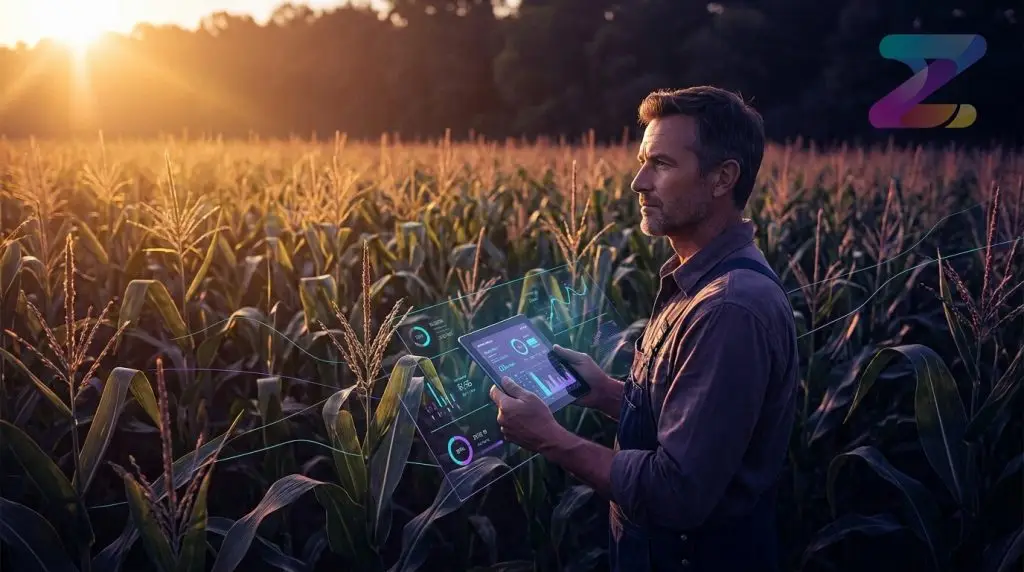
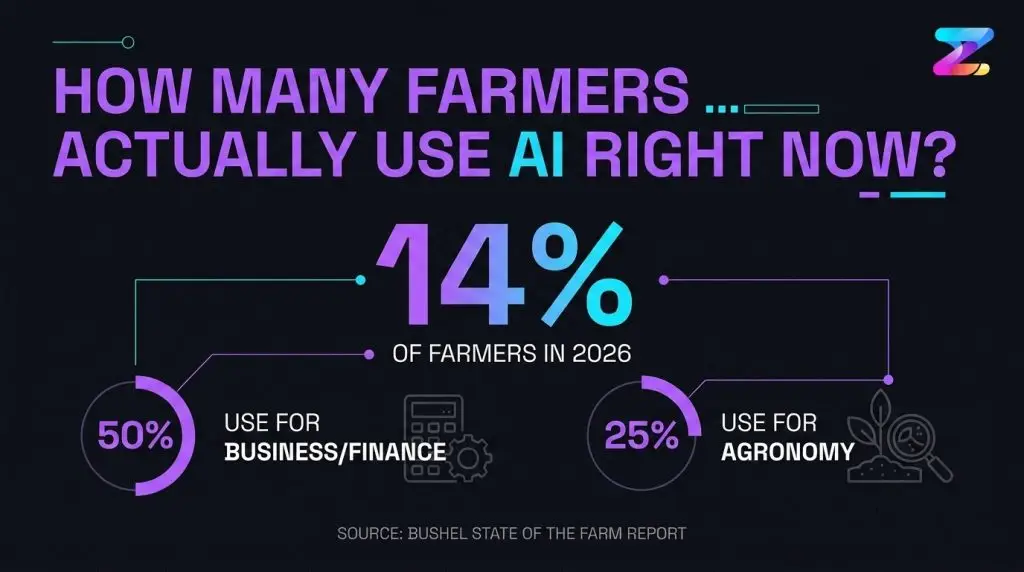
Despite the hype, on-farm AI adoption remains low. The most credible data comes from Bushel’s 2026 State of the Farm report, which surveyed over 1,400 producers across the United States and Canada.
report using AI tools on their farm today. Source: farms.com
This 14% figure shows that the vast majority of farmers are not using AI at all. A separate survey from MorganMyers and Ag Access in mid-2026 found that while a higher number—75%—had *tried* tools like ChatGPT, only about 48% of farmers use them weekly or more to support their business.
More telling is *what* the early adopters are using AI for. The narrative often focuses on futuristic field robots, but the reality is far more practical and office-based.
According to the Bushel report, among the farms that do use AI:
- 50% use it for business or financial analysis.
- Only 25% use it for yield prediction or agronomy.
This data paints a clear picture: as of September 2026, AI’s primary role on the farm is as a business analyst, not a digital agronomist. Farmers are using general-purpose AIs to model input costs, compare financing options, and draft business communications—tasks that happen at a desk, not in a field. This makes sense; these tools are readily available, require no special hardware, and offer an immediate return on time saved.
Which Tasks AI Is Already Automating (and Which It Isn’t)
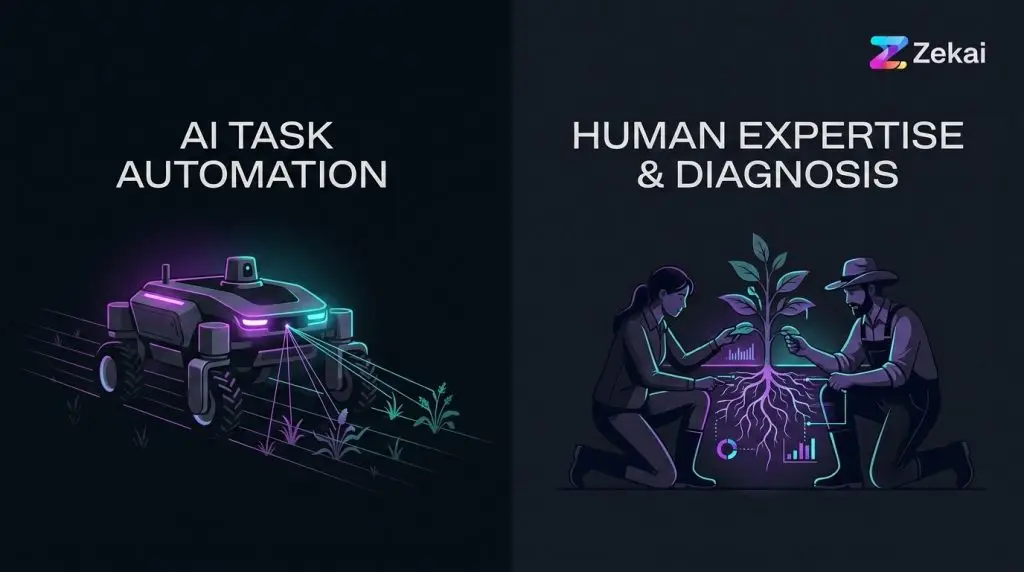
AI’s impact isn’t about replacing whole jobs; it’s about automating specific, well-defined tasks. The technology excels where decisions are based on clear data patterns and repetitive physical action. It struggles with complexity, context, and the unpredictable realities of a living ecosystem.
Here is where we see AI making the most significant inroads as of September 2026:
| Task Category | ✅ Tasks AI Is Automating | ❌ Tasks Requiring Human Judgment |
|---|---|---|
| Weed & Pest Control | Identifying and spot-spraying common weeds. | Diagnosing a novel blight or unusual pest behavior. |
| Irrigation | Adjusting water flow based on soil sensor data and weather forecasts. | Deciding whether to invest in a new irrigation system for a new crop. |
| Harvesting | Picking uniform, ripe produce in a controlled environment (e.g., strawberries). | Judging when to harvest a specialty crop with variable ripeness. |
| Data Analysis | Flagging anomalies in satellite imagery or yield maps. | Interpreting why an anomaly occurred and creating a multi-year recovery plan. |
| Record Keeping | Transcribing dictated field notes and logging chemical applications. | Developing a farm’s overall compliance strategy for new regulations. |
Swipe the table sideways →
The most mature examples of task automation are in precision application. Systems like John Deere’s See & Spray use computer vision to identify individual weeds in real-time and apply herbicide only to the weed, not the entire field. This automates the task of broadcast spraying, with John Deere reporting herbicide reductions of over 50%. Similarly, autonomous weeding robots from companies like Carbon Robotics use high-powered lasers to eliminate weeds without soil disturbance or chemicals. These tools replace the *task* of weeding, a job often done by manual labor or imprecise machinery, but they don’t replace the farmer who decides which fields to prioritize, when to run the machines, and how to integrate weeding into a broader crop health strategy.
What Agronomists Do That AI Still Can’t Replace: The Judgment Gap
While AI can diagnose a textbook case of corn leaf blight from a photo, it cannot replace the holistic expertise of a seasoned agronomist. The core of an agronomist’s value lies in navigating ambiguity and integrating dozens of variables—many of them unquantifiable.
AI models are trained on historical data. They are excellent at pattern recognition within that known data set. However, they are fundamentally poor at:
- Complex, System-Level Problem Solving: An agronomist connects seemingly unrelated issues—a weird patch in the north field, a late frost two seasons ago, a subtle change in the new seed variety’s performance, and the farmer’s risk tolerance—to form a diagnosis. An AI, working with siloed data, misses these connections.
- Tactile, Sensory Assessment: An experienced agronomist can diagnose soil compaction by feel, assess plant health by smell, and notice subtle changes in turgor pressure by touch. These are rich data streams that current sensor technology does not capture.
- Building Trust and Understanding Goals: A farmer’s relationship with their agronomist is a partnership. The agronomist knows the farmer’s financial situation, their appetite for risk, and their long-term goals for the land. They tailor advice accordingly. An AI provides a technically correct answer, not necessarily the *right* answer for that specific farmer in that specific situation.
- Adapting to Novelty: When facing an unprecedented weather event, a brand-new pest, or a supply chain disruption not present in its training data, an AI’s recommendations become unreliable. Human experts, by contrast, can reason from first principles and create novel solutions.
AI is a powerful advisory tool, but it is not a replacement for professional judgment. The agronomist of the future won’t be replaced by AI; they’ll be the one using AI to analyze data from tools like BeCrop faster, so they can spend more time in the field solving the complex problems the AI can’t.
Who’s Actually at Risk? Farm Owners vs. Hired Labor vs. Consultants
The impact of AI will not be felt evenly. Different roles on the farm face different levels of exposure to automation.
- Farm Owners & Managers: This role is the least at risk of replacement. In fact, AI is a powerful augmentation tool for them. It automates tedious back-office work, provides data for better decision-making, and frees up time for strategic management. The U.S. Bureau of Labor Statistics projects a slight decline in overall agricultural manager roles due to consolidation, but still anticipates around 85,500 openings per year, largely from retirements. The job isn’t disappearing; it’s evolving to become more data-centric.
- Hired Manual Labor (for repetitive tasks): This role is the most at risk. Tasks like manual weeding, thinning, and harvesting of uniform crops are prime candidates for automation by robotics and AI. This shift doesn’t necessarily mean mass unemployment, but rather a change in the type of labor needed—fewer people doing repetitive fieldwork and more people operating, maintaining, and managing the automated systems.
- Independent Agronomy Consultants: This role is in the middle, facing evolution, not extinction. Consultants who simply provide generic, textbook advice are at risk from AI-powered advisory tools. However, those who act as strategic partners, help farmers integrate new technologies, and provide the high-level, context-aware judgment that AI lacks will become more valuable than ever. The job shifts from being a source of raw information to being an interpreter of complex data and a strategic guide.
The Accountability Question: Who’s Liable When AI Gets It Wrong?
A critical barrier to replacing human judgment is the unresolved issue of liability. If an AI model recommends the wrong fertilizer mix and damages a crop, who is responsible?
- The farmer who followed the advice?
- The software company that developed the AI model?
- The data provider whose information trained the model?
Current legal frameworks are not equipped to handle these questions. Legal experts note that liability is often shared among manufacturers, developers, and operators, creating a complex and uncertain environment. In many cases, the contractual terms of the software place the ultimate responsibility on the user—the farmer. This “accountability gap” ensures that for any high-stakes decision, a human expert must remain in the loop to assume the final risk. Until laws evolve to clearly assign liability for AI-driven errors, full automation of critical farm management and agronomic decisions is impossible.
The Job Is Changing, Not Disappearing
AI will not replace the farmer or the agronomist. It will, however, change their jobs permanently. The most resilient professionals will be those who embrace AI as a tool to automate low-value tasks and augment high-value decision-making.
By 2028, we expect the most valuable skills in agriculture to be:
- Data Interpretation: The ability to critically analyze outputs from multiple AI systems and synthesize them into a coherent strategy.
- Technology Integration: Knowing which tools to use for which tasks and how to make them work together in a cohesive “stack.”
- Systems Thinking: Understanding the entire farm as a complex ecosystem, from soil biology to market dynamics.
The future of agriculture belongs to those who can master the technology without losing the human judgment that has always been at the heart of farming. To stay ahead of these trends, professionals should continue to explore the evolving landscape of AI tools for agriculture.
Will AI take over farming completely?
No, AI is not expected to take over farming completely. As of September 2026, adoption is low (around 14%) and focused on business tasks, not replacing core farm management. AI automates specific tasks but cannot replicate the critical thinking, problem-solving, and hands-on judgment required to manage a complex agricultural operation.
What farming jobs are most at risk from AI?
Jobs involving highly repetitive manual labor are most at risk. This includes tasks like hand-weeding, crop thinning, and harvesting uniform produce, which are increasingly being automated by robotics. Roles that require management, strategic decision-making, and complex problem-solving, like farm manager or agronomist, are the least at risk of being replaced.
Can AI replace the need for agronomists?
No, AI serves as a tool for agronomists, not a replacement. While AI can quickly analyze data and identify known patterns (like common diseases), it lacks the ability to solve novel problems, integrate complex variables from the real world, or build the trusted relationship necessary for effective consulting. The agronomist’s role is evolving to focus more on this high-level strategic judgment.
How many farmers are actually using AI?
According to a 2026 survey from Bushel, only 14% of farmers in the U.S. and Canada are currently using AI tools. A separate MorganMyers survey found that while more have experimented with AI, only about 48% use it on a weekly basis, mostly for office-based tasks like financial analysis and research.
What are the biggest barriers to AI adoption in agriculture?
The biggest barriers include the high cost of implementation for specialized hardware, limited rural connectivity, a lack of technical knowledge, and a significant trust gap. Many farmers remain skeptical about the reliability and economic value of AI-generated recommendations and are uncomfortable letting AI influence major farm decisions without human oversight.
Where to go next
Three routes, picked for what you just read.
Sources (34)
- ZEKAI. “AI for Farmers & Agronomists: The Complete 2026 Guide.” zekaiwork.com.
- Vertex AI Search result citing an article on Agriculture Law, April 9, 2025.
- Bushel. “Bushel’s 2026 State of the Farm report examines early AI use and broader digital trends in agriculture.” April 2, 2026.
- Australian Regional AI Network. “Farmers are using AI, but not where you might expect.” April 10, 2026.
- Gecić Law. “AI in Agriculture: Navigating Liability and Regulation.” July 27, 2023.
- Farms.com. “Farmers Test AI but Trust Still Growing.” June 22, 2026.
- MorganMyers. “2026 Farmer Trust In AI Report.” June 8, 2026.
- Unity Environmental University. “From Farm to Global Markets: Top Careers with a Master’s in Agribusiness.” September 4, 2025.
- EnvironmentalScience.org. “Agricultural Manager Career: Salary, Outlook & Education.” February 9, 2026.
- AgFunderNews. “AI Push on Farms: New U.S. Bill Targets a Technology Most Farmers Still Ignore.” July 21, 2026.
- Global Ag Tech Initiative. “AI in Agriculture: A Threat to Jobs or a Tool for Empowerment?” December 4, 2024.
- Farms.com. “2026 Farm Trends Reveal Younger Farmers and Digital Growth.” April 8, 2026.
- AgFunderNews. “Guest article: AI can transform precision agriculture, but what are the legal risks?” July 15, 2024.
- CMS.law. “AI in agriculture – contractual challenges.”
- JC Post. “Survey: AI Use Growing on U.S. Farms, but producers remain cautious.” June 22, 2026.
- AgFunderNews. “Many growers still find ‘no meaningful benefit’ from AI use on the farm: survey.” July 15, 2026.
- The Ponte Vedra Recorder. “About half of farmers and ranchers regularly use artificial intelligence tools…” June 26, 2026.
- Unity Environmental University. “How to Become a Farm and Ranch Manager.”
- Natural Resources for Human Health. “Civil Liability for Environmental Damages Arising from the Use of Artificial Intelligence…” August 27, 2026.
- Research.com. “2026 AI, Automation, and the Future of Agriculture Degree Careers.” July 16, 2026.
- U.S. Bureau of Labor Statistics. “Farmers, Ranchers, and Other Agricultural Managers.” May 2023.
- RFD-TV via Facebook. “Farmers and ranchers are testing artificial intelligence…” June 23, 2026.
- Successful Farming via Facebook. “About half of farmers and ranchers regularly use artificial intelligence tools…” June 25, 2026.
- Bushel. “Bushel’s® 2025 State of the Farm Report Highlights How Technology Supports Trusted Relationships.” April 8, 2025.
- Research.com. “2026 Agriculture Degree Careers Ranked by Salary, Growth, and Work-Life Balance.” July 20, 2026.
- UC Davis College of Engineering. “When It Comes to AI, Farmers Will Need to Strike a Balance.” September 7, 2023.
- Successful Farming via Facebook. “About half of farmers and ranchers regularly use artificial intelligence tools…” June 25, 2026.
- Choices Magazine. “Automation or Augmentation? AI and the Future of American Farming.”
- Reddit. “Anthropic says Agriculture work would be the least impacted by AI.” March 12, 2026.
- Automate.org. “From Soil to Tech: The Impact of Automation in Agriculture.” November 27, 2023.
- BPM. “AI in Agriculture: Pros, Cons and How to Stay Ahead.” September 12, 2025.
- MIT Climate Portal. “As labor costs rise, AI is learning to farm.” June 11, 2025.
- Agritecture. “Robotics, Automation & AI.”
- Agri Spray Drones. “3 Advantages of Incorporating Automation Into Agriculture.” July 17, 2025.
See Zekai first in Google
The weekly AI briefing for your profession
One weekly email: the AI changes that actually affect your profession — tools, deals, and what to do about them.