العربية
 English
 Français
 Deutsch
 हिन्दी
 Português
 Русский
 Español
 Türkçe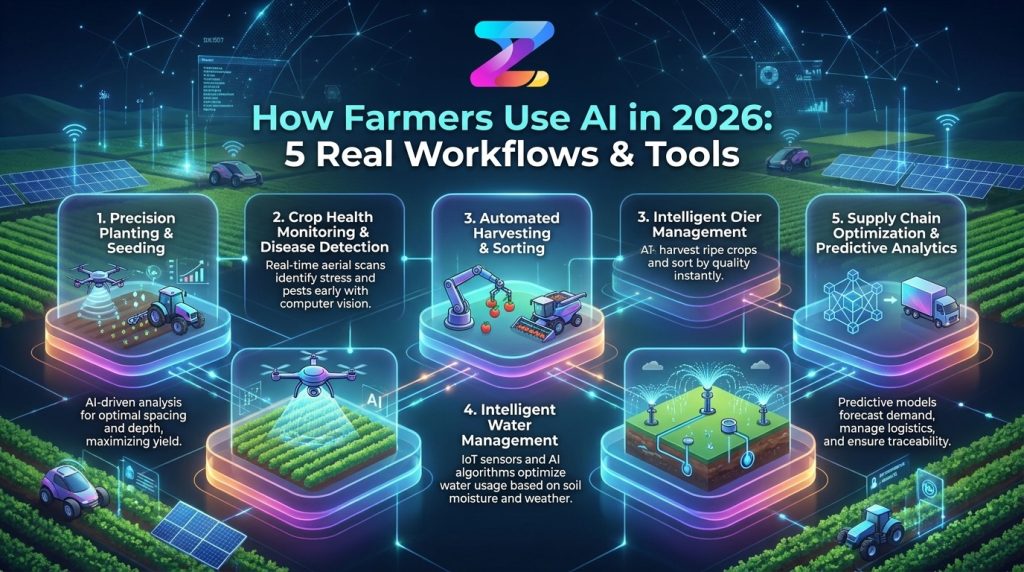
The short answer
As of 2026, about half of farmers who have tried AI use it weekly for practical tasks like equipment troubleshooting, drafting paperwork, and getting a “second opinion” on spray programs. The most effective workflows pair a general AI like ChatGPT with a specialized agricultural tool. For example, a farmer might identify a disease with a photo-scanning app, then use an AI chatbot to draft a regionally-specific treatment plan based on the result.
The conversation around artificial intelligence in farming is split between visions of fully autonomous farms and the reality of what works on the ground today. While headlines focus on futuristic robots, working farmers and agronomists are using currently available AI in more practical ways to save time, double-check decisions, and manage the mountain of data a modern farm generates. This isn’t about replacing intuition; it’s about augmenting it with powerful new tools.
At ZEKAI, we review AI tools independently to separate marketing hype from field-ready reality. This guide focuses on the workflows farmers are actually adopting, backed by the latest survey data. We’ll show you how to combine specialized agricultural platforms with general-purpose AI assistants to make better decisions this season. For a complete overview of AI’s role in the industry, visit our AI in Agriculture profession hub.
The State of AI in Agriculture: What the 2026 Data Shows
Adoption of AI on the farm is happening, but it’s concentrated on specific tasks and demographics. Different surveys show slightly different numbers, but they paint a consistent picture: AI is starting in the farm office, not necessarily in the field.
Source: farms.com
A 2026 survey from MorganMyers and Ag Access found that three-quarters of producers have experimented with AI tools like ChatGPT. Of those who have tried it, nearly half use it weekly. However, widespread trust is still developing, with only 24% of farmers stating they fully trust the recommendations AI provides.
Another key report provides a more conservative look at overall adoption.
Source: farms.com
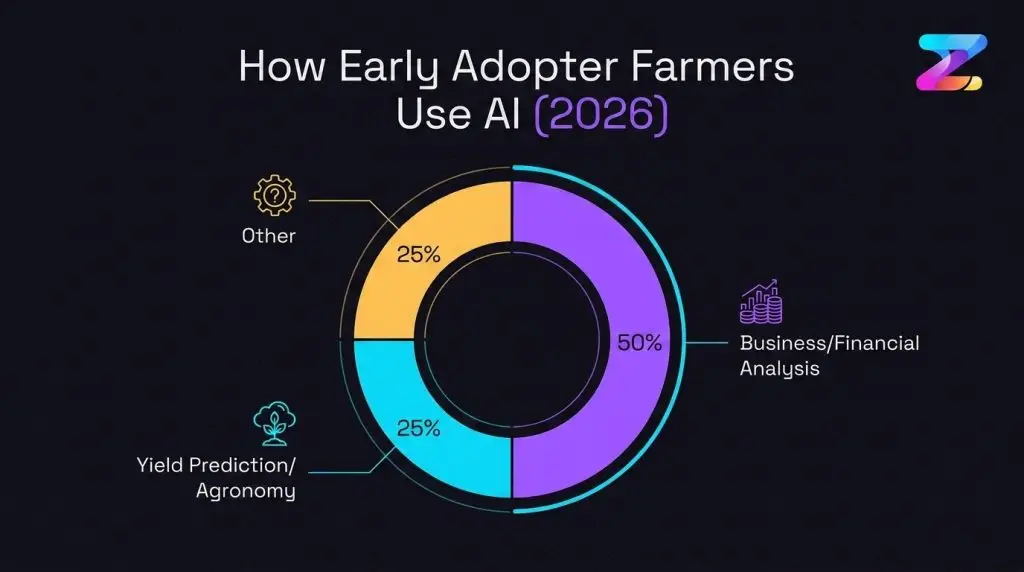
The Bushel 2026 State of the Farm report, which surveyed over 1,400 producers, found that only 14% of farmers use AI tools on their farm today. Among these early adopters, the primary use case is business and financial analysis (50%), with agronomic tasks like yield prediction trailing behind (25%).
This data tells a clear story: farmers are cautiously adopting AI as an assistant for research, planning, and administrative tasks. The highest-value workflows today aren’t about letting an AI run the farm, but using it to think better and work faster. You can find more data like this on our AI Statistics page.
Workflow 1: Equipment Troubleshooting & Maintenance Logs
When a planter acts up or a combine throws an obscure error code mid-harvest, time is critical. Digging through a 500-page PDF manual is slow and inefficient. This is one of the most common and practical uses for a multimodal AI assistant.
The workflow is simple:
- Capture the Problem: Take a clear photo or short video of the error code on the display, the broken part, or the unusual sound’s source.
- Query the AI: Upload the image to an AI assistant (like Google Gemini or OpenAI’s GPT-4o) with a specific prompt.
- Get a Plan: The AI can often identify the error code or part from the image and provide a step-by-step troubleshooting guide from its knowledge base of technical manuals.
- Log the Fix: After completing the repair, dictate a few sentences describing the problem and the solution. The AI can parse this into a clean, dated entry for your maintenance records. This workflow is designed to reduce downtime compared to manually searching a service manual.
This error code (see attached image) appeared on my John Deere S780 combine. The model year is 2024. Based on the image and model, identify the error code, explain the most likely causes, and provide a step-by-step guide for a field repair. List the specific tools I will need.This approach turns your phone into an interactive service manual that understands what it’s looking at. It’s most valuable for owner-operators and farm mechanics, but remember that an AI cannot replace the hands-on skill of a qualified technician and can sometimes be wrong. Always use its advice as a starting point, not a final command.
Workflow 2: Spray Program & Chemical Application Checks
Tank mixes, application rates, and regulatory compliance are complex and high-stakes. While your agronomist and the product label are the final authorities, an AI can serve as a powerful final check to catch potential mistakes.
Farmers are using LLMs to:
- Check Compatibility: “Can I tank mix Brand X fungicide with Brand Y insecticide and a liquid boron supplement for application on soybeans at the R3 stage?”
- Calculate Rates: “My field is 120 acres. The label rate for Product Z is 12 fl oz/acre. My sprayer tank holds 1,000 gallons and my application rate is 15 gallons/acre. How much Product Z do I need for the field, and how much do I add per tank?”
- Verify Nozzle Selection: “For applying a systemic herbicide at 10 GPA and a ground speed of 12 MPH, what A.I. XR flat-fan nozzle size is recommended to maintain a medium droplet size?”
The key is to force the AI to cite its sources and constrain it to reliable information, a technique validated by university extension specialists.
Act as a certified crop advisor. I plan to spray [Product Name] on [Crop] at the [Growth Stage]. My goal is to control [Pest/Disease]. The proposed rate is [Rate per acre].
1.  Confirm this use case is on the label.
2.  List any potential tank-mix antagonisms with [List other products].
3.  Summarize the key personal protective equipment (PPE) requirements from the label.
**IMPORTANT:** Restrict your answers *only* to information found in official manufacturer product labels and peer-reviewed land-grant university extension publications from the last 5 years.This is not about getting AI to make a decision for you. It’s about using it to challenge your own plan and catch a simple oversight before it becomes a costly problem. We encourage farmers to test their own challenging prompts in our AI Challenge section.
Workflow 3: Field Scouting with an LLM “Second Opinion”
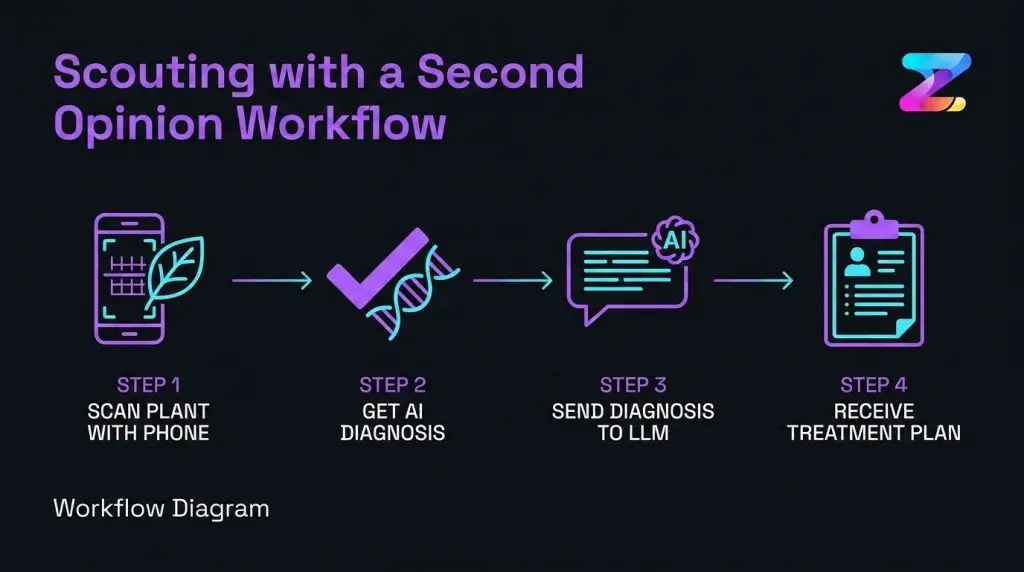
Specialized crop scouting apps are excellent at identifying a potential disease from a photo. But identification is only the first step. The next questions are: What’s the economic threshold for treatment? What are the best IPM (Integrated Pest Management) strategies? What are the recommended products for my specific region?
This is a perfect workflow for combining a specialized AI tool with a general one.
- Scan & Identify: Use a dedicated app like Plantix (free) or a drone-based system to get a fast, accurate identification of a potential disease or pest.
- Export the Diagnosis: Take the result from the scouting app (e.g., “Northern Corn Leaf Blight, 92% confidence”).
- Query the LLM for a Plan: Feed that specific diagnosis into a well-constructed prompt in a general AI chatbot to develop an actionable plan.
I have a confirmed diagnosis of Northern Corn Leaf Blight in my cornfield in central Iowa, currently at the VT (tasseling) growth stage.
1.  What is the economic threshold for treatment at this stage?
2.  List three recommended fungicides for my region, including their efficacy ratings and pre-harvest intervals.
3.  Besides spraying, what are two IPM strategies I should consider for managing this disease now and in future seasons?
Restrict your answers to information from Iowa State University Extension, Purdue University Extension, and the University of Illinois Extension.This workflow respects the strengths of each tool. The specialized app does the high-accuracy visual identification, and the general LLM acts as a research assistant to build out a management plan based on trusted, regional sources.
Workflow 4: Turning Soil Data into a Nutrient Plan
A standard soil test provides the numbers, but a modern biological analysis can tell you the *why* behind them. Services that analyze the soil microbiome are giving farmers a deeper understanding of nutrient cycling, disease pressure, and overall soil function.
BeCrop
Provides deep microbial insights beyond what a standard chemical soil test can offer.
Pricing on request
- Price from
- Quote-based — a 2023 report cited ~$199/sample
- Free tier
- Portal access reportedly available; confirm details with Biome Makers
BeCrop by Biome Makers is a leader in this space. They use DNA sequencing and an AI platform to analyze the bacteria and fungi in your soil, providing reports on everything from nutrient pathways (how well your soil makes phosphorus available) to risks from soil-borne diseases. A 2023 report noted the cost is around $199 per test.
The AI workflow here involves taking that complex biological data and making it actionable.
- Analyze the Microbiome: Submit a soil sample to a service like BeCrop.
- Identify Limiting Factors: Use the platform’s AI-generated report to pinpoint key issues—for example, a deficiency in microbes that solubilize potassium or high pressure from Pythium.
- Prompt for a Solution: Use these specific, data-backed findings to create a prompt for an LLM or to discuss with your agronomist.
My BeCrop soil report (for a field intended for soybeans) shows low levels of phosphorus-solubilizing microbes and a high-risk index for Sudden Death Syndrome (SDS). My target yield is 70 bu/acre.
1.  Recommend three commercially available biological products or soil amendments known to increase phosphorus solubilization.
2.  What in-furrow or seed treatment strategies are most effective for mitigating SDS risk based on this data?
3. How should I adjust my starter fertilizer plan in light of the microbial deficiency?This workflow moves beyond generic recommendations to a plan tailored to the unique biological engine of your specific field.
BE Tool review BeCrop — read our full review Pricing, free tier and where it falls shortWorkflow 5: Automating Paperwork and Compliance by Voice
Farming involves a staggering amount of record-keeping for compliance, certifications, and insurance. Many farmers are finding that AI assistants can act as a personal secretary, turning scattered field notes into structured data. This process is designed to save time on administrative work during the growing season.
The workflow leverages the voice-to-text capabilities on every smartphone.
- Dictate Notes: Throughout the day, use a simple voice memo app to record observations. For example: “August 29th, sprayed Field B4 with Brand X fungicide at 10 ounces per acre. Wind was 5 miles per hour from the southwest. Saw some evidence of Japanese beetles on the west edge.”
- Consolidate and Paste: At the end of the week, send the audio files through a transcription service or simply copy the transcribed text from your phone. Paste the raw, unstructured text into an AI chatbot.
- Prompt for Structure: Ask the AI to organize the information.
Parse the following dictated field notes. Create a Markdown table with columns for: 'Date', 'Field ID', 'Activity', 'Products Used', 'Rate', 'Weather Conditions', and 'Scouting Observations'. Fill the table with the information from the notes below. After the table, write a brief narrative summary suitable for a weekly compliance report.
[Paste raw notes here]This simple process transforms messy audio notes into a clean, searchable, and usable log for everything from FSA reporting to conversations with your crop insurance agent. It bridges the gap between what you see in the field and what you need on paper.
Why Half of Farmers Still Don’t Trust AI
Despite the practical workflows, the data shows significant skepticism remains. The MorganMyers survey noted that while many farmers are experimenting with AI, only 24% fully trust its recommendations. This isn’t just resistance to new technology; it’s a rational response to the current limitations of AI.
- Lack of “Ground-Truthing”: An AI has never walked a field after a hailstorm or felt the soil texture between its fingers. It lacks the physical, embodied knowledge that is core to farming expertise.
- The Risk of “Hallucinations”: LLMs are designed to generate plausible text, not to be factually perfect. They can invent product names, misstate application rates, or confidently give incorrect advice. This makes the “restrict to sources” prompt strategy essential.
- Liability and Accountability: If an AI recommends a tank mix that damages a crop, who is liable? The farmer? The AI developer? The data source? This question is largely unanswered and creates a major barrier to using AI for high-stakes decisions.
- Data Privacy: Farm data is highly sensitive business information. Concerns about how and where data is stored and used by large tech companies are valid and often slow adoption.
Successful AI adoption on the farm means treating it as a capable but flawed assistant, not as a replacement for the farmer or agronomist. For a deeper dive into the future of these roles, visit our AI in Agriculture profession hub.
What is the best AI for agriculture?
It depends on the task. For disease identification from a photo, Plantix is a strong, free option. For deep soil analysis, BeCrop offers microbial insights. For day-to-day questions, troubleshooting, and drafting, a general AI assistant like ChatGPT or Gemini is most effective, especially when constrained to reliable agricultural sources.
Can AI predict crop yield?
Yes, AI models can predict crop yield with increasing accuracy. They do this by analyzing vast datasets including historical yield data, satellite imagery (like NDVI), weather patterns, and soil conditions. However, predictions are probabilistic and can be affected by unpredictable events like pest outbreaks or extreme weather late in the season.
What are the disadvantages of AI in agriculture?
The main disadvantages are the high initial cost of some technologies (like robotics), a dependency on reliable internet connectivity which is lacking in many rural areas, and data privacy concerns. Furthermore, AI models can be wrong, and the liability for bad recommendations is a significant, unresolved issue.
How are robotics used in agriculture?
Robotics are used for labor-intensive and repetitive tasks. This includes autonomous tractors for tillage and planting, robotic arms for harvesting delicate produce like strawberries, drones for targeted spraying, and autonomous weeders like the Saga Robotics Thorvald that use UV light or lasers to kill weeds without chemicals.
Will AI replace farmers or agronomists?
No, current data suggests AI will augment, not replace, farmers and agronomists. AI is automating narrow tasks like spraying or identifying weeds, but it cannot replicate the holistic judgment, systems-thinking, and hands-on expertise required for farm management. It is changing the job, not eliminating it.
How can small farms afford AI?
Small farms can start with a range of powerful and free AI tools. The Plantix app offers free disease diagnosis, OneSoil provides free satellite field monitoring, and general AI chatbots like ChatGPT have free tiers perfect for research and paperwork. The key is to leverage these free software tools before investing in expensive hardware.
Where to go next
Three routes, picked for what you just read.
Sources (36)
- Bushel. “2026 State of the Farm report.” bushelpowered.com/state-of-the-farm
- ArXiv. “AgriCruiser: An Open Source Agriculture Robot for Over-the-row Navigation.” arxiv.org
- International Wine Challenge. “Updated robot roams French vineyards.” internationalwinechallenge.com
- AIMS Press. “Artificial intelligence on the agro-industry in the United States of America.” aimspress.com
- Farms.com. “Bushel’s 2026 State of the Farm report reveals important changes in North American agriculture.” farms.com
- MorganMyers. “Agriculture Archives.” morganmyers.com
- Farms.com. “Farmers Test AI but Trust Still Growing.” farms.com
- Fast Company. “Why the industry that feeds 8 billion people still can’t read its own data.” fastcompany.com
- Bushel. “Bushel’s® 2025 State of the Farm Report Highlights How Technology Supports Trusted Relationships.” bushelpowered.com
- Saga Robotics. “Saga Robotics secures USD 11,2 Million as Thorvald enters commercial breakout phase.” sagarobotics.com
- Facebook. “Bushel’s 2026 State of the Farm report shows an increase…” facebook.com
- Agurotech. “Frequently Asked Questions.” agurotech.com
- Midwest Laboratories. “Soil DNA Analysis.” midwestlabs.com
- Precision Farming Dealer. “2026 State of the Farm Report Examines Early AI Use…” precisionfarmingdealer.com
- Taylor & Francis. “An interdisciplinary approach to artificial intelligence in agriculture.” tandfonline.com
- Agurotech. “general terms & conditions – agurotech monitoring & decision support system.” agurotech.com
- EU-Startups. “10 promising European startups leading precision agriculture.” eu-startups.com
- Grain Data Solutions. “Generative AI and Agriculture: A New Era of Farming Efficiency.” graindatasolutions.com
- PitchBook. “Verdi 2026 Company Profile: Valuation, Funding & Investors.” pitchbook.com
- Facebook. “Join Eastern Chapter and Greg Ehm with Meyocks on Sept 28…” facebook.com
- AgFunderNews. “Saga Robotics raises $11.2m to expand fleet of ‘bots…” agfundernews.com
- Silicon Canals. “Oslo’s Saga Robotics nets €9.5M for ‘berry’ big boost to its farm bot.” siliconcanals.com
- Farm Progress. “3 reasons to consider biological soil testing.” farmprogress.com
- Versa. “AI Powered ERP Pricing 2026 – Simple & Affordable.” versaclouderp.com
- Verdi. “Easy and Affordable Precision Irrigation Automation.” verdi.ag
- Biome Makers. “BeCrop Farm: The Precision Agriculture Tool for Retailers and Farmers.” biomemakers.com
- SVG Ventures | THRIVE. “Verdi raises $6.5M to bring automation to aging farm infrastructure.” thriveagrifood.com
- Preprints.org. “Agricultural Intelligence: A Technical Review…” preprints.org
- GeekWire. “Irrigation tech startup Verdi raises $4.7M…” geekwire.com
- Biome Makers. “Biome Makers Releases 2024 Impact Report…” biomemakers.com
- Facebook. “American Farm Bureau explores artificial intelligence in agriculture.” facebook.com
- Euractiv. “Extreme weather events are disrupting farming predictability, AI can help.” euractiv.com
- Navus Ventures. “Navus reinvests in Blue Radix…” navus.ventures
- AgFunderNews. “Soil biology specialist Biome Makers bags $15m Series B funding.” agfundernews.com
- Facebook. “The use of artificial intelligence is growing…” facebook.com
- Facebook. “If you don’t mind signing this petition…” facebook.com
See Zekai first in Google
The weekly AI briefing for your profession
One weekly email: the AI changes that actually affect your profession — tools, deals, and what to do about them.