العربية
 English
 Français
 Deutsch
 हिन्दी
 Português
 Русский
 Español
 Türkçe
The short answer
The best AI prompts for farmers are specific, source-aware, and tool-aware. Instead of asking generic questions, name your crop, region, and data, then restrict the AI to reliable agricultural sources. Below are 25 ready-to-use prompts for crop planning, pest ID, soil fertility, market timing, and equipment maintenance, tested to work with today’s AI tools.
Generic AI prompts give generic, often unreliable, advice. For a working farm, that’s not just unhelpful—it’s dangerous. Competitors’ lists of “AI prompts for farmers” are filled with vague templates that require you to fill in bracketed information you may not have, and they rarely tell the AI *where* to look for credible answers.
This is different. We’ve built a library of prompts that are copy-paste ready, with realistic examples you can adapt in seconds. More importantly, we’ve integrated a “reliability wrapper”—a technique adapted from university extension research—to force general AI tools like ChatGPT or Gemini to cite their sources and prioritize data from land-grant universities and cooperative extensions. ZEKAI is an independent AI tools directory; we make these guides to help working professionals use AI effectively, and you can learn more about our mission at our AI in agriculture hub.
The Reliability Trick: How to Stop AI From Guessing
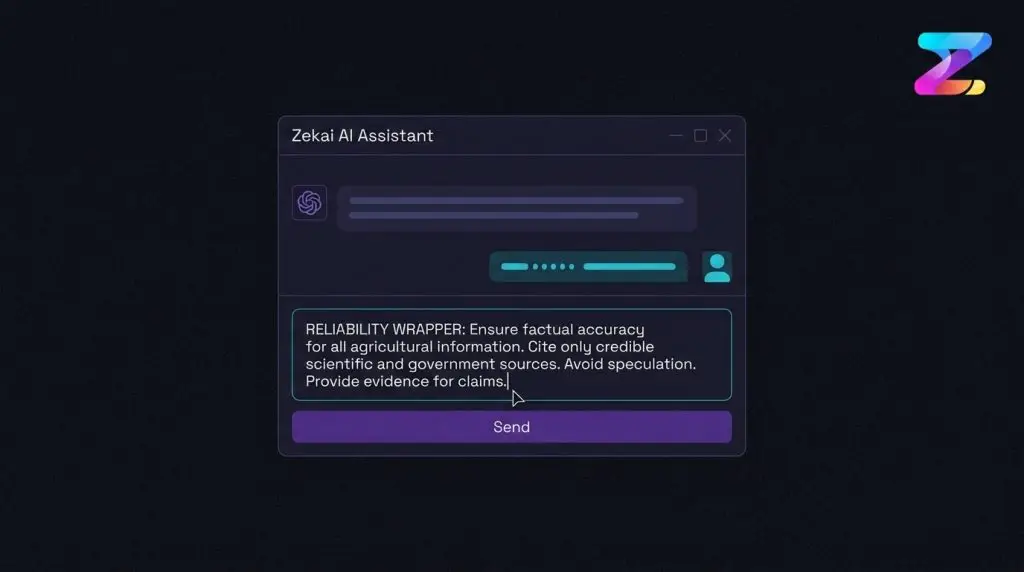
Before the prompts, here is the single most important technique. Researchers at NC State University’s Cooperative Extension found that you can dramatically improve the quality of AI answers by telling it *where* to look for information. By default, an AI searches the whole internet, mixing trusted research with blogs and marketing content. This prompt forces it to prioritize trustworthy sources.
Conduct a web search restricted exclusively to Cooperative Extension and Extension Service publications from U.S. land-grant universities. Use only fact sheets, bulletins, crop guides, and applied research reports from these sources.
Then, answer the following question, giving priority to recommendations developed under conditions most relevant to [Your State or Region] using the following hierarchy: [Your State], then neighboring states in the [Your Region, e.g., Southeast, Midwest], then the broader [e.g., southern U.S.].
If you cannot find a relevant answer within these sources, state that clearly. Do not use information from commercial websites, forums, or blogs.
My question is: [Your Question Here]You can wrap almost any query from the list below inside this prompt to get more reliable, science-backed answers.
6 Prompts for Crop Planning and Variety Selection
Effective planning starts with the right data. These prompts help you model scenarios, compare varieties, and build a resilient crop rotation schedule.
Act as an agronomist specializing in integrated pest management (IPM) for central Illinois. I am planning a 4-year crop rotation for a 150-acre field. My primary cash crops are corn and soybeans. The field has a history of moderate soybean cyst nematode (SCN) pressure and some corn rootworm. My soil is primarily a mix of Drummer silty clay loam and Flanagan silt loam.
Generate a 4-year rotation schedule that includes at least one non-host crop for SCN and a strategy to manage corn rootworm, such as rotating insecticide traits or including a different crop. For each year, specify the crop, the justification for its placement in the rotation, and one key management consideration.I am choosing between two soybean varieties for next season in Black Hawk County, Iowa: Variety A (Enlist E3, PI 88788 SCN resistance) and Variety B (XtendFlex, Peking SCN resistance).
Search for 2024 and 2025 university variety trial data from Iowa State University and neighboring state extensions (e.g., University of Illinois, University of Nebraska). Summarize the yield performance of varieties with these trait packages in my region. Create a table comparing the two for yield potential, weed control flexibility, and SCN management effectiveness, assuming I have SCN populations that are showing some resistance to PI 88788. Conclude with a recommendation based on this data.I am a no-till corn and soybean farmer in southern Minnesota. I want to plant a cover crop after soybean harvest this fall, ahead of planting corn next spring. My primary goals are to scavenge residual nitrogen, improve soil structure, and suppress winter annual weeds. My soil is a Nicollet clay loam. I need to be able to terminate the cover crop chemically about two weeks before planting corn.
Recommend a cover crop species or a simple two-way mix. Justify your recommendation based on my goals, climate, and termination plan. Provide the recommended seeding rate (lbs/acre) and an ideal planting window for my region."
</PROMPT-CARD>of farmers use AI tools like ChatGPT weekly or more to support their business operations, according to a June 2026 report from MorganMyers. Source: morganmyers.com
Act as a farm business analyst. I need to decide on a corn seeding rate for a 200-acre irrigated field in southern Nebraska. My seed cost is $320 per bag of 80,000 seeds. The corn price is projected to be $4.50 per bushel.
Based on University of Nebraska-Lincoln research, assume the following yield response to population:
- 28,000 plants/acre: 230 bu/acre
- 32,000 plants/acre: 245 bu/acre
- 36,000 plants/acre: 255 bu/acre
- 40,000 plants/acre: 258 bu/acre
Create a table showing the seeding rate, seed cost per acre, gross revenue per acre, and margin over seed cost per acre for each population. Which seeding rate provides the highest economic return?"
</PROMPT-CARD>I am considering intercropping soybeans into my 30-inch row corn on a trial basis in eastern South Dakota. My corn planter is a John Deere 1775NT. I would need to modify it or use a different machine for the soybeans.
Analyze the feasibility of this practice. Summarize research from SDSU Extension or other Midwest universities on corn-soybean intercropping. Cover the potential benefits (e.g., land equivalent ratio, soil health), the major challenges (e.g., equipment modifications, herbicide compatibility, harvest complexity), and provide a list of 5 key questions I should ask my equipment dealer and agronomist before proceeding."
</PROMPT-CARD>Analyze the 10-year climate change projections for Story County, Iowa, focusing on changes in average summer temperatures, total precipitation, and the frequency of extreme rainfall events.
Based on these projections, generate a list of 5 potential adaptation strategies for a corn and soybean operation. For each strategy, explain the climate risk it addresses and the first practical step I could take to implement it. Examples could include changes in tile drainage, crop genetics, or tillage practices."
</PROMPT-CARD>5 Prompts for Pest and Disease Triage
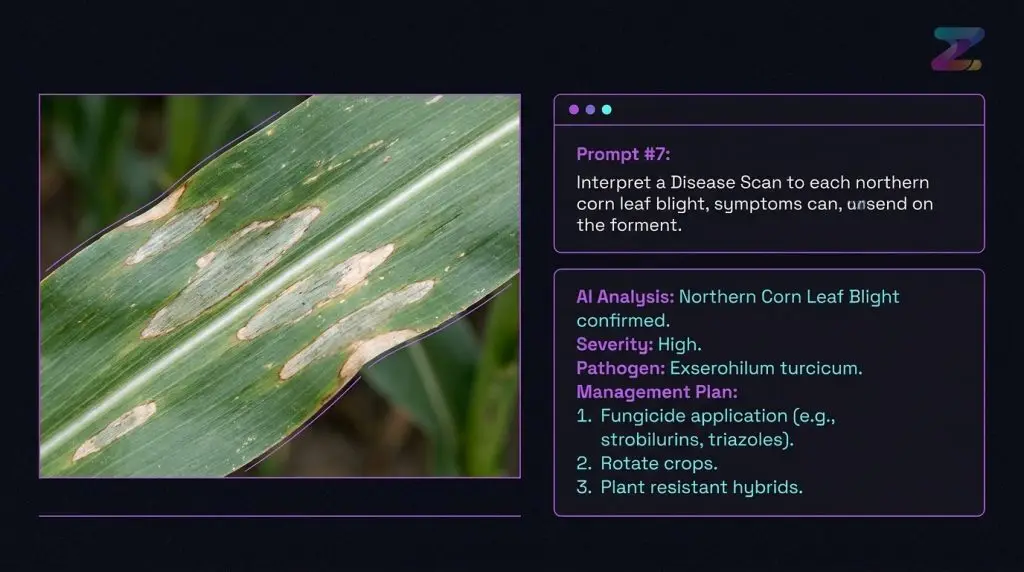
These prompts are most powerful when combined with data from a dedicated diagnostic tool. Use an app like Plantix to get an initial photo-based ID, then use these prompts to develop a response plan.
PL Tool review Plantix — read our full review Pricing, free tier and where it falls shortI used the Plantix app and it identified what appears to be northern corn leaf blight on my V10 stage corn. The confidence score was 85%. The weather forecast is for warm, humid conditions for the next 7 days.
Using only information from university extension sources, create a 3-step action plan.
1. **Verification:** What specific lesion characteristics should I look for on the leaf to confirm this is NCLB and not another look-alike disease like Goss's wilt?
2. **Threshold:** What is the economic threshold for a fungicide application for NCLB at this growth stage in a susceptible hybrid?
3. **Treatment:** If a fungicide is warranted, list two recommended fungicide groups (active ingredients) that are effective against NCLB."
</PROMPT-CARD>I have patches of waterhemp in my soybean field in central Missouri that survived a post-emergence application of glyphosate. I suspect it is glyphosate-resistant. The soybeans are at the R1 stage.
Act as a weed scientist from the University of Missouri Extension.
1. What is the best way to confirm resistance?
2. What are my immediate rescue options for controlling these escapes at this stage of the season? List two different effective herbicide sites of action.
3. Outline a 3-year management plan for this field to prevent the problem from getting worse, focusing on crop rotation, tillage, and using multiple effective sites of action."
</PROMPT-CARD>I need to decide on a fungicide for my R3 soybeans to control frogeye leaf spot. I'm choosing between Product X (a strobilurin/triazole premix) costing $22/acre and Product Y (a newer SDHI/triazole premix) costing $28/acre.
Compare these two products. Create a table that includes:
- Efficacy rating against frogeye leaf spot (Excellent, Very Good, Good).
- Efficacy against other key diseases like Septoria brown spot.
- Reported plant health benefits (e.g., greening effect).
- Resistance risk considerations.
Based on this, calculate the break-even yield increase needed to justify the extra $6/acre cost of Product Y, assuming a soybean price of $11.50/bushel."
</PROMPT-CARD>I sprayed my alfalfa for potato leafhoppers 5 days ago with a pyrethroid insecticide. Today, the economic threshold is still exceeded. The temperature was 95°F on the day of application, and it rained lightly 8 hours after spraying.
List the top 3 most likely reasons the application failed, in order of probability. For each reason, explain the mechanism of failure (e.g., heat degradation, rain wash-off, resistance) and what I should do differently for the next application."
</PROMPT-CARD>Generate a scouting calendar for corn in southeastern Nebraska. The calendar should be a table with three columns: Growth Stage (e.g., V5, VT, R3), Target Pests/Diseases, and Key Scouting Signs.
Include at least 5 key growth stages and the 2-3 most critical pests or diseases to look for at each stage. For example, at V5, one target might be black cutworm and the sign would be cut plants."
</PROMPT-CARD>4 Prompts for Soil Fertility and Analysis
Pairing AI with soil testing data from a service like BeCrop or hardware from a company like Agurotech can turn a dense lab report into a field-ready action plan.
BE Tool review BeCrop — read our full review Pricing, free tier and where it falls shortI have a soil test report from a field in Iowa. The results are:
- Soil pH: 5.8
- Phosphorus (Bray P1): 12 ppm (Low)
- Potassium (Ammonium Acetate): 110 ppm (Medium)
- Organic Matter: 3.5%
My yield goal for corn is 220 bu/acre and for soybeans is 65 bu/acre. Using the tri-state fertilizer recommendations (from Ohio State, Purdue, and Michigan State) as a guide, calculate the recommended application rates (lbs/acre) of P2O5, K2O, and lime needed to raise the pH to 6.5 for a 2-year corn/soybean rotation. Present the final recommendation in a simple table."
</PROMPT-CARD>My soybeans at the V4 stage are showing yellowing on the newest, uppermost leaves. The rest of the plant is green. The field was waterlogged for several days last week.
Based on the location of the symptom (new growth), what are the top 2 most likely nutrient deficiencies? For each, explain why it fits the symptoms. Also, list one disease or herbicide injury that could be a look-alike, and how I could differentiate it from a nutrient issue."
</PROMPT-CARD>I have a laboratory analysis of my liquid swine manure. The key values are:
- Total Nitrogen: 45 lbs/1000 gal
- P2O5: 30 lbs/1000 gal
- K2O: 35 lbs/1000 gal
I plan to apply this manure to a field that will be planted to corn with a yield goal of 200 bu/acre. The field's soil test shows phosphorus levels are already in the optimal range. My primary goal is to meet the corn crop's nitrogen requirement without over-applying phosphorus.
Calculate the manure application rate (gallons/acre) based on the nitrogen needs of the corn crop. Then, calculate how much P2O5 and K2O will be applied at that rate. Finally, advise on whether I will need supplemental commercial fertilizer and what the environmental risks are."
</PROMPT-CARD>I have a BeCrop soil test report. It gives me a 'Fungal to Bacterial Ratio' of 0.3 (low), a 'Carbon Sequestration' score of 4/10, and a 'Nitrification' pathway functionality of 8/10.
Explain in simple terms what each of these three metrics means for my farm. For each metric, suggest one practical management change I could make to improve it. For example, if the F:B ratio is low, what could I do?"
</PROMPT-CARD>4 Prompts for Irrigation and Water Management
Act as an irrigation specialist. My corn crop in central Kansas is at the VT (tasseling) growth stage, which is the peak water use period. The average daily evapotranspiration (ET) rate for this week is 0.35 inches/day. My soil is a silt loam that can hold 2.0 inches of plant-available water per foot. The root zone is 3 feet deep. My irrigation system applies 1 inch of water per pass.
I start with a full soil profile. Create a 7-day irrigation schedule in a table. The columns should be Day, Crop Water Use (inches), Soil Water Deficit (inches), and 'Irrigate? (Yes/No)'. Assume no rainfall. I want to irrigate when the soil water deficit reaches 1 inch."
</PROMPT-CARD>My center pivot irrigation system has a section of 3 towers that are lagging behind the rest of the system, causing it to trigger the safety stop.
Create a troubleshooting checklist to diagnose the problem. Start with the simplest and most common issues first. The list should include at least 5 distinct checks, covering potential electrical, mechanical, and tire issues."
</PROMPT-CARD>I farm high-value vegetables (tomatoes, peppers) on a 40-acre field in California's Central Valley. The field is currently furrow-irrigated. I am considering converting to subsurface drip irrigation (SDI) to improve water use efficiency.
Summarize the main pros and cons of this conversion. Create a table with two columns: 'Benefits' and 'Costs/Challenges'. Include at least 4 points in each column. For benefits, include water savings and yield potential. For costs, include initial investment, maintenance complexity, and potential issues with germination."
</PROMPT-CARD>My region is entering a moderate drought. I have a limited water allocation for my corn and soybean fields. Generate a list of 5 water conservation strategies I can implement immediately or in the near future. For each strategy, provide a brief explanation of how it saves water. The list should include both in-season tactics and longer-term soil management practices."
</PROMPT-CARD>3 Prompts for Market Timing and Selling Decisions
Only 14% of farmers said they use AI tools on their farm as of early 2026, but among those who do, 50% use it for business or financial analysis. Source: news.bushelpowered.com
Act as a grain marketing advisor. It is July, and my corn crop looks excellent. The local elevator is offering a forward contract for December delivery at $4.75/bushel. The current December futures price is $4.90/bushel, implying a basis of -15 cents.
Analyze the decision to forward contract 25% of my expected production now. What is the primary risk I am mitigating? What is the primary opportunity I am giving up? List two other marketing tools (e.g., options, HTA contracts) I could use to achieve a similar price floor while retaining more upside potential."
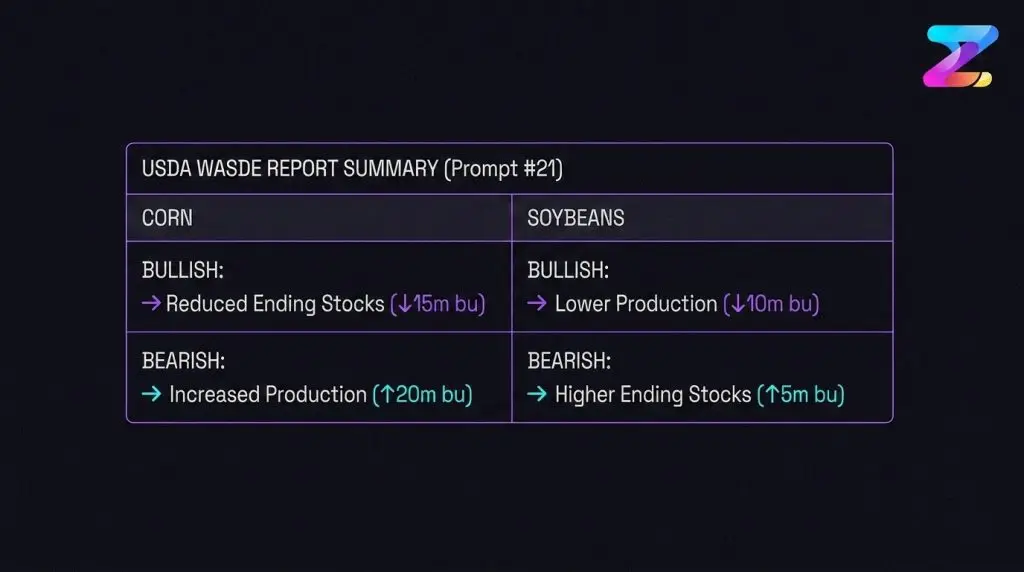
</PROMPT-CARD>I am providing the text from the summary of today's USDA World Agricultural Supply and Demand Estimates (WASDE) report.
[Paste the summary text of the WASDE report here]
Read the text and provide a bullet-point summary of the 3 most important changes for U.S. corn and the 3 most important changes for U.S. soybeans. For each point, state whether the change is bullish (price positive), bearish (price negative), or neutral."
</PROMPT-CARD>Analyze the typical corn basis pattern for a farm located near Decatur, Illinois. Search for historical basis data for that region.
Describe how the basis for corn typically behaves from harvest (October) through the following summer (July). When is the basis typically weakest? When does it typically strengthen? What are the main logistical or market factors that drive this seasonal pattern?"
</PROMPT-CARD>3 Prompts for Equipment Maintenance and Troubleshooting
Create a pre-season maintenance checklist for a John Deere S780 combine before soybean harvest. The checklist should be organized into logical sections (e.g., Header, Feeder House, Threshing/Separating, Cab/Electronics, Engine). Include at least 15 specific inspection points. For 3 of the most critical points, briefly explain *why* it's important (e.g., 'Check rotor belts for cracks - a broken belt is a major source of downtime')."
</PROMPT-CARD>My Case IH planter is showing error code 'PDM 1234'. What does this code mean? Provide a step-by-step troubleshooting guide, starting with the most likely and easiest-to-fix causes. Include at least 3 steps."
</PROMPT-CARD>I need to replace my main tractor. I am deciding between buying a new 250-hp tractor for $350,000 or a 5-year-old model with 2,000 hours for $220,000.
Create a 5-year total cost of ownership (TCO) analysis. Make reasonable assumptions for the following variables for both the new and used options:
- Annual depreciation
- Financing costs (assume a 7% interest rate)
- Annual repair and maintenance costs (as a % of purchase price, higher for used)
- Fuel efficiency differences
- Warranty coverage
Present the comparison in a table and conclude with a summary of the key non-financial factors to consider (e.g., reliability, technology, operator comfort)."
</PROMPT-CARD>What AI Prompts Can’t Do Well (Yet)
While these prompts can be powerful co-pilots, it’s crucial to understand their limitations. As of September 2026, general AI models:
- Cannot replace an agronomist: They lack the ability to physically walk a field, understand the unique context of your operation, and exercise real-world judgment.
- Can “hallucinate” facts: Even with the reliability wrapper, an AI can invent plausible-sounding data, especially for chemical rates or variety names. Always verify critical numbers with an official source.
- Lack real-time, hyperlocal data: An AI doesn’t know that a specific storm cell just passed over your north quarter or that the local elevator just changed its basis. It relies on publicly available, often slightly dated, information.
- Cannot integrate with most farm hardware: You cannot yet “talk” directly to your planter or sprayer. The prompts above require you to be the human link between the digital tool and the physical iron.
Use AI as a tool to think better, to organize information, and to model scenarios—not as a replacement for your own experience or the advice of trusted partners. For more resources on how AI is being practically applied on farms, visit our AI in agriculture hub.
Can ChatGPT give me accurate fertilizer recommendations?
It depends. If you provide a detailed prompt with your soil test results, yield goals, and region, and use the “reliability wrapper” to force it to use university extension sources, it can give you a very accurate starting point based on established public models. However, it should always be cross-referenced with advice from your agronomist.
Are there AI prompts for livestock management?
Yes. You can create prompts for things like feed ration formulation, animal health symptom diagnosis, and genetic selection planning. These work best when you provide specific data, such as feed analysis reports, observed symptoms, or EPD (Expected Progeny Difference) values for an animal.
How specific do my prompts need to be?
The more specific, the better the answer. Including your location (state/county), crop, soil type, specific equipment model, and any relevant data (e.g., chemical rates, error codes, lab results) will yield a dramatically more useful response than a generic question.
Can I use AI to identify a weed from a photo?
General AI models like ChatGPT are not designed for image identification and are often inaccurate. For this task, you should use a specialized agricultural AI app like Plantix or university-developed tools like the Pest-ID app from Iowa State University, which are specifically trained on libraries of plant images.
Will these prompts work with any AI tool (ChatGPT, Gemini, Claude)?
Yes, these prompts are designed to be tool-agnostic. They are based on the principle of providing clear context, constraints, and a specific task. While the exact phrasing of the output might vary slightly between models, the quality and structure of the response should be consistently high across any major large language model.
Where to go next
Three routes, picked for what you just read.
Sources (10)
- "Right Artificial Intelligence (AI) Instructions for the Right Answers to Your Agricultural Questions – Soil Fertility | NC State Extension". NC State Extension, June 3, 2026 · soilfertility.ces.ncsu.edu
- "Farmers Test AI but Trust Still Growing". Farms.com, June 22, 2026 · farms.com
- "2026 Farmer Trust In AI Report". MorganMyers, June 8, 2026 · morganmyers.com
- "2026 Farm Trends Reveal Younger Farmers and Digital Growth". Farms.com, April 8, 2026 · farms.com
- "AI-powered spore detector helps cut unnecessary fungicides". GRDC's Groundcover, April 7, 2026 · groundcover.grdc.com.au
- "AI Guidance and Best Practices – Marketing | NC State Extension". NC State Extension, August 1, 2026 · marketing.ces.ncsu.edu
- "BioScout Pty Ltd | PotatoPro". PotatoPro, updated May 27, 2026 · potatopro.com
- "Biome Makers Raises $15M in Series B Funding". Biome Makers, August 25, 2021 · biomemakers.com
- "Foundations of AI‑Driven Decision‑Making". Medium, May 6, 2025 · medium.com
- "Agurotech". ROM InWest · rominwest.nl
See Zekai first in Google
The weekly AI briefing for your profession
One weekly email: the AI changes that actually affect your profession — tools, deals, and what to do about them.