العربية
 English
 Français
 Deutsch
 हिन्दी
 Português
 Русский
 Español
 Türkçe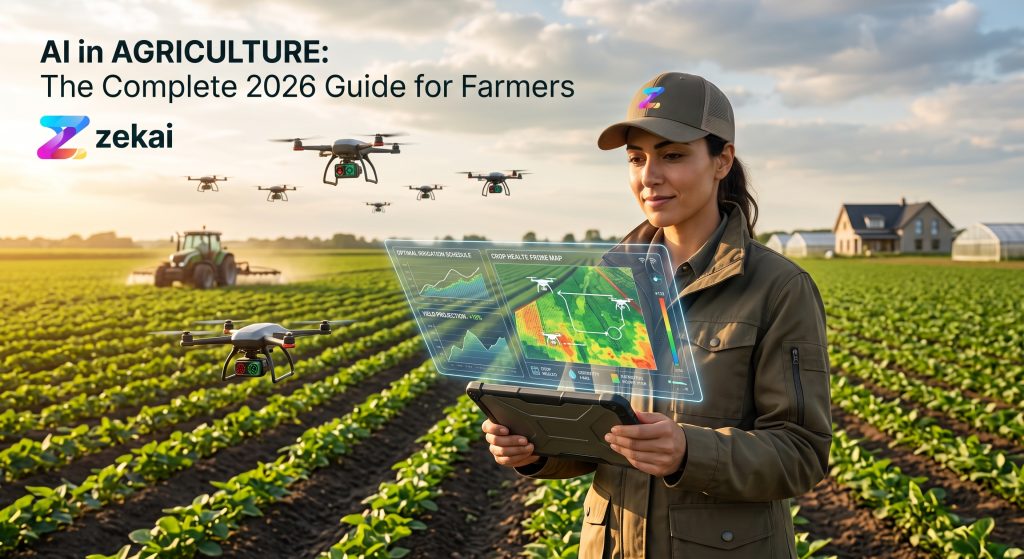
The short answer
In 2026, AI helps farmers and agronomists increase yields and reduce costs by automating specific tasks. Computer vision tools like Plantix identify crop disease from a phone photo, satellite platforms like OneSoil monitor field health, and robotic systems like John Deere See & Spray apply inputs with precision.
Artificial intelligence is no longer a technology for enterprise agribusiness alone. Practical, affordable AI tools are now available for working farms, helping to analyze soil, detect disease, automate spraying, and manage records. This guide cuts through the hype to show which tools actually work on a farm, what they cost as of September 2026, and how to integrate them into your operation.
ZEKAI is an independent AI tools directory. We review tools hands-on, and our research is supported by our readers. This article is the cornerstone of our AI in agriculture hub, linking to all our in-depth reviews and guides for farmers and agronomists.
How We Evaluated AI Agriculture Tools
To find the tools worth a farmer’s time and money, we ranked them on four practical criteria. A tool must perform well across all four to earn our recommendation.
- Task-Specific Performance: Does the tool reliably accomplish the one job it was built for? For a disease-detection app, this means diagnostic accuracy. For a robotic weeder, it’s weed-kill rate and crop-damage avoidance.
- Price & ROI: What is the true cost, including hardware, subscriptions, and per-acre fees? We prioritize tools with transparent pricing and a clear path to paying for themselves through input savings, yield gains, or labor reduction.
- Ease of Use: Can a farmer or agronomist use this in the field without a data science degree? We look for intuitive interfaces, offline functionality, and simple-to-interpret outputs.
- Data Ownership & Privacy: Who owns the data you generate? We favor platforms with clear policies stating that the farmer owns their farm data and has control over how it is shared.
AI for Crop & Soil Health
This category of AI uses machine learning to analyze soil biology and monitor in-season crop development, often via satellite imagery or direct soil sampling. These tools help optimize nutrient application and identify problem areas before they become visible to the naked eye.
| Tool | Primary Use | Pricing (as of Sep 2026) | Key Feature |
|---|---|---|---|
| BeCrop | Soil microbiome analysis | Free tier; Paid plans (quote-based) | Identifies specific bacteria/fungi affecting nutrient cycling. |
| OneSoil | Satellite crop monitoring | Free for NDVI; Paid for high-res imagery | Variable-rate application maps from satellite data. |
| Agurotech | Soil sensing & analysis | Quote-based | Real-time soil moisture and nutrient sensors. |
| Verdi | Precision irrigation & fertigation | Quote-based | AI-driven irrigation schedules based on plant-level sensors. |
Swipe the table sideways →
BeCrop
The best tool for understanding the ‘why’ behind your soil’s health.
Pricing on request
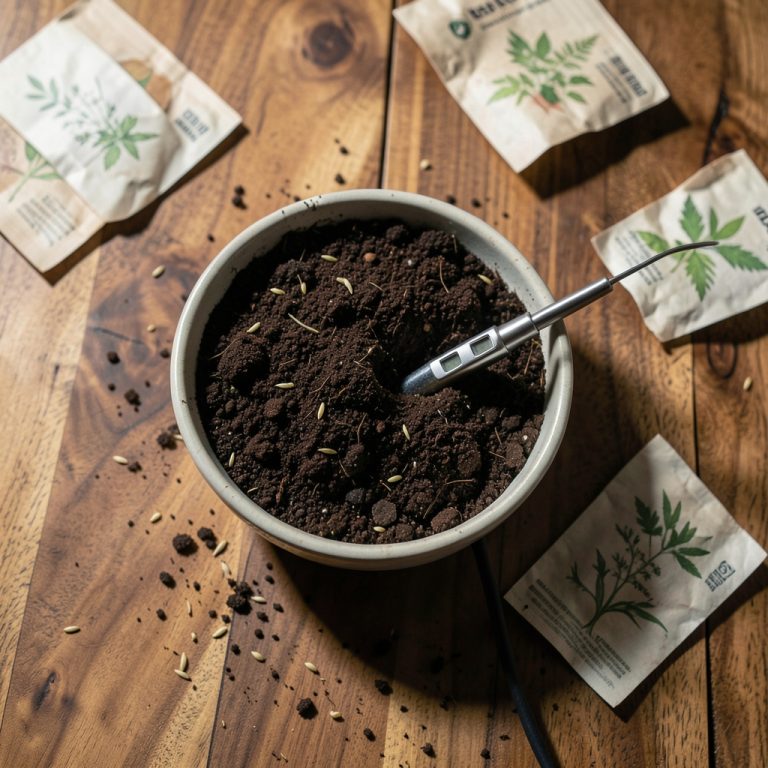
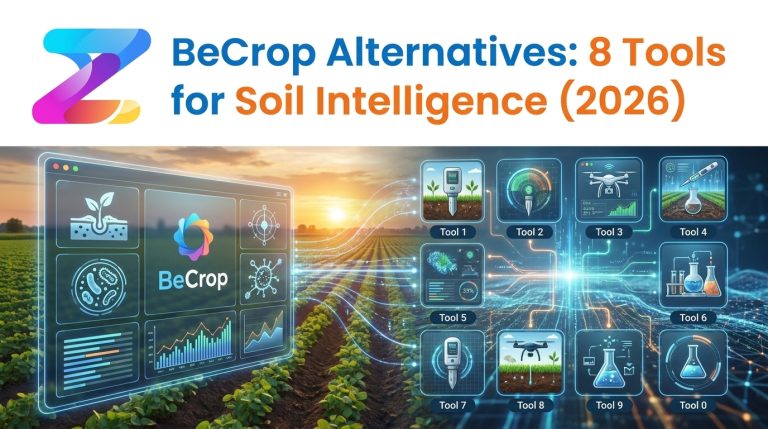
BeCrop by Biome Makers analyzes the DNA of microorganisms in your soil to provide a detailed report on its health and function. Instead of just telling you nutrient levels, it identifies the specific microbial communities responsible for nutrient cycling, disease risk, and overall resilience. We recommend it for high-value crop producers who need to diagnose complex soil issues that conventional tests miss. The free “BeCrop Basic” tier offers an introduction to the platform’s capabilities. Its main drawback is the turnaround time for sample analysis, which isn’t instantaneous. It is not for farmers who need immediate, in-season fertility recommendations.
- Price from
- Free tier available
- Free tier
- Verified, includes basic reports
OneSoil
The best free entry point into precision agriculture for most farms.
Free plan available
The OneSoil platform uses free satellite imagery to create field-zone maps based on crop variability. You can use these to create variable-rate seeding or fertilizer prescriptions. Its interface is clean and easy to use on a phone or desktop. The free version provides access to NDVI (Normalized Difference Vegetation Index) monitoring, which is enough for basic crop scouting. To get higher-resolution imagery from Planet Labs and access season-long history, you must upgrade to a paid plan. OneSoil is best for row-crop farmers looking to experiment with variable-rate technology without a large initial investment. It’s less useful for crops where canopy-level imagery doesn’t tell the whole story.
- Price from
- Free tier available
- Free tier
- Verified, includes NDVI monitoring
AI for Pest & Disease Detection
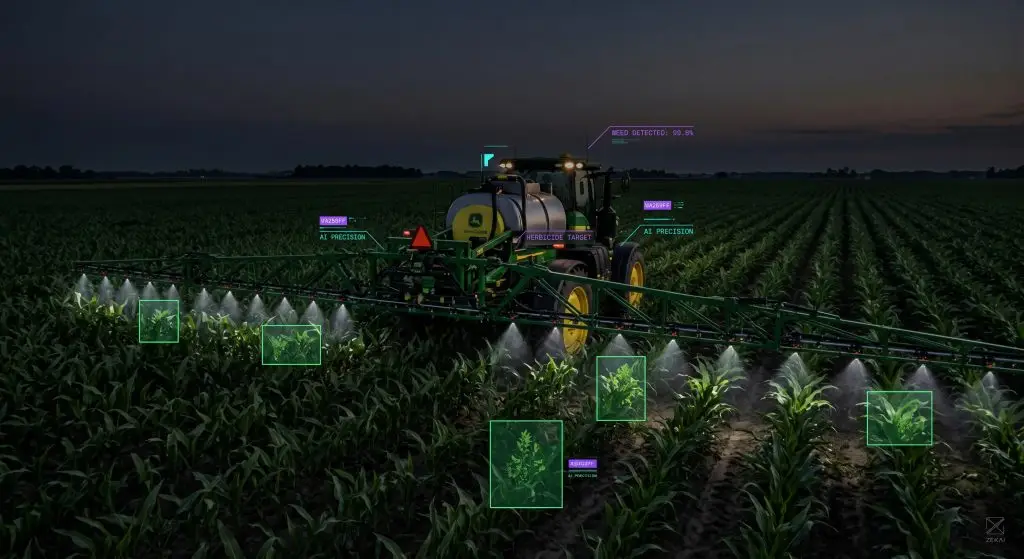
Using computer vision, these tools can identify pests and diseases from a single photo taken with a smartphone. They act as a first line of defense, helping you triage issues in the field and decide whether to call an agronomist.
| Tool | Platform | Pricing (as of Sep 2026) | Key Feature |
|---|---|---|---|
| Plantix | Mobile App (iOS, Android) | Free | Instant disease ID from a photo; community forum. |
| BioScout | Mobile App + Hardware | Pricing on request | Airborne spore detection for proactive fungicide decisions. |
Swipe the table sideways →
Plantix
An essential, free diagnostic tool that should be on every farmer’s phone.
Free plan available
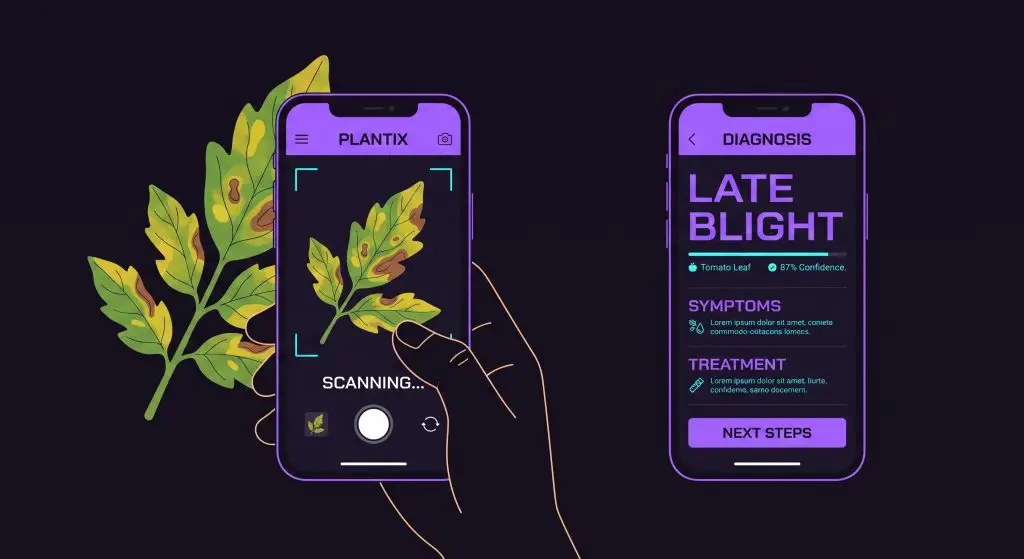
Plantix is a mobile app that provides an impressively accurate diagnosis of crop diseases and nutrient deficiencies from a phone photo. Developed by PEAT GmbH, its core features are completely free. You take a picture of a suspicious leaf, and the app’s computer vision model identifies the likely issue and suggests treatment options. While it can struggle with blurry images or complex, co-occurring diseases, its accuracy is remarkable for a free tool. We recommend every farmer and agronomist download it. It’s not a replacement for a human expert or lab testing, but it’s an invaluable tool for early warnings and in-field triage.
- Price from
- Free
- Free tier
- Verified, all core features are free
Step-by-Step: Diagnosing a Plant with Your Phone
- Open the App: In the field, open the Plantix app.
- Take a Clear Photo: Frame the affected leaf or plant part in good, even light. Ensure the image is sharp and in focus. Avoid shadows.
- Analyze: The app uploads the photo and compares it against its database of millions of images.
- Review Diagnosis: Within seconds, Plantix provides a diagnosis with a confidence score, photos of the disease for comparison, and links to recommended control measures.
- Log and Decide: Log the finding and decide on next steps, whether it’s a targeted treatment or a call to your agronomist.
AI for Precision Spraying, Weeding & Automation
This is where AI has the most visible impact, powering autonomous tractors and “see-and-spray” systems that can differentiate a crop from a weed. These systems dramatically reduce herbicide use, cut labor costs, and enable farming at a scale or precision that is humanly impossible. Some of these applications are part of our AI Challenge to find the most impactful use cases.
potential reduction in water usage by using AI-powered precision irrigation systems. Source: intellias.com
| Tool | Function | Pricing (as of Sep 2026) | Key Differentiator |
|---|---|---|---|
| John Deere See & Spray | Green-on-green spraying | Hardware purchase | Integrates with existing John Deere equipment. |
| Carbon Robotics LaserWeeder | Non-chemical weeding | Hardware purchase | Uses lasers to kill weeds, enabling organic operations. |
| Saga Robotics | Autonomous UV-C treatment | Hardware purchase/service | Fights mildew on high-value crops like grapes without chemicals. |
| GUSS Automation | Autonomous orchard spraying | Hardware purchase | Allows one operator to manage a fleet of up to 8 sprayers. |
Swipe the table sideways →
John Deere See & Spray
The leading AI upgrade for large-scale row crop farmers already in the Deere ecosystem.
Pricing on request
John Deere’s See & Spray™ Ultimate is a factory-installed system on their latest sprayers. It uses 36 cameras to scan over 2,100 square feet per second, identifying weeds among the crop (“green-on-green”) and activating individual spray nozzles only when a weed is detected. This can reduce herbicide use by up to 59%, according to John Deere’s own data. The primary downside is cost and vendor lock-in; it’s an expensive upgrade that only works on new John Deere sprayers. It’s not for small farms or those not invested in the Deere ecosystem.
- Price from
- Hardware purchase
- Free tier
- N/A
Carbon Robotics
A breakthrough for organic and specialty crop growers battling high labor costs.
Pricing on request
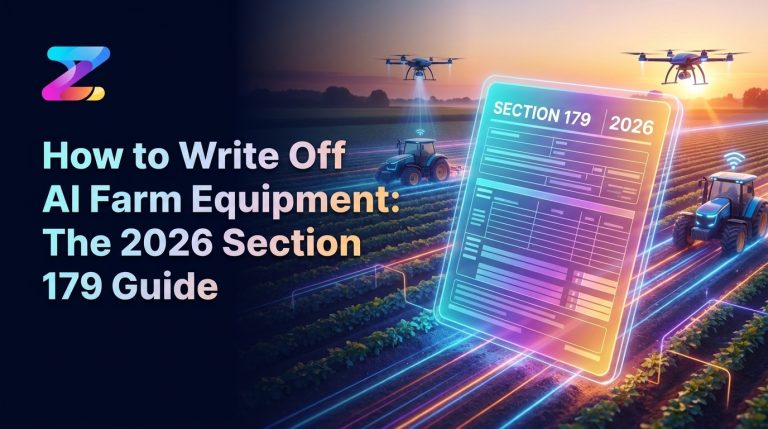
The Carbon Robotics LaserWeeder™ is a pull-behind implement that uses high-powered CO2 lasers to identify and eliminate weeds. It requires no chemicals, making it ideal for organic farms or those dealing with herbicide-resistant weeds. The system can weed up to two acres per hour with millimeter accuracy. The upfront capital cost is substantial, placing it out of reach for many small farms. However, for large-scale vegetable growers facing severe labor shortages or high hand-weeding costs, the ROI can be less than three years.
- Price from
- Hardware purchase
- Free tier
- N/A
AI for Livestock & Farm Management
AI is not limited to crops. On the livestock side, computer vision and sensors monitor animal health and behavior. For whole-farm management, AI helps organize records, track finances, and ensure compliance.
- CattleCare and Beewise use cameras and sensors to monitor livestock. CattleCare focuses on early lameness and disease detection in dairy cows, while Beewise builds AI-powered robotic hives that manage bee health, climate, and pest control automatically.
- AgriWebb and Granular are farm management platforms. They use AI to streamline record-keeping, manage grazing plans, and provide financial insights.
AgriWebb
The best record-keeping tool for livestock producers moving from paper to digital.
Pricing on request
AgriWebb is a livestock farm management app that helps producers track individual animal records, manage grazing rotations, and maintain compliance documentation from their phone, even when offline. The free “AgriWebb Individual” tier is surprisingly capable, allowing you to manage your mob and paddock records. We recommend it as the first step for any livestock operation looking to digitize its records. The main limitation is that its most powerful analytics and planning features require a paid subscription.
- Price from
- Free tier available
- Free tier
- Verified, includes individual animal records
Genuinely Free AI Tools for Farmers
Many companies engage in “free-washing,” promoting expensive enterprise platforms as “free” because they have a severely limited trial. The tools below are different: their core function is available at no cost, providing real value to a farm on a budget.
- Plantix: As mentioned, its core disease ID function is completely free.
- OneSoil: The free tier provides unlimited access to NDVI satellite monitoring for all your fields.
- BeCrop: The “BeCrop Basic” tier provides a foundational report on your soil’s microbial pathways.
- AgriWebb: The “Individual” plan offers robust digital record-keeping for livestock producers at no cost.
- USDA NAIP Imagery: The USDA’s National Agriculture Imagery Program provides free, high-resolution aerial imagery of the entire continental U.S., updated every few years. This public data is a valuable resource for historical analysis and creating base maps.
How Farmers Are Actually Using AI in 2026
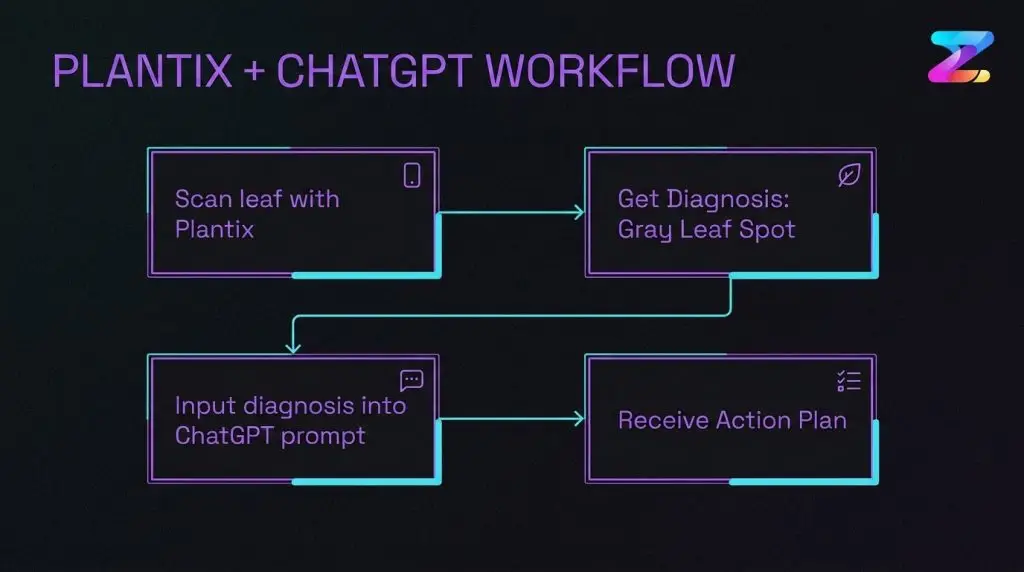
Surveys show that while adoption is growing, trust remains a hurdle. A 2026 survey by MorganMyers and Ag Access found that while 48% of farmers use AI tools weekly, only 24% fully trust the recommendations. The most effective workflows don’t replace farmer judgment; they augment it by pairing specialized ag-tech data with the reasoning power of general AI assistants like ChatGPT.
Here are two workflows you can use today:
I am a corn farmer in Iowa. I used the Plantix app to scan a leaf and it identified Gray Leaf Spot with 92% confidence. The app suggests fungicides containing Azoxystrobin, Pyraclostrobin, or Fluoxastrobin.
My field is currently at the R2 (blister) growth stage.
Act as an experienced agronomist. Based on this information, provide a 3-point action plan.
1.  Confirm if this diagnosis is a high-priority threat at this growth stage.
2.  List two specific, commercially available fungicide products that fit the recommendation.
3.  Outline the key factors I should consider before deciding to spray.
Restrict your sources to U.S. land-grant university extension programs.I am preparing a tank mix for my soybean fields in Illinois. I plan to mix:
- Glyphosate (Group 9 herbicide)
- Clethodim (Group 1 herbicide)
- A foliar fertilizer with a high potassium content
- Ammonium Sulfate (AMS) as a water conditioner
Act as a crop chemical specialist. Review this proposed tank mix.
1. Identify any potential antagonism or chemical incompatibility issues.
2. Confirm the recommended mixing order for these product types.
3. State if there are any common crop injury risks associated with this mix in hot weather.
Cite your sources.Will AI Replace Farmers? What the 2026 Data Says
No, but it is automating specific tasks and changing the skills required to run a modern farm. The idea of a single “robot farmer” is science fiction. The reality is a set of specialized tools that take over dull, dangerous, or difficult jobs.
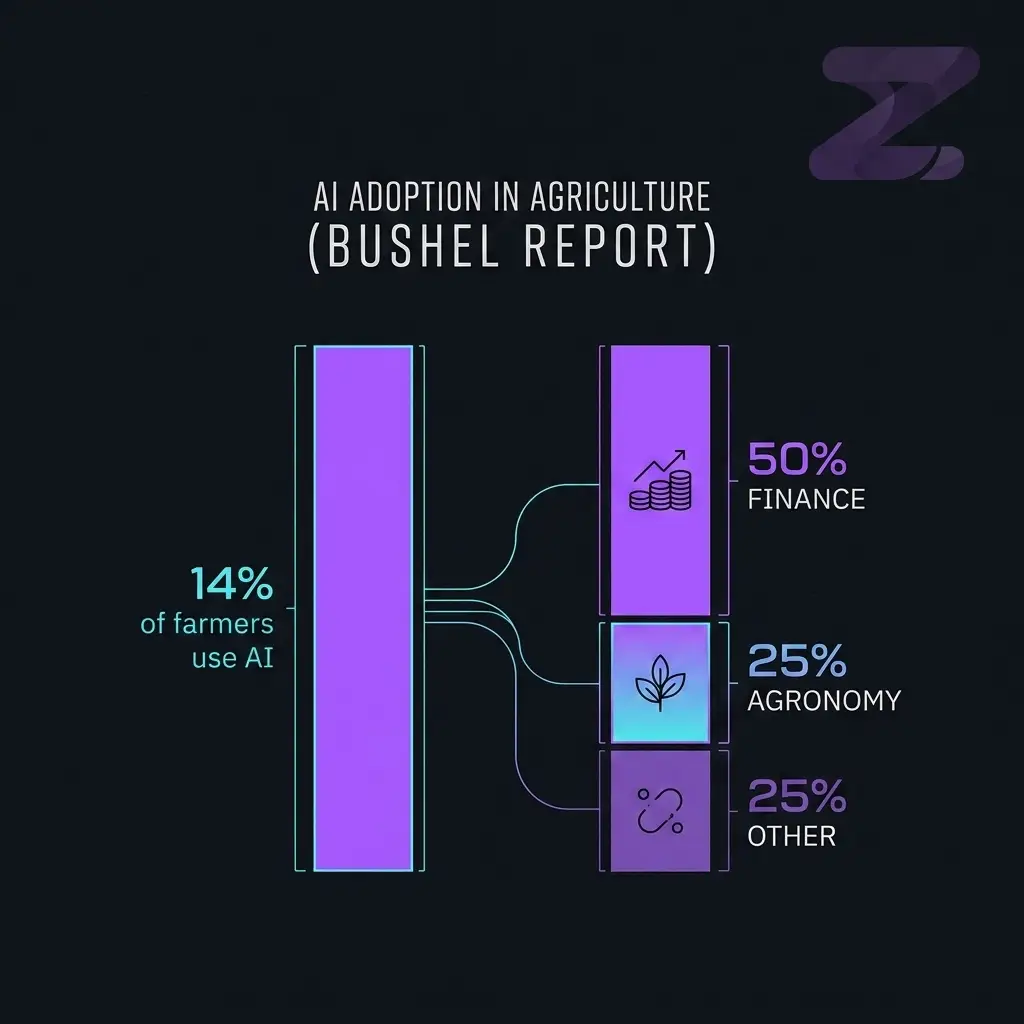
of U.S. farmers are currently using AI tools, according to a 2026 survey by Bushel. Source: precisionfarmingdealer.com
The data shows AI adoption is still in its early stages. The Bushel 2026 State of the Farm Report found that only 14% of U.S. farmers currently use AI. Among those who do, 50% use it for financial analysis and business management, while only 25% use it for agronomic decisions like yield prediction.
AI is replacing *tasks*, not *people*. John Deere’s See & Spray replaces the task of broadcast spraying, not the operator who runs the machine. Plantix automates the initial step of disease identification, it doesn’t replace the agronomist who interprets that data in the context of the whole farm. The farmer’s role is shifting from manual execution to that of a systems manager, overseeing a fleet of automated tools and making judgment calls based on better data. For more on this trend, see our AI Tools Statistics 2026 report.
The jobs most at risk are those based on repetitive manual labor, such as hand-weeding or scouting endless acres on foot. The jobs being created require skills in data interpretation, equipment maintenance, and technology management. The future of farming belongs to those who can effectively integrate these new tools into their operation, a topic we explore further at our AI in agriculture hub.
What is the best AI for agriculture?
It depends on the job. For disease identification, Plantix is the best free starting point. For satellite monitoring, OneSoil is excellent. For autonomous weeding, Carbon Robotics and John Deere See & Spray are leading solutions. The “best” AI is the one that solves a specific, costly problem on your farm.
How much does farm AI cost?
Costs range from free to hundreds of thousands of dollars. Mobile apps like Plantix are free. Subscription platforms like OneSoil’s premium tier can be hundreds or thousands per year. Hardware systems like the Carbon Robotics LaserWeeder represent a major capital investment, often costing more than $500,000.
Can AI predict crop yield?
Yes, AI models can predict crop yield with increasing accuracy. They do this by analyzing vast datasets, including historical yield data, current and forecasted weather, soil sensor readings, and satellite imagery. However, these predictions are probabilities, not guarantees, and are still subject to unpredictable events like severe weather.
How does AI help in soil management?
AI helps by analyzing soil sensor data, microbial DNA from samples (like with BeCrop), and satellite imagery to create detailed soil health maps. This allows farmers to move from whole-field management to precision management, applying nutrients and water only where they are needed, reducing waste and improving soil health over time.
Is my farm data safe with AI companies?
It depends on the company. This is a critical question to ask before adopting any new platform. Reputable companies have clear privacy policies stating that you, the farmer, own your data. Always read the terms of service to understand how your data will be used, stored, and shared before committing to a tool.
Will AI replace agronomists?
No, AI is unlikely to replace agronomists. It will, however, change their job. AI tools can automate data collection and initial analysis, freeing up agronomists to focus on higher-value work: interpreting complex data, creating holistic farm strategies, and building trusted relationships with farmers. The role is evolving from data gatherer to strategic advisor.
Where to go next
Three routes, picked for what you just read.
Sources (3)
- Intellias, “AI in Agriculture: A 2026 Guide for Agricultural Executives,” https://www.intellias.com/artificial-intelligence-in-agriculture/
- Precision Farming Dealer, “2026 State of the Farm Report Examines Early AI Use,” https://precisionfarmingdealer.com/articles/7080-2026-state-of-the-farm-report-examines-early-ai-use
- Iowa Capital Dispatch, “Survey shows farmers split on AI use in the fields, majority skeptical of results,” https://iowacapitaldispatch.com/2026/06/24/survey-shows-farmers-split-on-ai-use-in-the-fields-majority-skeptical-of-results/
See Zekai first in Google
The weekly AI briefing for your profession
One weekly email: the AI changes that actually affect your profession — tools, deals, and what to do about them.